

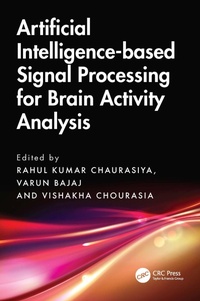
Artificial Intelligence-based Signal Processing for Brain Activity Analysis
1st Edition
Published on 12. November 2025
340 pages
978-1-040-43771-1 (ISBN)
Description

Artificial Intelligence-based Signal Processing for Brain Activity Analysis is an indispensable resource for addressing the pressing challenges in medicine, detection of brain-related disorders, brain-computer interfacing, and neuromarketing. It delves into contemporary AI, ML, and signal processing approaches for analysis of brain activity.
The salient features of this book include:
(1) Acquisition, preprocessing, noise removal, and processing methods for brain signals, including EEG, ECoG, MEG, fMRI, and fNIRS.
(2) Latest AI and ML algorithms relevant for classification of brain signals, including traditional machine learners, deep transfer learners, LSTM and auto-encoders, and transformers.
(3) Applications in medicine, including mental healthcare, mental stress reduction, psychological disorder detection, OCD detection, sleep disorder detection, seizure detection, brain tumor detection, Alzheimer's disease detection, and bipolar disorder prediction.
(4) Applications in brain-computer interfacing (BCI), gaming and entertainment, and neuromarketing.
(5) Recent case studies and experimental and research works.
The text is primarily written for senior undergraduate students, graduate students, industry professionals, researchers, and academicians working in the field of AI, ML, signal processing techniques, biomedical signal processing, brain signal analysis, and brain activity analysis.
The salient features of this book include:
(1) Acquisition, preprocessing, noise removal, and processing methods for brain signals, including EEG, ECoG, MEG, fMRI, and fNIRS.
(2) Latest AI and ML algorithms relevant for classification of brain signals, including traditional machine learners, deep transfer learners, LSTM and auto-encoders, and transformers.
(3) Applications in medicine, including mental healthcare, mental stress reduction, psychological disorder detection, OCD detection, sleep disorder detection, seizure detection, brain tumor detection, Alzheimer's disease detection, and bipolar disorder prediction.
(4) Applications in brain-computer interfacing (BCI), gaming and entertainment, and neuromarketing.
(5) Recent case studies and experimental and research works.
The text is primarily written for senior undergraduate students, graduate students, industry professionals, researchers, and academicians working in the field of AI, ML, signal processing techniques, biomedical signal processing, brain signal analysis, and brain activity analysis.
More details
Edition
1. Auflage
Language
English
Place of publication
London
United Kingdom
Publishing group
Taylor & Francis Ltd
Target group
College/higher education
Professional and scholarly
Illustrations
41 Tables, black and white; 145 Line drawings, black and white; 27 Halftones, black and white; 172 Illustrations, black and white
File size
17,67 MB
ISBN-13
978-1-040-43771-1 (9781040437711)
Copyright in bibliographic data and cover images is held by Nielsen Book Services Limited or by the publishers or by their respective licensors: all rights reserved.
Schweitzer Classification
Other editions
Additional editions
Rahul Chaurasiya | Varun Bajaj | Vishakha Chourasia
Artificial Intelligence-based Signal Processing for Brain Activity Analysis
Book
11/2025
1st Edition
CRC Press
€233.60
Available immediately
Persons
Dr. Rahul Kumar Chaurasiya is working as Associate Professor at Maulana Azad National Institute of Technology (MANIT) Bhopal, India. He received the Bachelor of Technology degree from MANIT Bhopal, India in 2009 and the Master of Engineering degree from the Indian Institute of Science (IISc) Bangalore, India in 2011. He received his Ph.D. degree in 2017 from National Institute of Technology (NIT) Raipur. He was a senior software engineer with Brocade Communications Systems, Bangalore, in 2011-12. During 2013-19, he was assistant professor at the NIT Raipur, and during 2019-20 he was assistant professor at the Malaviya National Institute of Technology (MNIT) Jaipur, India. From June 2020 to Dec 2024, he worked as assistant Professor at MANIT Bhopal. He is a life member of Soft Computer Research Society (SCRS), life member of Indian Academy of Neuroscience (IAN), Life member of IETE, and senior member of IEEE.
Dr. Chaurasiya's research area includes Machine Learning, Pattern Recognition, Brain-Computer Interfacing, Optimization, and Biomedical Signal Processing. He has authored and published more than 85 research articles in aforementioned areas. He has also published one technical book as author and two as editor. He has completed three sponsored-research projects (sponsored through DST, TEQIP-III, and MANIT) and is currently working on one project sponsored through ISRO. He has six patents granted and one published in his name. He has successfully Supervised 3 PhD candidates and is currently supervising 4 more. He has also supervised total 13 M Tech candidates. He is a recipient of SERB International Travel Support and UGC International Travel Grant. He has visited England, Singapore, Thailand, UAE, and Japan to present his research work in different international conferences. He has delivered more than 50 expert lectures in his area of interest.
Dr. Varun Bajaj (PhD, SMIEEE20) is working as an Associate Professor in the Department of Electronics and Communication Engineering, at Maulana Azad National Institute of Technology Bhopal, India. He served as Associate Professor in the discipline of Electronics and Communication Engineering, Indian Institute of Information Technology, Design and Manufacturing (IIITDM) Jabalpur, India since July 2021 to Jan 2024. He worked as Assistant Professor in IIITDM Jabalpur from March 2014 to July 2021. He also worked as a visiting faculty in IIITDM Jabalpur from September 2013 to March 2014. He worked as Assistant Professor at Department of Electronics and Instrumentation, Shri Vaishnav Institute of Technology and Science, Indore, India during 2009-2010. He received his Ph.D. degree in the Discipline of Electrical Engineering, at Indian Institute of Technology Indore, India in 2014. He received M.Tech. Degree with Honors in Microelectronics and VLSI design from Shri Govindram Seksaria Institute of Technology & Science, Indore, India in 2009, B.E. degree in Electronics and Communication Engineering from Rajiv Gandhi Technological University, Bhopal, India in 2006.
He is an Associate Editor of IEEE Sensor Journal, Biomedical Signal Processing for Frontiers in Signal Processing, Subject Editor-in-Chief of IET Electronics Letters. He is Senior Member IEEE June 2020, MIEEE 16-20, and also contributing as active technical reviewer of leading international journals. He has served as member of review boards for around 80 scientific journals. He has also served in the scientific committees of various international conferences. He has delivered more than 50 expert talks and lectures in conferences, workshops, and short-term courses organized by various institutes. He has received several awards and has been listed as the world's top 2 % researchers/scientists by Stanford University, USA (2020 to 2024).
He has 197 publications which include journal papers (, 116), conference papers (, 45), books (16), and book chapters (20). He has also Granted 2 international patents and published 7 Indian patents. The citation impact of his publications is around 8500 citations, h-index of 54, and i10 index of 127 (Google Scholar Jan 2025). He has guided nine ( 09 completed, and 3 In process) PhD Scholars, Nine M. Tech. Scholars. He has worked on 5 research projects funded by DST & CSIR and 3 Consultancy projects. His research interests include Biomedical Signal Processing, AI in Healthcare, Brain Computer Interface, Pattern Recognition, ECG signal processing.
Dr. Vishakha Chourasia received her B.Tech degree in Computer Science and Engineering from Rajiv Gandhi Technical University (RGTU) Bhopal, India in 2011. She completed her M.Tech degree from National Institute of Technical Teachers Training and Research (NITTTR), Bhopal in 2015. She received Ph.D in 2022 from the department of Information Technology of National Institute of Technology (NIT) Raipur. She has working as Assistant Professor in Department of Information Technology at Indian Institute of Information Technology (IIIT) Bhopal, India during 2022-2025. She is currently perusing post-doctoral fellowship from Scuola Superiore Sant'Anna, Pisa, Italy.
Dr. Chourasia's research focuses on Machine Learning, Artificial Intelligence, Opportunistic Networks, Vehicular Communication, Sensor Networks, Biomedical Image Processing, and Optimization Techniques. She has published more than 20 research articles in international journals, conferences, and books. She has 2 patent granted and 1 published in her name. She is currently working on one research project sponsored through ISRO. She has served as scientific committee member and session chair in various international conferences.
Dr. Chaurasiya's research area includes Machine Learning, Pattern Recognition, Brain-Computer Interfacing, Optimization, and Biomedical Signal Processing. He has authored and published more than 85 research articles in aforementioned areas. He has also published one technical book as author and two as editor. He has completed three sponsored-research projects (sponsored through DST, TEQIP-III, and MANIT) and is currently working on one project sponsored through ISRO. He has six patents granted and one published in his name. He has successfully Supervised 3 PhD candidates and is currently supervising 4 more. He has also supervised total 13 M Tech candidates. He is a recipient of SERB International Travel Support and UGC International Travel Grant. He has visited England, Singapore, Thailand, UAE, and Japan to present his research work in different international conferences. He has delivered more than 50 expert lectures in his area of interest.
Dr. Varun Bajaj (PhD, SMIEEE20) is working as an Associate Professor in the Department of Electronics and Communication Engineering, at Maulana Azad National Institute of Technology Bhopal, India. He served as Associate Professor in the discipline of Electronics and Communication Engineering, Indian Institute of Information Technology, Design and Manufacturing (IIITDM) Jabalpur, India since July 2021 to Jan 2024. He worked as Assistant Professor in IIITDM Jabalpur from March 2014 to July 2021. He also worked as a visiting faculty in IIITDM Jabalpur from September 2013 to March 2014. He worked as Assistant Professor at Department of Electronics and Instrumentation, Shri Vaishnav Institute of Technology and Science, Indore, India during 2009-2010. He received his Ph.D. degree in the Discipline of Electrical Engineering, at Indian Institute of Technology Indore, India in 2014. He received M.Tech. Degree with Honors in Microelectronics and VLSI design from Shri Govindram Seksaria Institute of Technology & Science, Indore, India in 2009, B.E. degree in Electronics and Communication Engineering from Rajiv Gandhi Technological University, Bhopal, India in 2006.
He is an Associate Editor of IEEE Sensor Journal, Biomedical Signal Processing for Frontiers in Signal Processing, Subject Editor-in-Chief of IET Electronics Letters. He is Senior Member IEEE June 2020, MIEEE 16-20, and also contributing as active technical reviewer of leading international journals. He has served as member of review boards for around 80 scientific journals. He has also served in the scientific committees of various international conferences. He has delivered more than 50 expert talks and lectures in conferences, workshops, and short-term courses organized by various institutes. He has received several awards and has been listed as the world's top 2 % researchers/scientists by Stanford University, USA (2020 to 2024).
He has 197 publications which include journal papers (, 116), conference papers (, 45), books (16), and book chapters (20). He has also Granted 2 international patents and published 7 Indian patents. The citation impact of his publications is around 8500 citations, h-index of 54, and i10 index of 127 (Google Scholar Jan 2025). He has guided nine ( 09 completed, and 3 In process) PhD Scholars, Nine M. Tech. Scholars. He has worked on 5 research projects funded by DST & CSIR and 3 Consultancy projects. His research interests include Biomedical Signal Processing, AI in Healthcare, Brain Computer Interface, Pattern Recognition, ECG signal processing.
Dr. Vishakha Chourasia received her B.Tech degree in Computer Science and Engineering from Rajiv Gandhi Technical University (RGTU) Bhopal, India in 2011. She completed her M.Tech degree from National Institute of Technical Teachers Training and Research (NITTTR), Bhopal in 2015. She received Ph.D in 2022 from the department of Information Technology of National Institute of Technology (NIT) Raipur. She has working as Assistant Professor in Department of Information Technology at Indian Institute of Information Technology (IIIT) Bhopal, India during 2022-2025. She is currently perusing post-doctoral fellowship from Scuola Superiore Sant'Anna, Pisa, Italy.
Dr. Chourasia's research focuses on Machine Learning, Artificial Intelligence, Opportunistic Networks, Vehicular Communication, Sensor Networks, Biomedical Image Processing, and Optimization Techniques. She has published more than 20 research articles in international journals, conferences, and books. She has 2 patent granted and 1 published in her name. She is currently working on one research project sponsored through ISRO. She has served as scientific committee member and session chair in various international conferences.
Content
1. Introduction and Acquisition Methods of Brain Signals 2. AI-EEG: Advanced Integration and Machine Learning Standards for EEG Data Acquisition and Processing 3. Feature Extraction from Brain Signals in Brain-Computer Interface (BCI) Technology 4. PTSD Diagnosis Based on False Memory Tasks and Fuzzy Synchronization Likelihood Index 5. XAI-Enhanced EEG Analysis for Limb Task Identification 6. EEG-based Estimation of Obsessive Compulsive Disorder Severity using Nonlinear Regression via Deep Negative Correlation Learning and Fuzzy Weighting 7. Determination of OCD severity using rule-based representation learner: an EEG study 8. A Deep Transfer Convolutional Neural Network Framework Leveraging VGG16 for Motor Imagery Classification from EEG Signals 9. Classification of Inner Speech EEG signals for BCI Applications 10. Using AttnSleep for Single-channel BCI Processing 11. Comprehensive Analysis of Seizure activity in Critical Care Patients with Harmful Brain Patterns 12. Integration of Multimodal Data for Enhanced Artifacts Detection and Removal in EEG-based BCI Systems 13. Emotion Recognition from EEG Signals Using Machine Learning Algorithms 14. Enhanced U-Net Based on Multi-Scale Fashion for MRI Segmentation 15. Analysis of Alzheimer MRI Image and their Associated Cancer Disease 16. A Review on Feature Extraction Techniques for Diagnosis of Neurological Disorders using Brain Signals
