

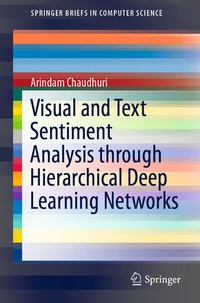
Visual and Text Sentiment Analysis through Hierarchical Deep Learning Networks
Description

This book presents the latest research on hierarchical deep learning for multi-modal sentiment analysis. Further, it analyses sentiments in Twitter blogs from both textual and visual content using hierarchical deep learning networks: hierarchical gated feedback recurrent neural networks (HGFRNNs). Several studies on deep learning have been conducted to date, but most of the current methods focus on either only textual content, or only visual content. In contrast, the proposed sentiment analysis model can be applied to any social blog dataset, making the book highly beneficial for postgraduate students and researchers in deep learning and sentiment analysis.
The mathematical abstraction of the sentiment analysis model is presented in a very lucid manner. The complete sentiments are analysed by combining text and visual prediction results. The book's novelty lies in its development of innovative hierarchical recurrent neural networks for analysing sentiments; stacking of multiple recurrent layers by controlling the signal flow from upper recurrent layers to lower layers through a global gating unit; evaluation of HGFRNNs with different types of recurrent units; and adaptive assignment of HGFRNN layers to different timescales. Considering the need to leverage large-scale social multimedia content for sentiment analysis, both state-of-the-art visual and textual sentiment analysis techniques are used for joint visual-textual sentiment analysis. The proposed method yields promising results from Twitter datasets that include both texts and images, which support the theoretical hypothesis.Reviews / Votes
"Readers interested in sentiment analysis research will find it useful. The research is a good contribution to our understanding of HGFRNNs and the development of a technique for sentiment analysis." (Maulik A. Dave, Computing Reviews, January 25, 2021)
More details
Other editions
Additional editions
Person
Arindam Chaudhuri
is currently working as Principal Data Scientist at the Samsung R & D Institute in Delhi, India. He has worked in industry, research, and academics in the domain of machine learning for the past 19 years. His current research interests include pattern recognition, machine learning, soft computing, optimization, and big data. He received his M.Tech and PhD in Computer Science from Jadavpur University, Kolkata, India and Netaji Subhas University, Kolkata, India in 2005 and 2011 respectively. He has published three research monographs and over 45 articles in international journals and conference proceedings.
Content
Chapter1. Introduction.- Chapter 2. Current State of Art.- Chapter 3. Literature Review.- Chapter 4. Twitter Datasets Used.- Chapter 5. Visual and Text Sentiment Analysis.- Chapter 6. Experimental Setup: Visual and Text Sentiment Analysis through Hierarchical Deep Learning Networks.- Chapter 7. Twitter Datasets Used.- Chapter 8. Experimental Results.- Chapter 9. Conclusion.
