

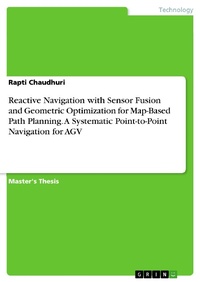
Reactive Navigation with Sensor Fusion and Geometric Optimization for Map-Based Path Planning. A Systematic Point-to-Point Navigation for AGV
1st Edition
Published on 21. July 2022
169 pages
978-3-346-68183-6 (ISBN)
Description

Master's Thesis from the year 2022 in the subject Engineering - Robotics, grade: 9, , course: Computer Science and Engineering, language: English, abstract: This book presents analysis of various intelligent approaches, including applicable heuristic graph theoretic and bio inspired techniques for achieving optimal point-to-point navigation. Usage of LiDAR and RGB-D sensor data as source input has been preferred, ensuring total workspace coverage and minimization of action performed by the robot in carrying out realistic applications in certain congested environment. Sampling-based approaches which use arbitrary information gain formulation and Learning-based techniques, both are studied extensively. Uniform Sampling-based techniques are found feasible in exploring the state space without any complexity in geometrically modeling the configuration area ensuring embedded intelligence into the mobile robots in finding optimal execution. The navigation over both static as well as dynamic obstacles are analysed and the observations are presented in a comparative manner.
For dynamic environment, it is somewhat comparatively difficult for achieving proper path navigation. VSLAM (Visual Simultaneous Localization And Mapping) uses the data captured by externally perceived sensors for the purpose of self-locating and simultaneous map-building leading to understanding the unknown environment. This thesis also proposes a keen way to detect onroute obstacles using training of model through adversarial neural network along with 3D reconstruction of a concerned surrounding followed by memory tracing of already explored path by the mobile agent for ease in achievement of optimized path from start to desired goal position. In case of GPS-denied indoor environment primarily the robot works based on its first hand sensor data, for example, proximity analysis, distance measure etc. In various scientific works it is observed that indoor robots face not only constraint space challenge but also systematic maneuver, path planning and path finding in case of cluttered environment.
Primary contributions of the work include LiDAR data inference by 2D Hect SLAM, Construction of Fusion SLAM accumulating 2D and 3D depth features and Geometric Optimization of navigation planning algorithms. The thesis concludes with the graphical and numerical analysis of the accuracy achieved using mentioned algorithms and specific benchmarking of the performance of used techniques.
More details
Other editions
Additional editions
Rapti Chaudhuri
Reactive Navigation with Sensor Fusion and Geometric Optimization for Map-Based Path Planning. A Systematic Point-to-Point Navigation for AGV
Book
06/2022
1st Edition
GRIN Verlag
€52.95
Shipment within 10-15 days
