

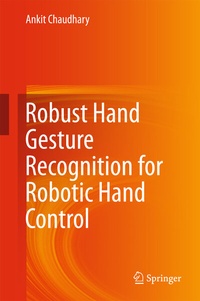
Robust Hand Gesture Recognition for Robotic Hand Control
Description

This book focuses on light invariant bare hand gesture recognition while there is no restriction on the types of gestures. Observations and results have confirmed that this research work can be used to remotely control a robotic hand using hand gestures. The system developed here is also able to recognize hand gestures in different lighting conditions. The pre-processing is performed by developing an image-cropping algorithm that ensures only the area of interest is included in the segmented image. The segmented image is compared with a predefined gesture set which must be installed in the recognition system. These images are stored and feature vectors are extracted from them. These feature vectors are subsequently presented using an orientation histogram, which provides a view of the edges in the form of frequency. Thereby, if the same gesture is shown twice in different lighting intensities, both repetitions will map to the same gesture in the stored data. The mapping ofthe segmented image's orientation histogram is firstly done using the Euclidian distance method. Secondly, the supervised neural network is trained for the same, producing better recognition results.
An approach to controlling electro-mechanical robotic hands using dynamic hand gestures is also presented using a robot simulator. Such robotic hands have applications in commercial, military or emergency operations where human life cannot be risked. For such applications, an artificial robotic hand is required to perform real-time operations. This robotic hand should be able to move its fingers in the same manner as a human hand. For this purpose, hand geometry parameters are obtained using a webcam and also using KINECT. The parameter detection is direction invariant in both methods. Once the hand parameters are obtained, the fingers' angle information is obtained by performing a geometrical analysis. An artificial neural network is also implemented to calculate the angles. These two methods can be used with only one hand, either right or left. A separate method that is applicable to both hands simultaneously is also developed and fingers angles are calculated. The contents of this book will be useful for researchers and professional engineers working on robotic arm/hand systems.
More details
Other editions
Additional editions
Person
Dr. Ankit Chaudhary received his Master of Engineering degree in Computer Science from the Birla Institute of Technology and Science, Pilani and his Ph.D. from the Central Electronics Engineering Research Institute, Council of Scientific and Industrial Research (CSIR). His research interests include vision-based applications, intelligent systems, and Robotics.
Having authored sixty research publications and edited one book, Dr. Chaudhary is an Associate Editor for Computers and Electrical Engineering and serves on the Editorial Boards of several international journals. He is also a reviewer for numerous journals, including IEEE Transactions on Image Processing, IET Image Processing, Machine Vision and Applications, and Robotics and Autonomous Systems. In the past, Dr. Chaudhary was associated with the University of Iowa's Department of Electrical and Computer Engineering and the Department of Computer Science BITS Pilani, also working as a Visiting Faculty/researcher at many research laboratories.
Content
Chapter 1: Introduction.- Chapter 2: Scientific Goals.- Chapter 3: State of the Art.- Chapter 4: Hand Image Segmentation.- Chapter 5: Light Invariant Hand Gesture Recognition.- Chapter 6: Fingertips Detection.- Chapter 7: Bent Finger's Angles Calculation.- Chapter 8: Both Hands' Angles Calculation.- Chapter 9: Conclusions.
