

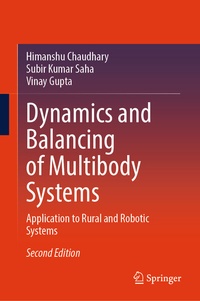
Dynamics and Balancing of Multibody Systems
Description

The book describes the methodologies for dynamics formulation, balancing, and optimizing dynamic quantities of multibody systems, such as mechanisms and robots. The writing equations of motion of multibody systems are simplified by using Decoupled Natural Orthogonal Complementary (DeNOC) matrices-based methodology originally proposed by the second author. Writing equations of motion using a DeNOC based approach enables the analytical expressions of even complicated systems which provide better physical insights of the system at-hand. The DeNOC based dynamics formulation of multibody systems is extended from system of continuum rigid-link to discrete equivalent system of point-masses coined as DeNOC-P. The dynamics formulation representing a link as point-masses is exploited to minimize the dynamic quantities shaking forces, shaking moments, or driving torques/forces by optimizing the mass redistribution of the link. Several numerical examples, such as carpet scraping machine, PUMA robot, Stewart platform, etc., are illustrated. The book also demonstrates a shape optimization methodology to realize the link with optimized mass redistribution. This textbook can be prescribed for teaching a course on dynamics and balancing of multibody systems at undergraduate and postgraduate level.
More details
Other editions
Additional editions
Persons
Dr. Himanshu Chaudhary is Professor in Mechanical Engineering at Malaviya National Institute of Technology Jaipur (Rajasthan, India), where he has been teaching computer aided design, theory of machines and mechanisms, optimization methods for engineering design, and machine design. He received his B.E. from Rajasthan Technical University Kota (erstwhile Engineering College Kota) and M.Tech. from Indian Institute of Technology (IIT) Kanpur, both in mechanical engineering. He received his Ph.D. from Indian Institute of Technology (IIT) Delhi in 2007. His research interests include multibody system dynamics, dynamic balancing, and optimization of machines and mechanisms, including robotic systems. He has about 100 journal and conference publications to his credit. Springer Verlag published his book "Dynamics and Balancing of Multibody Systems" under series Lecture Notes in Applied and Computational Mechanics, Vol. 37, ISBN 978-3-540-78178-3, 2009.
Prof. Subir Kumar Saha received his B.E. (NIT Durgapur) and M. Tech (IIT Kharagpur) in India, and Ph.D. from McGill University, Canada. Later, he joined Toshiba Corporation's R&D Center in Japan. In 1996, he joined IIT Delhi. As recognition of his international contributions, Prof. Saha was awarded the Humboldt Fellowship in 1999 by the AvH Foundation, Germany, and the Naren Gupta Chair Professorship at IIT Delhi in 2010. Presently, he is Project Director of IHFC (Technology Innovation Hub of IIT Delhi). Prof. Saha has authored several books, including a textbook on "Introduction to Robotics." To make robotics learning fun, a software RoboAnalyzer was developed under his supervision, and commercialized in 2022. He has more than 200 research publications and delivered several invited/keynote lectures in India and abroad.
Prof. Vinay Gupta earned his Ph.D. from IIT Delhi in "Dynamic Model Based Optimum Design of Robotic Systems" from the Mechanical Engineering Department. He has two decades of teaching and research experience. He has led several projects as Principal Investigator in collaboration with the Rural Technology Action Group (RuTAG) at IIT Delhi. Prof. Gupta co-supervised a Ph.D. candidate at IIT Delhi, focusing on technology selection, analysis, and design for rural and economically weaker sections. His research interests include multibody dynamics, mechanisms, optimum design, and robotics.
Content
Introduction.- Dynamics Of Open-Loop Systems.- Dynamics Of Closed-Loop Systems.- Balancing And Torques/Forces Minimization Of Planar Mechanisms.
