

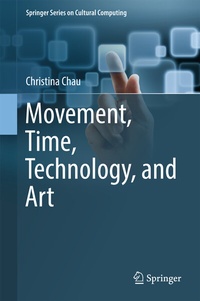
Movement, Time, Technology, and Art
Published on 12. June 2017
VI, 148 pages
978-981-10-4705-3 (ISBN)
Description

This book explores the ways in which artists use technology to create different perceptions of time in art in order to reflect on contemporary relationships to technology. By considering the links between technology, movement and contemporary art, the book explores changing relationship between temporality in art, art history, media art theory, modernity, contemporary art, and digital art.
This book challenges the dominant view that kinetic art is an antiquated artistic experiment and considers the changing perception of kinetic art by focusing on exhibitions and institutions that have recently challenged the notion of kinetic art as a marginalised and forgotten artistic experiment with mechanical media. This is achieved by deconstructing Frank Popper's argument that kinetic art is a precursor to subsequent explorations in the intersections between art, science and technology.
Rather than pandering to the prevailing art historicalassumption that kinetic sculpture is merely a precursor to art in a digital culture, the book proposes that perhaps kineticism succeeded too well, where movement has become a ubiquitous element of the aesthetic of contemporary art. If, as Boris Groys has recently suggested, installation has become the dominant mode of art in the contemporary age, then movement in real time with the viewer is used to aestheticise and explore the facets of our peculiar time.
This book challenges the dominant view that kinetic art is an antiquated artistic experiment and considers the changing perception of kinetic art by focusing on exhibitions and institutions that have recently challenged the notion of kinetic art as a marginalised and forgotten artistic experiment with mechanical media. This is achieved by deconstructing Frank Popper's argument that kinetic art is a precursor to subsequent explorations in the intersections between art, science and technology.
Rather than pandering to the prevailing art historicalassumption that kinetic sculpture is merely a precursor to art in a digital culture, the book proposes that perhaps kineticism succeeded too well, where movement has become a ubiquitous element of the aesthetic of contemporary art. If, as Boris Groys has recently suggested, installation has become the dominant mode of art in the contemporary age, then movement in real time with the viewer is used to aestheticise and explore the facets of our peculiar time.
More details
Series
Edition
1st ed. 2017
Language
English
Place of publication
Singapore
Singapore
Publishing group
Springer Singapore
Target group
Professional and scholarly
Product notice
Reflowable
Illustrations
VI, 148 p.
File size
1,86 MB
ISBN-13
978-981-10-4705-3 (9789811047053)
DOI
10.1007/978-981-10-4705-3
Schweitzer Classification
Other editions
Additional editions
Christina Chau
Movement, Time, Technology, and Art
Book
06/2017
Springer
€106.99
Shipment within 15-20 days
Person
Christina Chau is a lecturer in Media, Culture and Creative Arts at Curtin University, and editorial assistant for the academic journal Deleuze Studies.
Content
Introduction.- Revolutions.- Directions in Kinetic Art.- Systems Aesthetics.- Digital Determinism.- Three Key Influences of the Kinetic Aesthetics.- Your Negotiable Panorama.- Our Consciousness of Time.
