

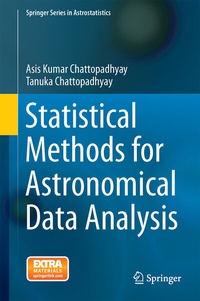
Statistical Methods for Astronomical Data Analysis
Description

This book introduces "Astrostatistics" as a subject in its own right with rewarding examples, including work by the authors with galaxy and Gamma Ray Burst data to engage the reader. This includes a comprehensive blending of Astrophysics and Statistics. The first chapter's coverage of preliminary concepts and terminologies for astronomical phenomenon will appeal to both Statistics and Astrophysics readers as helpful context. Statistics concepts covered in the book provide a methodological framework. A unique feature is the inclusion of different possible sources of astronomical data, as well as software packages for converting the raw data into appropriate forms for data analysis. Readers can then use the appropriate statistical packages for their particular data analysis needs. The ideas of statistical inference discussed in the book help readers determine how to apply statistical tests. The authors cover different applications of statistical techniques already developed or specifically introduced for astronomical problems, including regression techniques, along with their usefulness for data set problems related to size and dimension. Analysis of missing data is an important part of the book because of its significance for work with astronomical data. Both existing and new techniques related to dimension reduction and clustering are illustrated through examples. There is detailed coverage of applications useful for classification, discrimination, data mining and time series analysis. Later chapters explain simulation techniques useful for the development of physical models where it is difficult or impossible to collect data. Finally, coverage of the many R programs for techniques discussed makes this book a fantastic practical reference. Readers may apply what they learn directly to their data sets in addition to the data sets included by the authors.
More details
Other editions
Additional editions
Persons
Professor Tanuka Chattopadhyay is a Professor of Applied Mathematics at the University of Calcutta, India. Her areas of research are Astrophysics and Statistics. Professor Tanuka Chattopadhyay has published more than 25 research papers in national and international peer reviewed journals. She has also published two books on Computer Programming and Astrophysics. Professor Chattopadhyay had visiting appointments at the Pennsylvania State University,USA and Institut de Planétologie et d'Astrophysique de Grenoble, Joseph Fourier University, France. Since 2002 she has been the visiting Associate of Inter University centre for Astronomy and Astrophysics (IUCAA), Pune, India. She is a member of International Astrostatistics Association. She has received Major Research Projects Awards from University Grants Commission (UGC) and Department of Science and Technology (DST), India.
Asis Kumar Chattopadhyay is a Professor of Statistics at the University of Calcutta, India. He also worked as an Associate Professor at the Indian Statistical Institute, Kolkata during the period 2007-2008. Much of the material in the book was developed for class lectures at post graduate level in Applied Multivariate Analysis and Statistical Inference. Professor Chattopadhyay has held visiting appointments at the University of Southern Queensland, Australia and Institut de Planétologie et d'Astrophysique de Grenoble, Joseph Fourier University, France. He has also been selected as Visiting Associate of Inter University Center for Astronomy and Astrophysics (IUCAA), Pune, India since the year 2005. Now he is the coordinator of IUCAA Resource Centre at Calcutta University. Professor Chattopadhyay has published more than 40 research articles National and International peer reviewed journals and two books. Professor Chattopadhyay is a member of International Astrostatistics Association, Calcutta Statistical Association, the Indian Association for Productivity, Qualityand Reliability, Operational Research Society of India and the Indian Association for the study of Population.
