

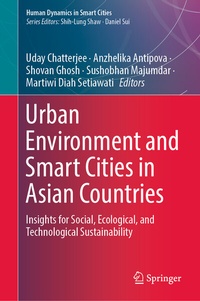
Urban Environment and Smart Cities in Asian Countries
Description

More details
Other editions
Additional editions
Persons
Dr. Anzhelika Antipova is Associate Professor in the Department of Earth Sciences, University of Memphis, Memphis, Tennessee, United States. Her areas ofresearch interest cover Urban Planning, urban and economic geography, medical/health geography, transportation studies.She has contributed various research papers published in various reputed national and international journals and edited journal special issues and book volumes. She has served as a reviewer for many International journals and books.
Dr.Shovan Ghosh , an Associate Professor in the department of Geography, Diamond Harbour Women's University, South 24 Pargana, West Bengal, has completed his M.A. and Ph.D in Geography from the University of Burdwan, West Bengal. He has secured first position in both under graduation and post-graduation level. He served as an Assistant Professor for more than ten years at Ramananda Centenary College, Purulia, West Bengal. His area of interests lies in Human Geography, Environmental Issues, Education and Geography, Regional planning, Backward Region Development, Urban Planning.
Dr. Sushobhan Majumdar is worked as an independent researcher after being awarded Doctoral degree from Jadavpur University in 2018. He was received post graduates i.e. M.Sc. degree from Presidency University and Jadavpur University in Geography and Geo-informatics. He was also engaged in a project focusing on population profile of Kolkata city under the Government of West Bengal. He has published on issues of sprawl, transportation, health issues and microclimate of urban areas under national and international repute. He is currently expanding his research on the relationship between land use and surface temperature with its spatial modeling.
Dr. Martiwi Diah Setiawati is a research fellow at the Research Center for Oceanography, National Research and Innovation Agency (BRIN)-previously known as Indonesia Institute of Sciences (LIPI). She obtained her Bachelor's degree in marine science and technology from IPB University, Indonesia, in 2009. In 2012, she got a Master of Science in Udayana University,Indonesia, and a Master of Engineering in Yamaguchi University, Japan, under a double degree program. She received her Doctoral Degree in Environmental Science and Engineering from Yamaguchi University-Japan in 2015. From 2016 until March 2021, she joined the Integrated Research System for Sustainability Sciences (IR3S), The University of Tokyo as a project researcher under the Climate Change Adaptation Initiative Project in Indonesia. As an environmental scientist, she is interested in remote sensing and GIS application to multiple environmental conditions, including habitat studies, disaster mitigation, climate change impact assessment, and adaptation. Her previous research projects cover the integrated climate assessment - risks, uncertainties, and society and developing models to predict future health risks posed by changes in climate, land use, and population.
