

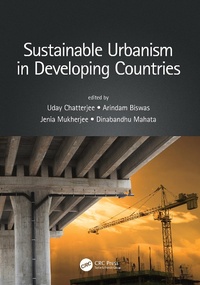
Sustainable Urbanism in Developing Countries
1st Edition
Published on 19. April 2022
465 pages
978-1-000-57237-7 (ISBN)
Description

The mushrooming of illegal housing on the periphery of cities is one of the main consequences of rapid urbanisation associated with social and environmental problems in the developing countries. Sustainable Urbanism in Developing Countries discusses the linkage between urbanism and sustainability and how sustainable urbanism can be implemented to overcome the problems of housing and living conditions in urban areas. Through case studies from India, Indonesia, China, etc., using advanced GIS techniques, this book analyses several planning and design criteria to solve the physical, social, and economic problems of urbanisation and refers to urban planning as an effective measure to protect and promote the cultural characteristics of specific locations in these developing countries.
FEATURES
Investigates an interdisciplinary approach to urbanism, including urban ecology, ecosystem services, sustainable landscapes, and advanced geographical systems
Analyses unique case studies of rapid urbanisation from a local to a national scale in countries such as India, Sri Lanka, China, Bangladesh, Malaysia, and Indonesia and their global impact
Examines the use of GIS and spatial statistics in analysing urban sprawl and the massive amount of data gathered by every operational activity of municipalities
Focuses on the holistic perspective of sustainable urbanism and the harmony in the human-nature relationship to achieve sustainable development
Covers a wide range of issues manifested in urban areas with economic, societal, and environmental implications contributed by leading scholars from the Global South
FEATURES
Investigates an interdisciplinary approach to urbanism, including urban ecology, ecosystem services, sustainable landscapes, and advanced geographical systems
Analyses unique case studies of rapid urbanisation from a local to a national scale in countries such as India, Sri Lanka, China, Bangladesh, Malaysia, and Indonesia and their global impact
Examines the use of GIS and spatial statistics in analysing urban sprawl and the massive amount of data gathered by every operational activity of municipalities
Focuses on the holistic perspective of sustainable urbanism and the harmony in the human-nature relationship to achieve sustainable development
Covers a wide range of issues manifested in urban areas with economic, societal, and environmental implications contributed by leading scholars from the Global South
More details
Edition
1. Auflage
Language
English
Place of publication
London
United Kingdom
Publishing group
Taylor & Francis Ltd
Target group
College/higher education
Professional and scholarly
Illustrations
52 Tables, black and white; 11 Line drawings, color; 19 Line drawings, black and white; 39 Halftones, color; 117 Halftones, black and white; 156 Illustrations, color; 30 Illustrations, black and white
ISBN-13
978-1-000-57237-7 (9781000572377)
Copyright in bibliographic data and cover images is held by Nielsen Book Services Limited or by the publishers or by their respective licensors: all rights reserved.
Schweitzer Classification
Other editions
Additional editions
Uday Chatterjee | Arindam Biswas | Jenia Mukherjee
Sustainable Urbanism in Developing Countries
Book
05/2024
1st Edition
CRC Press
€118.30
Shipment within 15-20 days
Uday Chatterjee | Arindam Biswas | Jenia Mukherjee
Sustainable Urbanism in Developing Countries
Book
04/2022
1st Edition
CRC Press
€265.20
Shipment within 15-20 days
Persons
Dr. Uday Chatterjee is an Assistant Professor in the Geography Department at Bhatter College, Dantan, India. He received his PhD from the Ravenshaw University, Odisha, India. His research papers have been published in various national and international journals. He has authored and co-authored several chapters for edited book volumes and has co-edited the book 'Harmony with Nature: Illusions and Elusions from Geographer's Perspective in the 21st Century' published in 2018 by Bhatter College Publications. His areas of research are urban planning, social environmental and human geography, and applied geomorphology. His research work has been funded by the WBPCB, Government of West Bengal, India. He has served as a reviewer for many international journals and he is a Life Member of eight academic societies. In 2017 directed the Faculty Development Program sponsored by ICSSR, Government of India.
Dr. Arindam Biswas is an Assistant Professor at the Department of Architecture and Planning, Indian Institute of Technology (IIT) Roorkee, India. He has a PhD in Urban Planning from the University of Tokyo. He is recipient of ASEM Duo-India Fellowship, DAAD Fellowship (Government of Germany) and MEXT Scholarship (Government of Japan). He is presently pursuing researches sponsored by different research foundations of Government of India like Department of Science and Technology (DST), Ministry of Environment Forest and Climate. He has published two editorial books and contributed in two book chapters. He has also extensively published research articles on urban infrastructure, inclusive growth, resilience, housing and informality, innovation and regional development.
Dr Jenia Mukherjee is an Assistant Professor at the Department of Humanities and Social Sciences, Indian Institute of Technology, Kharagpur. Her research interest spans across urban studies and environmental history. She received the Australian Leadership Awards Fellowship in 2010 and 2015. She completed her book project: Blue infrastructures: Natural Ecology, Political History and Urban Development in Kolkata (Singapore: Springer Nature, 2020), and has contributed several book chapters in edited volumes. She also has widely published in peer-reviewed impact factor journals including Environment and Planning E, International Journal of Urban Sustainable Development, Urban Research and Practice, etc. She is a member of the Editorial Advisory Board: Routledge Equity, Justice and the Sustainable City series.
Dinabandhu Mahata is a Researcher at the Department of Geography, Central University of Tamil Nadu and former research officer at the Department of Development Studies in International Institute for Population Sciences (IIPS), Mumbai, India. He is the recipient of the Government of India Fellowship during the study of Master of Population Studies (MPS) and Master of Philosophy (M.Phil) at the Department of Development Studies in IIPS, Mumbai, India. His work mainly focuses on urban geography, and its link with the environment. He has written journal articles and book chapters. He received a research grant from the International Union for the Scientific Study of Population (IUSSP) for International Population Conference in Cape Town, South Africa.
Dr. Arindam Biswas is an Assistant Professor at the Department of Architecture and Planning, Indian Institute of Technology (IIT) Roorkee, India. He has a PhD in Urban Planning from the University of Tokyo. He is recipient of ASEM Duo-India Fellowship, DAAD Fellowship (Government of Germany) and MEXT Scholarship (Government of Japan). He is presently pursuing researches sponsored by different research foundations of Government of India like Department of Science and Technology (DST), Ministry of Environment Forest and Climate. He has published two editorial books and contributed in two book chapters. He has also extensively published research articles on urban infrastructure, inclusive growth, resilience, housing and informality, innovation and regional development.
Dr Jenia Mukherjee is an Assistant Professor at the Department of Humanities and Social Sciences, Indian Institute of Technology, Kharagpur. Her research interest spans across urban studies and environmental history. She received the Australian Leadership Awards Fellowship in 2010 and 2015. She completed her book project: Blue infrastructures: Natural Ecology, Political History and Urban Development in Kolkata (Singapore: Springer Nature, 2020), and has contributed several book chapters in edited volumes. She also has widely published in peer-reviewed impact factor journals including Environment and Planning E, International Journal of Urban Sustainable Development, Urban Research and Practice, etc. She is a member of the Editorial Advisory Board: Routledge Equity, Justice and the Sustainable City series.
Dinabandhu Mahata is a Researcher at the Department of Geography, Central University of Tamil Nadu and former research officer at the Department of Development Studies in International Institute for Population Sciences (IIPS), Mumbai, India. He is the recipient of the Government of India Fellowship during the study of Master of Population Studies (MPS) and Master of Philosophy (M.Phil) at the Department of Development Studies in IIPS, Mumbai, India. His work mainly focuses on urban geography, and its link with the environment. He has written journal articles and book chapters. He received a research grant from the International Union for the Scientific Study of Population (IUSSP) for International Population Conference in Cape Town, South Africa.
Content
Part I: Local, Regional and Global Perspectives on Sustainable Urbanism 1. Alternative Rehabilitation Program against Agricultural Land Acquisition for New Development Project: A Case Study of New Town, Kolkata, West Bengal, India 2. Contextualizing Urban Sustainability: Limitations, Tensions in Indian Sustainable-Smart Urbanism Perceived through Intranational, International Comparisons and District City Ambala Study 3. The Geopolitics of Refugees: A Strategic Tool for Explaining the Concept of Migration in Developing Countries 4. Economic Development, Environmental Degradation and Sustainability: A Panel-Data Analysis of the Major Economies from 1990-2015 5. Demarcation and Spatial Distribution of Urban Centres in Sri Lanka 6. Colonial Urbanism and Morphology: The Case of the Colonial Port City of Kolkata Part II: Urban Planning, Innovation and Urban Resilience for Sustainable Development 7. Geopolitical Urbanism Network (GUN): Building Networked Understanding of Cities in Armed Conflicts for Sustaining Peace 8. Sustainable Spatial Planning for the Rural-Urban Continuum Settlements of Kerala, India 9. Self-Financing Urbanism in Developing Countries: A Ready Reckoner for Land Value Capture (LVC) Instruments 10. Urban Simulation Model and Urban Growth, Agglomeration, Gentrification: The Case of Lucknow, India 11. Carrying Capacity of Air Environment and Development of a Megacity: A Case of NCT Delhi, India 12. Urbanization and Sustainability in the South Pacific Region from the 1990s to 2020 Part III: Environmental Management and Ecosystem Services 13. Walkable Urban Neighborhoods: The Adverse Effects of Industrialization and Climate Change in Developing Countries 14. Urban Resilience to the Challenges of Climate Change: The Case of Africa 15. Not a 'Peripheral' Connection: Dynamics of Peri-Urban Agriculture in Kolkata Metropolitan Area, West Bengal 16. Degraded Land Management in Urban Areas: The Case of Biodiversity Parks in Delhi 17. Geospatial Analysis of Heat Islands in Badulla MC, Sri Lanka 18. Analyzing Land-Use/Land-Cover Changes and Its Impact on Land Surface Temperature in Berhampore Municipality, West Bengal, India Part IV: Multidimensional Approach to Urban Ecology, Space, Society and Sustainability 19. Reflections from East Kolkata Wetlands: A Conceptual Framework for Building Urban Resilience to Climate Change for Sustainable Urbanism in Developing Countries 20. Urban Societal Needs and Sustainability in Zambia: A Case of Public Land and Housing 21. Impact of Noise Pollution on Human Health in Barasat Urban Area, West Bengal 22. Water Vendors of Peri-Urban Kolkata: Life, Livelihood and Lived Experiences 23. 'Sacred Land Capture': An Introduction to a New Phenomenon of Encroachment in Urban India 24. Aging in Urban India: Needs and Policies for Sustainable Development
