

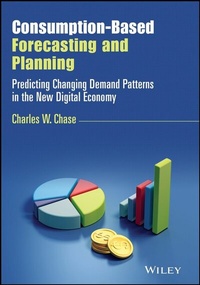
Consumption-Based Forecasting and Planning
Description

In Consumption-Based Forecasting and Planning, thought leader and forecasting expert Charles W. Chase delivers a practical and novel approach to retail and consumer goods companies demand planning process. The author demonstrates why a demand-centric approach relying on point-of-sale and syndicated scanner data is necessary for success in the new digital economy.
The book showcases short- and mid-term demand sensing and focuses on disruptions to the marketplace caused by the digital economy and COVID-19. You'll also learn:
* How to improve demand forecasting and planning accuracy, reduce inventory costs, and minimize waste and stock-outs
* What is driving shifting consumer demand patterns, including factors like price, promotions, in-store merchandising, and unplanned and unexpected events
* How to apply analytics and machine learning to your forecasting challenges using proven approaches and tactics described throughout the book via several case studies.
Perfect for executives, directors, and managers at retailers, consumer products companies, and other manufacturers, Consumption-Based Forecasting and Planning will also earn a place in the libraries of sales, marketing, supply chain, and finance professionals seeking to sharpen their understanding of how to predict future consumer demand.
More details
Other editions
Additional editions

Person
Content
Preface
Acknowledgments
About the Author
Chapter 1: The Digital Economy and Unexpected Disruptions
Chapter 2: A Wakeup Call for Demand Management
Chapter 3: Why Data and Analytics Are Important
Chapter 4: Consumption-Based Forecasting and Planning
Chapter 5: AI/Machine Learning Is Disrupting Demand Forecasting
Chapter 6: Intelligent Automation Is Disrupting Demand Planning
Chapter 7: The Future Is Cloud Analytics and Analytics at the Edge
Index
Preface
Retail and consumer goods executives know that when shaping business plans forecasts serve to temper and balance gut feelings and judgmental bias. Yet, most will admit that their forecasts are still disgracefully inaccurate. There are signs, however, based on early adoption of applying intelligent automation supported by machine learning and traditional predictive analytics that are changing the playing field, particularly for demand forecasting and planning. For example, a large global consumer goods company reduced its global days of finished goods inventory by 1.2 days after improving their overall forecast accuracy from 70% to 81% on average across their product portfolio. That corresponded to a 50 basis points improvement in overall customer service levels. So, you don't need to move the needle that much to gain significant improvements in overall supply chain performance.
The past year of the pandemic has highlighted that companies don't respond quickly to shifting consumer demand patterns, as well as other market disruptions. Companies were already facing many new challenges because of the new digital economy. The unforeseen disruption of COVID-19 worsened the economic uncertainty and market volatility. This perfect supply chain storm has become even more important for commercial teams to explore predictive analytics and automation. Those teams will need new systems to turbocharge their demand forecasting and planning capabilities to capture those shifting consumer demand patterns that are taking place as consumers move through the four phases of the pandemic-preliminary, outbreak, stabilization, and recovery. They will need efficient ways to generate and disseminate real-time consumer demand forecasts that reflect rapidly shifting market conditions. Likewise, it will be imperative for analysts and demand planning teams to embrace automated digital applications and dashboards to allow data to be refreshed frequently and incorporate multiple scenarios.
WHY IS THIS IMPORTANT?
We all know that not all forecasts will be 100% accurate, 100% of the time. That's also reflective of best-made plans and strategic initiatives. No statistical formula can predict the surge, outcome, or exact length of a black swan event like COVID-19-or can it? There's no data available for an unforeseen disruption-or is there? Nor will analytics generate optimal forecasts every time, maybe not when using traditional time series methods. In the wake of COVID-19, for example, retailers and consumer goods companies had to reset their traditional algorithms and data sets in an attempt to understand the effects of multiple phases of self-isolation, lockdowns, and reopenings over the past 10 months in an attempt to understand shifting consumption patterns.
The COVID-19 pandemic has disrupted the usual demand forecasting and planning processes. Consumer demand patterns for different products and services have shifted from the norm, given the uneven spread of the virus, and continuing economic and health uncertainties. Traditional statistical models that rely heavily only on shipments (supply) historical data alone were unable to capture the effects of the crisis for both current demand and into the next normal. However, some early adopter demand planning teams were using predictive analytics and were able to stress-test their demand forecasts and create "What If" scenarios. The technology allowed them to drill down on the impact of the crisis across specific product categories using different parameters. For instance, one consumer goods company used a combination of precrisis data, postcrisis assumptions across specific business drivers, and consumer-behavior research to model the shifting consumer demand patterns for their products across categories under various scenarios. One early finding showed that the next 1-8 weeks compound annual growth rate in the "pasta goods" category changed from a single-digit growth percent in a business-as-usual setting to a double-digit percent increase based on the scenarios. The behavior was linked to POS (point-of-sale), Google trends, epidemiological, stringency index, and regional economic data. By contrast, non-essential products were not influenced as much by the current situation, as demand remained unchanged across all scenarios and assumptions.
Once opportunities have been identified and benefits targeted, organizations implementing predictive analytics and machine learning on a large-scale basis must invest in the following core requirements:
- Clean, quality, accessible data. Perhaps more than other functional groups, the demand planning organization implementing or scaling up a predictive analytics process must ensure the reliability and accuracy of data. When business information isn't adequately sourced, aggregated, reconciled, or secured, demand analysts and planners spend more time on redundant tasks that don't add value. Business leaders must work with IT and the business to set the governance rules for data usage, what good data looks like, who owns the data, and who can access the data.
- Organizational training, protocols, and structure. Demand Planning, IT, and business leaders must ensure that employees at all levels are trained to understand the systems required to collect, access, and maintain the data. It doesn't matter how clean or how easy it is to access the data if the demand planning function doesn't have the right operational and organizational training and structure to implement predictive analytics programs. It needs supporting processes and protocols to gather insights from the data, share those insights, and develop action plans in unison across all the other functions.
- Cultural challenges. The executive team will also need to focus on corporate cultural challenges; for example, by highlighting "lighthouse cases" that might inspire other parts of the business to use predictive analytics. The company and demand planning team will most likely need to hire data scientists and data-visualization specialists. They will need to retrain internal demand planners to work with data scientists, as well. Otherwise, execution will stall, and in many cases, fail.
- Process and model sustainability. Analytics and machine learning models are never 100% stable over time, so they need to be adjusted continually, which strengthens the case for in-house competences. It is worth assembling a small hybrid group of data scientists and demand planners with strong business acumen to work together on special projects that make the case for deeper investments in analytics talent.
- The importance of having a strategic vision. The SVP supply chain, or CAO (Chief Analytics Officer), of companies must have a clear vision of how they will use new technologies. In my experience, CAOs are well positioned to provide that vision and to lead the widespread adoption of advanced analytics. They have most of the necessary data in hand, as well as the traditional quantitative expertise to assess the real value to be gained from analytics programs. Project teams and senior leaders may suspect that their companies could streamline processes or export products more efficiently. For example, the CAO can put these ideas in the proper context.
At investor days or in quarterly earnings reports, C-suite leaders tend to talk about analytics programs in broad terms. For instance, how they will change the industry, how the company will work with customers differently, or how digitization will affect the financials. In doing so, they can help fulfill the repeated request, from both senior management and the board, that they serve not only as traditional transaction managers but also as key strategy partners and as value managers. Of course, CAOs cannot lead digital transformations all alone; they should serve as global collaborators, encouraging everyone, including leaders in IT, sales, and marketing, to own the process. CAOs on the cutting edge of advanced analytics are positioning themselves not just as forward-thinking analytics leaders but also as valued business partners to other leaders in their companies. Those who aren't will need to think about how analytics programs could change the way they work, and then lead by example.
TRACKING SHIFTING CONSUMER DEMAND PATTERNS
Without a doubt, consumer behavior has changed several dimensions across product categories, channel selection, shopper trip frequency, brand preferences, and omnichannel consumption. These shifts, combined with projections for virus containment and economic recovery, are critical for retail and consumer goods strategies. Leading retail and consumer goods companies are using traditional predictive analytics and machine learning algorithms with multiple sources of insights including point-of-sale data, primary consumer research, social media, and online search trends to understand how consumer demand could evolve during and after the crisis at a granular level (SKU/Ship-to-location).
Leading executives are planning to rapidly adapt their sales and marketing plans to reflect changing consumption patterns as well as consumer sentiment. The overall consumer outlook seems to vary depending on the stage of the pandemic response, causing executives to adjust the intensity of their marketing, including ad copy and calls to action, and to stay in sync with the evolving situation. Changing consumer demand patterns for essential purchases and non-essentials is leading retail and consumer goods companies to consider shifting marketing spending in channels such as...
