

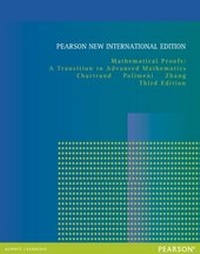
Mathematical Proofs: A Transition to Advanced Mathematics
Pearson New International Edition
3rd Edition
Published on 3. October 2013
424 pages
978-1-292-05234-2 (ISBN)
Description

For the more abstract mathematics courses that follow calculus Appropriate for self-study or for use in the classroom, this text introduces students to proof techniques, analysing proofs, and writing proofs of their own. Written in a clear, conversational style, this book provides a solid introduction to such topics as relations, functions, and cardinalities of sets, as well as the theoretical aspects of fields such as number theory, abstract algebra, and group theory. It is also a great reference text that students can look back to when writing or reading proofs in their more advanced courses.
All prices
More details
Edition
3rd edition
Language
English
Place of publication
Harlow
United Kingdom
Target group
College/higher education
ISBN-13
978-1-292-05234-2 (9781292052342)
Copyright in bibliographic data and cover images is held by Nielsen Book Services Limited or by the publishers or by their respective licensors: all rights reserved.
Schweitzer Classification
Other editions
Additional editions
Gary Chartrand | Albert D. Polimeni | Ping Zhang
Mathematical Proofs: A Transition to Advanced Mathematics
Pearson New International Edition
Book
11/2013
3rd Edition
Pearson Education Limited
€96.99
Shipment within 10-20 days
Content
0. Communicating Mathematics
Learning Mathematics
What Others Have Said About Writing
Mathematical Writing
Using Symbols
Writing Mathematical Expressions
Common Words and Phrases in Mathematics
Some Closing Comments About Writing
1. Sets
1.1. Describing a Set
1.2. Subsets
1.3. Set Operations
1.4. Indexed Collections of Sets
1.5. Partitions of Sets
1.6. Cartesian Products of Sets
Exercises for Chapter 1
2. Logic
2.1. Statements
2.2. The Negation of a Statement
2.3. The Disjunction and Conjunction of Statements
2.4. The Implication
2.5. More On Implications
2.6. The Biconditional
2.7. Tautologies and Contradictions
2.8. Logical Equivalence
2.9. Some Fundamental Properties of Logical Equivalence
2.10. Quantified Statements
2.11. Characterizations of Statements
Exercises for Chapter 2
3. Direct Proof and Proof by Contrapositive
3.1. Trivial and Vacuous Proofs
3.2. Direct Proofs
3.3. Proof by Contrapositive
3.4. Proof by Cases
3.5. Proof Evaluations
Exercises for Chapter 3
4. More on Direct Proof and Proof by Contrapositive
4.1. Proofs Involving Divisibility of Integers
4.2. Proofs Involving Congruence of Integers
4.3. Proofs Involving Real Numbers
4.4. Proofs Involving Sets
4.5. Fundamental Properties of Set Operations
4.6. Proofs Involving Cartesian Products of Sets
Exercises for Chapter 4
5. Existence and Proof by Contradiction
5.1. Counterexamples
5.2. Proof by Contradiction
5.3. A Review of Three Proof Techniques
5.4. Existence Proofs
5.5. Disproving Existence Statements
Exercises for Chapter 5
6. Mathematical Induction
6.1 The Principle of Mathematical Induction
6.2 A More General Principle of Mathematical Induction
6.3 Proof By Minimum Counterexample
6.4 The Strong Principle of Mathematical Induction
Exercises for Chapter 6
7. Prove or Disprove
7.1 Conjectures in Mathematics
7.2 Revisiting Quantified Statements
7.3 Testing Statements
Exercises for Chapter 7
8. Equivalence Relations
8.1 Relations
8.2 Properties of Relations
8.3 Equivalence Relations
8.4 Properties of Equivalence Classes
8.5 Congruence Modulo n
8.6 The Integers Modulo n
Exercises for Chapter 8
9. Functions
9.1 The Definition of Function
9.2 The Set of All Functions from A to B
9.3 One-to-one and Onto Functions
9.4 Bijective Functions
9.5 Composition of Functions
9.6 Inverse Functions
9.7 Permutations
Exercises for Chapter 9
10. Cardinalities of Sets
10.1 Numerically Equivalent Sets
10.2 Denumerable Sets
10.3 Uncountable Sets
10.4 Comparing Cardinalities of Sets
10.5 The Schroeder-Bernstein Theorem
Exercises for Chapter 10
11. Proofs in Number Theory
11.1 Divisibility Properties of Integers
11.2 The Division Algorithm
11.3 Greatest Common Divisors
11.4 The Euclidean Algorithm
11.5 Relatively Prime Integers
11.6 The Fundamental Theorem of Arithmetic
11.7 Concepts Involving Sums of Divisors
Exercises for Chapter 11
12. Proofs in Calculus
12.1 Limits of Sequences
12.2 Infinite Series
12.3 Limits of Functions
12.4 Fundamental Properties of Limits of Functions
12.5 Continuity
12.6 Differentiability
Exercises for Chapter 12
13. Proofs in Group Theory
1
Learning Mathematics
What Others Have Said About Writing
Mathematical Writing
Using Symbols
Writing Mathematical Expressions
Common Words and Phrases in Mathematics
Some Closing Comments About Writing
1. Sets
1.1. Describing a Set
1.2. Subsets
1.3. Set Operations
1.4. Indexed Collections of Sets
1.5. Partitions of Sets
1.6. Cartesian Products of Sets
Exercises for Chapter 1
2. Logic
2.1. Statements
2.2. The Negation of a Statement
2.3. The Disjunction and Conjunction of Statements
2.4. The Implication
2.5. More On Implications
2.6. The Biconditional
2.7. Tautologies and Contradictions
2.8. Logical Equivalence
2.9. Some Fundamental Properties of Logical Equivalence
2.10. Quantified Statements
2.11. Characterizations of Statements
Exercises for Chapter 2
3. Direct Proof and Proof by Contrapositive
3.1. Trivial and Vacuous Proofs
3.2. Direct Proofs
3.3. Proof by Contrapositive
3.4. Proof by Cases
3.5. Proof Evaluations
Exercises for Chapter 3
4. More on Direct Proof and Proof by Contrapositive
4.1. Proofs Involving Divisibility of Integers
4.2. Proofs Involving Congruence of Integers
4.3. Proofs Involving Real Numbers
4.4. Proofs Involving Sets
4.5. Fundamental Properties of Set Operations
4.6. Proofs Involving Cartesian Products of Sets
Exercises for Chapter 4
5. Existence and Proof by Contradiction
5.1. Counterexamples
5.2. Proof by Contradiction
5.3. A Review of Three Proof Techniques
5.4. Existence Proofs
5.5. Disproving Existence Statements
Exercises for Chapter 5
6. Mathematical Induction
6.1 The Principle of Mathematical Induction
6.2 A More General Principle of Mathematical Induction
6.3 Proof By Minimum Counterexample
6.4 The Strong Principle of Mathematical Induction
Exercises for Chapter 6
7. Prove or Disprove
7.1 Conjectures in Mathematics
7.2 Revisiting Quantified Statements
7.3 Testing Statements
Exercises for Chapter 7
8. Equivalence Relations
8.1 Relations
8.2 Properties of Relations
8.3 Equivalence Relations
8.4 Properties of Equivalence Classes
8.5 Congruence Modulo n
8.6 The Integers Modulo n
Exercises for Chapter 8
9. Functions
9.1 The Definition of Function
9.2 The Set of All Functions from A to B
9.3 One-to-one and Onto Functions
9.4 Bijective Functions
9.5 Composition of Functions
9.6 Inverse Functions
9.7 Permutations
Exercises for Chapter 9
10. Cardinalities of Sets
10.1 Numerically Equivalent Sets
10.2 Denumerable Sets
10.3 Uncountable Sets
10.4 Comparing Cardinalities of Sets
10.5 The Schroeder-Bernstein Theorem
Exercises for Chapter 10
11. Proofs in Number Theory
11.1 Divisibility Properties of Integers
11.2 The Division Algorithm
11.3 Greatest Common Divisors
11.4 The Euclidean Algorithm
11.5 Relatively Prime Integers
11.6 The Fundamental Theorem of Arithmetic
11.7 Concepts Involving Sums of Divisors
Exercises for Chapter 11
12. Proofs in Calculus
12.1 Limits of Sequences
12.2 Infinite Series
12.3 Limits of Functions
12.4 Fundamental Properties of Limits of Functions
12.5 Continuity
12.6 Differentiability
Exercises for Chapter 12
13. Proofs in Group Theory
1
