

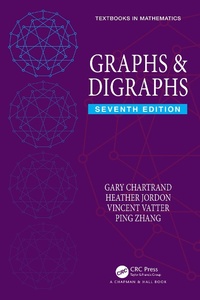
Graphs & Digraphs
7th Edition
Published on 23. January 2024
364 pages
978-1-003-80108-5 (ISBN)
Description

Graphs & Digraphs, Seventh Edition masterfully employs student-friendly exposition, clear proofs, abundant examples, and numerous exercises to provide an essential understanding of the concepts, theorems, history, and applications of graph theory. This classic text, widely popular among students and instructors alike for decades, is thoroughly streamlined in this new, seventh edition, to present a text consistent with contemporary expectations.
Changes and updates to this edition include:
A rewrite of four chapters from the ground up
Streamlining by over a third for efficient, comprehensive coverage of graph theory
Flexible structure with foundational Chapters 1-6 and customizable topics in Chapters 7-11
Incorporation of the latest developments in fundamental graph theory
Statements of recent groundbreaking discoveries, even if proofs are beyond scope
Completely reorganized chapters on traversability, connectivity, coloring, and extremal graph theory to reflect recent developments
The text remains the consummate choice for an advanced undergraduate level or introductory graduate-level course exploring the subject's fascinating history, while covering a host of interesting problems and diverse applications. Our major objective is to introduce and treat graph theory as the beautiful area of mathematics we have always found it to be. We have striven to produce a reader-friendly, carefully written book that emphasizes the mathematical theory of graphs, in all their forms. While a certain amount of mathematical maturity, including a solid understanding of proof, is required to appreciate the material, with a small number of exceptions this is the only pre-requisite.
In addition, owing to the exhilarating pace of progress in the field, there have been countless developments in fundamental graph theory ever since the previous edition, and many of these discoveries have been incorporated into the book. Of course, some of the proofs of these results are beyond the scope of the book, in which cases we have only included their statements. In other cases, however, these new results have led us to completely reorganize our presentation. Two examples are the chapters on coloring and extremal graph theory.
Changes and updates to this edition include:
A rewrite of four chapters from the ground up
Streamlining by over a third for efficient, comprehensive coverage of graph theory
Flexible structure with foundational Chapters 1-6 and customizable topics in Chapters 7-11
Incorporation of the latest developments in fundamental graph theory
Statements of recent groundbreaking discoveries, even if proofs are beyond scope
Completely reorganized chapters on traversability, connectivity, coloring, and extremal graph theory to reflect recent developments
The text remains the consummate choice for an advanced undergraduate level or introductory graduate-level course exploring the subject's fascinating history, while covering a host of interesting problems and diverse applications. Our major objective is to introduce and treat graph theory as the beautiful area of mathematics we have always found it to be. We have striven to produce a reader-friendly, carefully written book that emphasizes the mathematical theory of graphs, in all their forms. While a certain amount of mathematical maturity, including a solid understanding of proof, is required to appreciate the material, with a small number of exceptions this is the only pre-requisite.
In addition, owing to the exhilarating pace of progress in the field, there have been countless developments in fundamental graph theory ever since the previous edition, and many of these discoveries have been incorporated into the book. Of course, some of the proofs of these results are beyond the scope of the book, in which cases we have only included their statements. In other cases, however, these new results have led us to completely reorganize our presentation. Two examples are the chapters on coloring and extremal graph theory.
More details
Series
Edition
7th edition
Language
English
Place of publication
London
United Kingdom
Publishing group
Taylor & Francis Ebooks
Target group
College/higher education
Illustrations
191 Halftones, black and white; 191 Illustrations, black and white
ISBN-13
978-1-003-80108-5 (9781003801085)
Copyright in bibliographic data and cover images is held by Nielsen Book Services Limited or by the publishers or by their respective licensors: all rights reserved.
Schweitzer Classification
Other editions
Additional editions
Gary Chartrand | Heather Jordon | Vincent Vatter
Graphs & Digraphs
Book
01/2024
7th Edition
Chapman & Hall/CRC
€187.00
Shipment within 10-20 days
Gary Chartrand | Heather Jordon | Vincent Vatter
Graphs & Digraphs
Book
01/2024
7th Edition
Chapman & Hall/CRC
€85.40
Shipment within 10-20 days
Persons
Gary Chartrand is professor emeritus at Western Michigan University. He was awarded all three of his university degrees in mathematics from Michigan State University. His main interest in mathematics has always been graph theory.
He has authored or co-authored over 300 research articles in graph theory. He served as the first managing editor of the Journal of Graph Theory (for seven years) and was a member of the editorial boards of the Journal of Graph Theory and Discrete Mathematics. He served as a vice president of the Institute of Combinatorics and Its Applications. He directed the dissertations of 22 doctoral students at Western Michigan University.
He is the recipient of the University Distinguished Faculty Scholar Award and the Alumni Association Teaching Award from Western Michigan University and the Distinguished Faculty Award from the State of Michigan. He also received an award as managing editor of the best new journal (Journal of Graph Theory) by the Association of American Publishers in the scientific, medical, and technical category.
Heather Jordon earned her PhD in mathematics from Western Michigan University in 1996 under the direction of Gary Chartrand. She is currently an Associate Editor for Mathematical Reviews, produced by the American Mathematical Society.
Vincent Vatter earned his PhD in mathematics from Rutgers University in 2006, studying under Doron Zeilberger. Prior to that, he received his bachelor's degree in mathematics from Michigan State University in 2001. Currently, he is a professor of mathematics at the University of Florida, where he resides with his two daughters, Madison and Vienna. He has authored or co-authored over 60 research articles in enumerative combinatorics, graph theory, order theory, and theoretical computer science, and has directed the dissertations of five doctoral students.
Ping Zhang earned her PhD in mathematics from Michigan State University. After spending a year at the University of Texas at El Paso, she joined Western Michigan University, where she currently serves as a professor. In 2017, she was named a Distinguished University Faculty Scholar. Her primary research interests are in algebraic combinatorics and graph theory.
Dr. Zhang has co-authored six textbooks, notably Graphs & Digraphs and Chromatic Graph Theory, and is a co-editor of The Handbook of Graph Theory, Second Edition, all published by CRC Press. She has also authored or co-authored over 340 research articles and given more than 80 talks at various universities and conferences. At Western Michigan University, she has directed the dissertations of 26 doctoral students.
He has authored or co-authored over 300 research articles in graph theory. He served as the first managing editor of the Journal of Graph Theory (for seven years) and was a member of the editorial boards of the Journal of Graph Theory and Discrete Mathematics. He served as a vice president of the Institute of Combinatorics and Its Applications. He directed the dissertations of 22 doctoral students at Western Michigan University.
He is the recipient of the University Distinguished Faculty Scholar Award and the Alumni Association Teaching Award from Western Michigan University and the Distinguished Faculty Award from the State of Michigan. He also received an award as managing editor of the best new journal (Journal of Graph Theory) by the Association of American Publishers in the scientific, medical, and technical category.
Heather Jordon earned her PhD in mathematics from Western Michigan University in 1996 under the direction of Gary Chartrand. She is currently an Associate Editor for Mathematical Reviews, produced by the American Mathematical Society.
Vincent Vatter earned his PhD in mathematics from Rutgers University in 2006, studying under Doron Zeilberger. Prior to that, he received his bachelor's degree in mathematics from Michigan State University in 2001. Currently, he is a professor of mathematics at the University of Florida, where he resides with his two daughters, Madison and Vienna. He has authored or co-authored over 60 research articles in enumerative combinatorics, graph theory, order theory, and theoretical computer science, and has directed the dissertations of five doctoral students.
Ping Zhang earned her PhD in mathematics from Michigan State University. After spending a year at the University of Texas at El Paso, she joined Western Michigan University, where she currently serves as a professor. In 2017, she was named a Distinguished University Faculty Scholar. Her primary research interests are in algebraic combinatorics and graph theory.
Dr. Zhang has co-authored six textbooks, notably Graphs & Digraphs and Chromatic Graph Theory, and is a co-editor of The Handbook of Graph Theory, Second Edition, all published by CRC Press. She has also authored or co-authored over 340 research articles and given more than 80 talks at various universities and conferences. At Western Michigan University, she has directed the dissertations of 26 doctoral students.
Content
1 Graphs
1.1 Fundamentals
1.2 Isomorphism
1.3 Families of graphs
1.4 Operations on graphs
1.5 Degree sequences
1.6 Path and cycles
1.7 Connected graphs and distance
1.8 Trees and forests
1.9 Multigraphs and pseudographs
2 Digraphs
2.1 Fundamentals
2.2 Strongly connected digraphs
2.3 Tournaments
2.4 Score sequences
3 Traversability
3.1 Eulerian graphs and digraphs
3.2 Hamiltonian graphs
3.3 Hamiltonian digraphs
3.4 Highly hamiltonian graphs
3.5 Graph powers
4 Connectivity
4.1 Cut-vertices, bridges, and blocks
4.2 Vertex connectivity
4.3 Edge-connectivity
4.4 Menger's theorem
5 Planarity
5.1 Euler's formula
5.2 Characterizations of planarity
5.3 Hamiltonian planar graphs
5.4 The crossing number of a graph
6 Coloring
6.1 Vertex coloring
6.2 Edge coloring
6.3 Critical and perfect graphs
6.4 Maps and planar graphs
7 Flows
7.1 Networks
7.2 Max-flow min-cut theorem
7.3 Menger's theorems for digraphs
7.4 A connection to coloring
8 Factors and covers
8.1 Matchings and 1-factors
8.2 Independence and covers
8.3 Domination
8.4 Factorizations and decompositions
8.5 Labelings of graphs
9 Extremal graph theory
9.1 Avoiding a complete graph
9.2 Containing cycles and trees
9.3 Ramsey theory
9.4 Cages and Moore graphs
10 Embeddings
10.1 The genus of a graph
10.2 2-Cell embeddings of graphs
10.3 The maximum genus of a graph
10.4 The graph minor theorem
11 Graphs and algebra
11.1 Graphs and matrices
11.2 The automorphism group
11.3 Cayley color graphs
11.4 The reconstruction problem
1.1 Fundamentals
1.2 Isomorphism
1.3 Families of graphs
1.4 Operations on graphs
1.5 Degree sequences
1.6 Path and cycles
1.7 Connected graphs and distance
1.8 Trees and forests
1.9 Multigraphs and pseudographs
2 Digraphs
2.1 Fundamentals
2.2 Strongly connected digraphs
2.3 Tournaments
2.4 Score sequences
3 Traversability
3.1 Eulerian graphs and digraphs
3.2 Hamiltonian graphs
3.3 Hamiltonian digraphs
3.4 Highly hamiltonian graphs
3.5 Graph powers
4 Connectivity
4.1 Cut-vertices, bridges, and blocks
4.2 Vertex connectivity
4.3 Edge-connectivity
4.4 Menger's theorem
5 Planarity
5.1 Euler's formula
5.2 Characterizations of planarity
5.3 Hamiltonian planar graphs
5.4 The crossing number of a graph
6 Coloring
6.1 Vertex coloring
6.2 Edge coloring
6.3 Critical and perfect graphs
6.4 Maps and planar graphs
7 Flows
7.1 Networks
7.2 Max-flow min-cut theorem
7.3 Menger's theorems for digraphs
7.4 A connection to coloring
8 Factors and covers
8.1 Matchings and 1-factors
8.2 Independence and covers
8.3 Domination
8.4 Factorizations and decompositions
8.5 Labelings of graphs
9 Extremal graph theory
9.1 Avoiding a complete graph
9.2 Containing cycles and trees
9.3 Ramsey theory
9.4 Cages and Moore graphs
10 Embeddings
10.1 The genus of a graph
10.2 2-Cell embeddings of graphs
10.3 The maximum genus of a graph
10.4 The graph minor theorem
11 Graphs and algebra
11.1 Graphs and matrices
11.2 The automorphism group
11.3 Cayley color graphs
11.4 The reconstruction problem
