

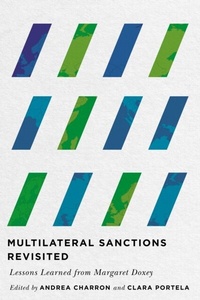
Multilateral Sanctions Revisited
Lessons Learned from Margaret Doxey
1st Edition
Published on 15. September 2022
978-0-2280-1260-3 (ISBN)
Description

Sanctions are back with a vengeance with new objectives, measures, challenges, and opportunities. Shaping the thinking of generations of scholars, Canadian visionary Margaret Doxey anticipated and analyzed these issues, making now the time to rediscover her seminal lessons and apply them to emerging sanctions practices that are taking shape in an increasingly geopolitically contested environment.
Written by an international team of women, Multilateral Sanctions Revisited explores UN measures, regional sanctions, autonomous measures, and their interrelations. Informed by Doxey's insights, the authors trace the evolution of scholarship surrounding multilateral sanctions. The first section analyzes how different actors, such as great powers and regional organizations, employ multilateral sanctions. Turning to contemporary issues, the book's second section addresses the application and consequences of multilateral sanctions including the norms they enforce, the pernicious problem of evasion, and future challenges, such as sanctioning cryptocurrencies.
Multilateral Sanctions Revisited is both a source for academics and a guidebook for practitioners written by leading and emerging sanctions scholars from three continents.
Written by an international team of women, Multilateral Sanctions Revisited explores UN measures, regional sanctions, autonomous measures, and their interrelations. Informed by Doxey's insights, the authors trace the evolution of scholarship surrounding multilateral sanctions. The first section analyzes how different actors, such as great powers and regional organizations, employ multilateral sanctions. Turning to contemporary issues, the book's second section addresses the application and consequences of multilateral sanctions including the norms they enforce, the pernicious problem of evasion, and future challenges, such as sanctioning cryptocurrencies.
Multilateral Sanctions Revisited is both a source for academics and a guidebook for practitioners written by leading and emerging sanctions scholars from three continents.
Reviews / Votes
"This remarkably comprehensive volume distinguishes itself by not only focusing on multilateral sanctions but also addressing the topic with an issue-specific approach. The range and quality of this book, along with the necessary work it does in recognizing women scholars of sanctions, are first-rate." George A. Lopez, University of Notre Dame and co-author of Sanctions and the Search for Security: Challenges to UN Action "This book utilizes and builds upon Margaret Doxey's multilateral framework of analysis to provide a fresh and incisive overview of sanctions policy and the issues that will likely dominate the field in the years ahead. A thorough critical analysis of a wide range of sanctions-related issues." David Cortright, University of Notre Dame and co-author of The Sanctions Decade: Assessing UN Strategies in the 1990s "Margaret Doxey (1975) wrote much of her influential work on sanctions in an era characterized by young international institutions, against the backdrop of the geopolitical tensions of the Cold War. The 16 women who contribute to [this book] honor Doxey's scholarship in a time of re-emerging global tensions. Contemporary sanctions are smarter than ever, but they fail to make up for the eroding moral legitimacy of measures imposed outside of the framework of the UN. Regardless of the reader's stand in the debate between respecting the consensus below the ceiling or pursuing higher norms above and beyond it, the inevitable consequence is that multiple unilateral sanctions can never be as effective as truly multilateral ones." World Affairs "Cutting-edge considerations and scholarly insight ... de facto make Multilateral Sanctions Revisited the new reference point in multilateral sanctions studies. Furthermore, as all the contributions(and even reviews) are made by female-only sanctions experts, this volume is ... tangible proof of the successful path a once-solitary female voice helped shape for many subsequent female scholars in the discipline." International Spectator "... expertly and comprehensively explained ... [this] book provides an authoritative guide to the use of multilateral sanctions and the UN's central role in it. While the future of the UN and multilateral sanctions looks uncertain, this book provides an excellent guide to all aspects of its past and present." International AffairsMore details
Series
Language
English
Place of publication
Montreal, QC
Canada
Target group
Professional and scholarly
Edition type
Digital original
Illustrations
6 diagrams, 9 tables
6 diagrams, 9 tables
File size
1,92 MB
ISBN-13
978-0-2280-1260-3 (9780228012603)
Copyright in bibliographic data and cover images is held by Nielsen Book Services Limited or by the publishers or by their respective licensors: all rights reserved.
Schweitzer Classification
Other editions
Additional editions
Book
09/2022
McGill-Queen's University Press
€35.50
Shipment within 15-20 days
Book
09/2022
McGill-Queen's University Press
€154.64
Article not available at the moment
Persons
Andrea Charron is associate professor of political studies at the University of Manitoba. Clara Portela is professor of political science at the University of Valencia.
