

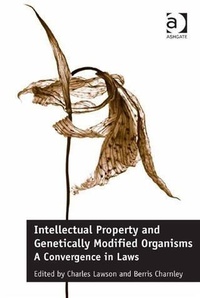
Intellectual Property and Genetically Modified Organisms
A Convergence in Laws
Published on 28. April 2015
258 pages
978-1-4724-4346-5 (ISBN)
Description

Taking a global viewpoint, this volume addresses issues arising from recent developments in the enduring and topical debates over Genetically Modified Organisms (GMOs) and their relationship to Intellectual Property (IP).
The work examines changing responses to the growing acceptance and prevalence of GMOs. Drawing together perspectives from several of the leading international scholars in this area, the contributions seek to break away from analysis of safety and regulation and examine the diversity of ways the law and GMOs have become entangled.
This collection presents the start of a much broader engagement with GMOs and law. As GMO technology becomes increasingly more complex and embedded in our lives, this volume will be a useful resource in leading further discussion and debate about GMOs in academia, in government and among those working on future policy.
The work examines changing responses to the growing acceptance and prevalence of GMOs. Drawing together perspectives from several of the leading international scholars in this area, the contributions seek to break away from analysis of safety and regulation and examine the diversity of ways the law and GMOs have become entangled.
This collection presents the start of a much broader engagement with GMOs and law. As GMO technology becomes increasingly more complex and embedded in our lives, this volume will be a useful resource in leading further discussion and debate about GMOs in academia, in government and among those working on future policy.
Reviews / Votes
`This collection offers a range of stimulating, original, and well-researched new work that will prove valuable to students of intellectual property, policy practitioners, and scholars in history and philosophy of science.'Nicolas Rasmussen, University of New South Wales, Australia
`Patents on GMOs raise various concerns as they vest disproportionate power in a few large corporations. How worried should we be? This enlightening volume covers all the relevant issues in a comprehensive, insightful fashion, going further than any other book towards finding the answers we need as scholars and citizens.'
Graham Dutfield, University of Leeds, UK
`Charnley and Lawson's timely volume provides not only essential accounts of disputes over intellectual property in GMOs in and out of the courts, but a gathering of historical and contemporary assessments of legislation, regulation, and policy concerning genetically engineered plants, animals, and fish. A goldmine of information and analysis, authoritative in detail while readily accessible in the clarity of its presentations.'
Daniel J. Kevles, Yale University, USA
More details
Edition
New edition
Language
English
Place of publication
Farnham
United Kingdom
Publishing group
Taylor & Francis Ltd
Target group
Professional and scholarly
Edition type
New edition
File size
1,48 MB
ISBN-13
978-1-4724-4346-5 (9781472443465)
Copyright in bibliographic data and cover images is held by Nielsen Book Services Limited or by the publishers or by their respective licensors: all rights reserved.
Schweitzer Classification
Other editions
Additional editions
Charles Lawson | Berris Charnley
Intellectual Property and Genetically Modified Organisms
A Convergence in Laws
Book
04/2015
1st Edition
Routledge
€215.41
Shipment within 10-20 days
Persons
Charles Lawson is a recognized expert in the international scholarship on intellectual property, and in particular patenting biologicals and the issues of access and benefit sharing under international law.
Berris Charnley is a historian of science. He is interested in seeds, genes, farms and food. Berris has published on the history of intellectual property in the biosciences, the historical construction of British food safety regulations in the 19th century and on developments in contemporary plant science.
Berris Charnley is a historian of science. He is interested in seeds, genes, farms and food. Berris has published on the history of intellectual property in the biosciences, the historical construction of British food safety regulations in the 19th century and on developments in contemporary plant science.
Content
Contents: Intellectual property and genetically modified organisms, Berris Charnley and Charles Lawson; Cui bono? Gauging the successes of publicly-funded plant breeding in retrospect, Berris Charnley; `The story of a love spurned': Monsanto in the United Republic of Soy, Stephen Hubicki; Competition in the agricultural seeds sector: patents and competition at a cross-roads?, Charles Lawson; Regulating for traditional innovation in agricultural organisms, Karinne Ludlow; Myriad Genetics and the remaining uncertainty for biotechnology inventions, Dianne Nicol; Just Label It: consumer rights, GM food labelling and international trade, Matthew Rimmer; Unnaturally natural: inventing and eating genetically engineered AquAdvantage (R) salmon and the paradox of nature, Jay Sanderson and Fran Humphries; Information about information about information: GMOs and law as a `flexible technology', Kieran Tranter; Index.
