

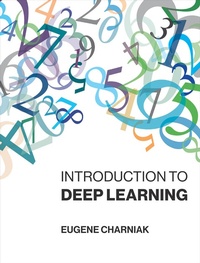
Introduction to Deep Learning
Description

This concise, project-driven guide to deep learning takes readers through a series of program-writing tasks that introduce them to the use of deep learning in such areas of artificial intelligence as computer vision, natural-language processing, and reinforcement learning. The author, a longtime artificial intelligence researcher specializing in natural-language processing, covers feed-forward neural nets, convolutional neural nets, word embeddings, recurrent neural nets, sequence-to-sequence learning, deep reinforcement learning, unsupervised models, and other fundamental concepts and techniques. Students and practitioners learn the basics of deep learning by working through programs in Tensorflow, an open-source machine learning framework. "I find I learn computer science material best by sitting down and writing programs,” the author writes, and the book reflects this approach.
Each chapter includes a programming project, exercises, and references for further reading. An early chapter is devoted to Tensorflow and its interface with Python, the widely used programming language. Familiarity with linear algebra, multivariate calculus, and probability and statistics is required, as is a rudimentary knowledge of programming in Python. The book can be used in both undergraduate and graduate courses; practitioners will find it an essential reference.
More details
Other editions
Additional editions
Person
Content
- Cover
- Copyright
- Contents
- Preface
- 1 Feed-Forward Neural Nets
- 1.1 Perceptrons
- 1.2 Cross-entropy Loss Functions for Neural Nets
- 1.3 Derivatives and Stochastic Gradient Descent
- 1.4 Writing Our Program
- 1.5 Matrix Representation of Neural Nets
- 1.6 Data Independence
- 1.7 References and Further Readings
- 1.8 Written Exercises
- 2 Tensorflow
- 2.1 Tensorflow Preliminaries
- 2.2 A TF Program
- 2.3 Multilayered NNs
- 2.4 Other Pieces
- 2.4.1 Checkpointing
- 2.4.2 tensordot
- 2.4.3 Initialization of TF Variables
- 2.4.4 Simplifying TF Graph Creation
- 2.5 References and Further Readings
- 2.6 Written Exercises
- 3 Convolutional Neural Networks
- 3.1 Filters, Strides, and Padding
- 3.2 A Simple TF Convolution Example
- 3.3 Multilevel Convolution
- 3.4 Convolution Details
- 3.4.1 Biases
- 3.4.2 Layers with Convolution
- 3.4.3 Pooling
- 3.5 References and Further Readings
- 3.6 Written Exercises
- 4 Word Embeddings and Recurrent NNs
- 4.1 Word Embeddings for Language Models
- 4.2 Building Feed-Forward Language Models
- 4.3 Improving Feed-Forward Language Models
- 4.4 Overfitting
- 4.5 Recurrent Networks
- 4.6 Long Short-Term Memory
- 4.7 References and Further Readings
- 4.8 Written Exercises
- 5 Sequence-to-Sequence Learning
- 5.1 The Seq2Seq Paradigm
- 5.2 Writing a Seq2Seq MT program
- 5.3 Attention in Seq2seq
- 5.4 Multilength Seq2Seq
- 5.5 Programming Exercise
- 5.6 Written Exercises
- 5.7 References and Further Readings
- 6 Deep Reinforcement Learning
- 6.1 Value Iteration
- 6.2 Q-learning
- 6.3 Basic Deep-Q Learning
- 6.4 Policy Gradient Methods
- 6.5 Actor-Critic Methods
- 6.6 Experience Replay
- 6.7 References and Further Readings
- 6.8 Written Exercises
- 7 Unsupervised Neural-Network Models
- 7.1 Basic Autoencoding
- 7.2 Convolutional Autoencoding
- 7.3 Variational Autoencoding
- 7.4 Generative Adversarial Networks
- 7.5 References and Further Readings
- 7.6 Written Exercises
- A Answers to Selected Exercises
- A.1 Chapter 1
- A.2 Chapter 2
- A.3 Chapter 3
- A.4 Chapter 4
- A.5 Chapter 5
- A.6 Chapter 6
- A.7 Chapter 7
- Bibliography
- Index
