

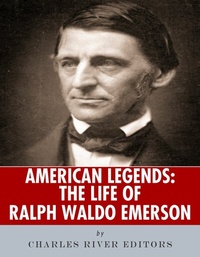
The Life of Ralph Waldo Emerson
Description

"Standing on the bare ground, - my head bathed by the blithe air, and uplifted into infinite space, - all mean egotism vanishes. I become a transparent eye-ball; I am nothing; I see all; the currents of the Universal Being circulate through me; I am part or particle of God." - Ralph Waldo Emerson
A lot of ink has been spilled covering the lives of history's most influential figures, but how much of the forest is lost for the trees? In Charles River Editors' American Legends series, readers can get caught up to speed on the lives of America's most important men and women in the time it takes to finish a commute, while learning interesting facts long forgotten or never known.
In the mid-19th century, Romantic literature was still in full bloom across the West, but some American authors began producing literature that, while still Romantic, was unique enough to be considered a different genre. This new genre, Transcendentalism, focused on the spirituality of the self and nature, not rejecting religion outright but concentrating on pragmatism and the importance of individuals as the spiritual center of the cosmos. In addition to drawing upon the Age of Enlightenment, Transcendentalist authors also utilized the philosophy of Plato, who taught that self-fulfillment through attaining knowledge should be an individual's ultimate goal.
The leader of Transcendentalism and the man who ushered the movement's practices and literature was Ralph Waldo Emerson (1802-1883), one of America's most famous writers and speakers. Whereas Romantic literature typically took the form of poetry, novels and short stories, much of Emerson's writings disregarded those traditional structures and were written as essays. Emerson initiated Transcendentalism with the publishing of his essay Nature in 1836, which espoused the virtues of nature and the interconnectedness of all life in nature. With his focus on the environment and natural history, Emerson became the first major American writer whose work was not influenced in any way by European literature.
But Emerson didn't just write Transcendentalist literature; he practiced what he preached. Now at the forefront of a movement, Emerson established group meetings, gave a series of lectures, and helped produce a Transcendentalist publication in the 1840s, which included his famous essay Self-Reliance. As Emerson's movement and stature grew, he befriended other authors, including Nathaniel Hawthorne, Louisa May Alcott, and Henry David Thoreau, who became his greatest protégé. Thoreau in particular took a keen interest in the idea of getting in touch with nature, writing in Walden, "Most of the luxuries and many of the so-called comforts of life are not only not indispensable, but positive hindrances to the elevation of mankind."
American Legends: The Life of Ralph Waldo Emerson looks at the life and work of Emerson and the movement he helped lead. Along with pictures, you will learn about Ralph Waldo Emerson like you never have before, in no time at all.
