

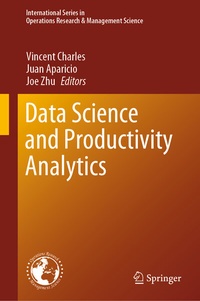
Data Science and Productivity Analytics
Description

This book includes a spectrum of concepts, such as performance, productivity, operations research, econometrics, and data science, for the practically and theoretically important areas of 'productivity analysis/data envelopment analysis' and 'data science/big data'. Data science is defined as the collection of scientific methods, processes, and systems dedicated to extracting knowledge or insights from data and it develops on concepts from various domains, containing mathematics and statistical methods, operations research, machine learning, computer programming, pattern recognition, and data visualisation, among others.
Examples of data science techniques include linear and logistic regressions, decision trees, Naïve Bayesian classifier, principal component analysis, neural networks, predictive modelling, deep learning, text analysis, survival analysis, and so on, all of which allow using the data to make more intelligent decisions. On the other hand, it is without a doubtthat nowadays the amount of data is exponentially increasing, and analysing large data sets has become a key basis of competition and innovation, underpinning new waves of productivity growth. This book aims to bring a fresh look onto the various ways that data science techniques could unleash value and drive productivity from these mountains of data.
Researchers working in productivity analysis/data envelopment analysis will benefit from learning about the tools available in data science/big data that can be used in their current research analyses and endeavours. The data scientists, on the other hand, will also get benefit from learning about the plethora of applications available in productivity analysis/data envelopment analysis.
More details
Other editions
Additional editions
Persons
Juan Aparicio is an Associate Professor at the Department of Statistics, Mathematics an Information Technology of the University Miguel Hernandez, Elche (Alicante), Spain. He is the director of the Center of Operations Research and is also Co-Chair (with Knox Lovell) of the Santander Chair on Efficiency and Productivity. He has published over 100 research contributions, mainly on Data Envelopment Analysis, Efficiency and Productivity Analysis.
Joe Zhu is Professor of Operations Analytics in the Foisie Business School, Worcester Polytechnic Institute. He is an internationally recognized expert in methods of performance evaluation and benchmarking using Data Envelopment Analysis (DEA), and his research interests are in the areas of operations and business analytics, productivity modeling, and performance evaluation and benchmarking. He has published and co-edited several books focusing on performance evaluation and benchmarking using DEA and developed the DEA Frontier software.
