

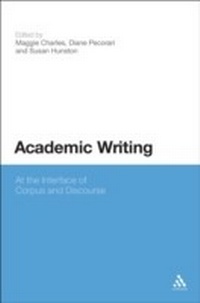
Academic Writing
At the Interface of Corpus and Discourse
1st Edition
Published on 13. November 2009
316 pages
978-1-4411-3580-3 (ISBN)
Description

Contemporary research into written academic discourse has become increasingly polarised between two approaches: corpus linguistics and discourse analysis. This volume presents a selection of recent work by experts in academic written discourse, and illustrates how corpus linguistics and discourse analysis can work as complementary approaches.
The overall introduction sets the volume against the backdrop of current work in English for Academic Purposes, and introductions to the each section draw out connections between the chapters and put them into context. The contributors are experts in the field and they cover both novice and expert examples of EAP. The book ends with an afterword that provides an agenda-setting closing perspective on the future of EAP research.
It will appeal to reserachers and postgrduates in applied linguistics, corpus linguistics, discourse analysis and EAP.
The overall introduction sets the volume against the backdrop of current work in English for Academic Purposes, and introductions to the each section draw out connections between the chapters and put them into context. The contributors are experts in the field and they cover both novice and expert examples of EAP. The book ends with an afterword that provides an agenda-setting closing perspective on the future of EAP research.
It will appeal to reserachers and postgrduates in applied linguistics, corpus linguistics, discourse analysis and EAP.
Reviews / Votes
"This rich collection of papers explores the complementarity of corpus and discourse approaches to written academic discourse, with examples given both of corpus investigations that are augmented by discourse analysis and also of corpus-assisted discourse analyses. As such, it makes a major contribution to the development of a combined corpus and discourse analytic approach to textual analysis. The papers contained in this collection present thorough, evidence-based descriptions of language use in a range of disciplines, which extend our understanding of how writers construct texts and interact with their readers, in diverse disciplinary contexts. This book is essential reading for students and researchers of academic discourse, and for those involved in the teaching of English for Academic Purposes. It will also interest applied corpus linguists and discourse analysts." The volume's clear structural and conceptual divisions, along with the various introductions, provide a helpful scaffold for the reader, particularly those less familiar with the issues under discussion. The comprehensive subject and author indexes are also reader friendly and facilitate access to the volume's many interconnecting themes. Given the growing importance of the discourse and corpus analytic approaches in combination, the examination of the interaction between the two approaches in this volume provides an important addition to the emerging body of literature in the area. The individual research reports provide important insights into features of academic writing, and the collection of research reports richly illustrates ways that corpus and discourse analytical approaches can be fruitfully combined.More details
Edition
1. Auflage
Language
English
Place of publication
New York
United States
Target group
Professional and scholarly
ISBN-13
978-1-4411-3580-3 (9781441135803)
Copyright in bibliographic data and cover images is held by Nielsen Book Services Limited or by the publishers or by their respective licensors: all rights reserved.
Schweitzer Classification
Other editions
Additional editions
Maggie Charles | Susan Hunston | Diane Pecorari
Academic Writing
At the Interface of Corpus and Discourse
Book
12/2011
Continuum Publishing Corporation
€56.50
Shipment within 15-20 days
Persons
Maggie Charles is Tutor in English for Academic Studies at Oxford University Language Centre, Oxford, UK. Susan Hunston is Professor of English Language at the University of Birmingham, UK. Diane Pecorari is a Senior Lecturer and Coordinator of English in the Department of Modern Languages, Maelardalen University, Sweden.
Content
Contributors \ Introduction: Exploring the Interface Between Corpus Linguistics and Discourse Analysis Maggie Charles, Diane Pecorari and Susan Hunston \ Part
I: Focus on Genre and Disciplinary Discourses \ Introduction to Part I Maggie
Charles \ 1. Schematic Structure and Lexico-Grammatical Realization
in Corpus-Based Genre Analysis: The Case of Research in the PhD Literature Review John Flowerdew and Richard Forest \ 2. Persuading Sponsors and Securing Funding: Rhetorical Patterns in Grant Proposals Dimitra Koutsantoni \ 3. Verbal
and Mental Processes in Academic Disciplines Jasper Holmes and Hilary Nesi \ 4. In the Wake of the Terror: Phraseological
tools of Time Setting in the Narrative of History Marina Bondi \ 5. Formulaic Language in Biology: A Topic-specific Investigation Diane Pecorari \ Part II:
Focus on Interpersonal Discourses \ Introduction to Part II Susan Hunston \ 6.
Corpus Informed Discourse Analysis: The Case of Academic Engagement Ken Hyland
\ 7. E-Conferencing: Corpus and Discourse Insights Ann Hewings, Caroline
Coffin and Sarah North \ 8. Stance, Interaction and the Rhetorical Patterns of Restrictive Adverbs: Discourse Roles of Only, Just, Simply and Merely Maggie
Charles \ 9. A Dialogic Account of Authority in Academic Writing, Ramona Tang \
Part III: Focus on Learner Discourses \ Introduction to Part III Diane Pecorari
\ 10. Lexical Verbs in Academic Discourse: A Corpus-driven Study of Learner Use
Sylviane Granger and Magali Paquot \ 11. Linking Adverbials in Student and Professional Writing in Literary Studies: What Makes Writing Mature Philip Shaw
\ 12. Variation in the Writing of Economics Students in Britain and Pakistan: The Case of Conjunctive Ties S. Amina Gardezi and Hilary Nesi \ 13. Can I Use Headings in My Essay? Section headings, Macrostructures and Genre Families in
the BAWE Corpus of Student Writing Sheena Gardner and Jasper Holmes \ 14. Using
the Revision Process to Help International Students Understand the Linguistic Construction of the Academic Identity Suganthi John \ Afterword John M. Swales
\ Author Index \ Subject Index
I: Focus on Genre and Disciplinary Discourses \ Introduction to Part I Maggie
Charles \ 1. Schematic Structure and Lexico-Grammatical Realization
in Corpus-Based Genre Analysis: The Case of Research in the PhD Literature Review John Flowerdew and Richard Forest \ 2. Persuading Sponsors and Securing Funding: Rhetorical Patterns in Grant Proposals Dimitra Koutsantoni \ 3. Verbal
and Mental Processes in Academic Disciplines Jasper Holmes and Hilary Nesi \ 4. In the Wake of the Terror: Phraseological
tools of Time Setting in the Narrative of History Marina Bondi \ 5. Formulaic Language in Biology: A Topic-specific Investigation Diane Pecorari \ Part II:
Focus on Interpersonal Discourses \ Introduction to Part II Susan Hunston \ 6.
Corpus Informed Discourse Analysis: The Case of Academic Engagement Ken Hyland
\ 7. E-Conferencing: Corpus and Discourse Insights Ann Hewings, Caroline
Coffin and Sarah North \ 8. Stance, Interaction and the Rhetorical Patterns of Restrictive Adverbs: Discourse Roles of Only, Just, Simply and Merely Maggie
Charles \ 9. A Dialogic Account of Authority in Academic Writing, Ramona Tang \
Part III: Focus on Learner Discourses \ Introduction to Part III Diane Pecorari
\ 10. Lexical Verbs in Academic Discourse: A Corpus-driven Study of Learner Use
Sylviane Granger and Magali Paquot \ 11. Linking Adverbials in Student and Professional Writing in Literary Studies: What Makes Writing Mature Philip Shaw
\ 12. Variation in the Writing of Economics Students in Britain and Pakistan: The Case of Conjunctive Ties S. Amina Gardezi and Hilary Nesi \ 13. Can I Use Headings in My Essay? Section headings, Macrostructures and Genre Families in
the BAWE Corpus of Student Writing Sheena Gardner and Jasper Holmes \ 14. Using
the Revision Process to Help International Students Understand the Linguistic Construction of the Academic Identity Suganthi John \ Afterword John M. Swales
\ Author Index \ Subject Index
