

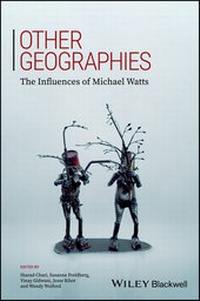
Other Geographies
Description

Reviews / Votes
'The essays in this book represent a sampling of Watts' UC Berkeley students' work across the four decades he served as professor, muse, and driving force for colleagues as well as students. The collection provides an entrée into this important scholar's broad-ranging and compelling legacy that branches out and extends, like a family tree, to distant continents and global institutions. How has Michael Watts shaped Political Ecology and other subfields of Critical Human Geography? Let us count the ways.' Nancy Lee Peluso, Professor of Society & Environment, University of California, Berkeley, USA 'This important volume is a testament to the range of scholarship inspired by Michael Watts as illustrated by the insightful contributions of his former students, who are major scholars in their own right. Together, their contributions form an exciting new contribution to political ecology and critical agrarian studies - each presenting new understandings while tracing their intellectual debt to Watts's work.' Matt Turner, Professor of Geography, University of Wisconsin-Madison, USAMore details
Other editions
Additional editions
Persons
Content
Notes on Contributors
Teo Ballvé is an Assistant Professor in Peace & Conflict Studies and Geography at Colgate University in upstate New York. Before returning to academia, he worked for many years as a journalist, covering Latin American affairs and US policy toward the region. He is the co-editor (with Vijay Prashad) of Dispatches from Latin America: On the Frontlines Against Neoliberalism (South End Press; LeftWord, 2006).
Thomas J. Bassett's research centres on the political ecology of agrarian change in West Africa. He earned his PhD in Geography at the University of California, Berkeley, in 1984. He was Professor Michael Watts's first PhD student. Dr Bassett's long-term research in West Africa grapples with the question of why peasant farmers and herders, despite their access to land and labour, remain vulnerable to food insecurity. His research in Côte d'Ivoire traces the transformation of farming and pastoral systems, their interactions with markets and the state, and the multi-scale political ecological dynamics that produce vulnerability as well as opportunities for reducing it. His recent publications focus on world market prices and cotton grower incomes in West Africa (World Development), the adaptation concept in the climate change literature (Geoforum) and political ecological perspectives on socio-ecological relations (Natures, Sciences et Sociétés). He also writes on the history of maps and mapmaking in Africa with contributions to three volumes of the six-volume The History of Cartography.
Joe Bryan's research draws from 20 years of experience working with indigenous movements in the Americas, including work in Ecuador, Nicaragua, the United States and Mexico. Much of that work focuses on efforts by indigenous peoples to formulate claims to territory, in particular through the production of maps. He has written extensively on his work in both English and Spanish, and is the co-author, with Denis Wood, of Weaponizing Maps: Indigenous Peoples and Counterinsurgency in the Americas. He is currently Associate Professor of Geography at the University of Colorado, Boulder.
Judith Carney is Professor of Geography at UCLA. Her research centres on African ecology and development, food security, gender and agrarian change, and African contributions to New World environmental history. She is the author of more than 90 scholarly articles and two books: Black Rice: The African Origins of Rice Cultivation in the Americas (Harvard University Press, 2001) and In the Shadow of Slavery: Africa's Botanical Legacy in the Atlantic World (University of California Press, 2009). Black Rice received the Melville Herskovits Book Award and In the Shadow of Slavery, the Frederick Douglass Book Prize. She has received professional honours from the Association of American Geographers, including a Distinguished Scholarship Honor, the Robert Netting Award for original research that bridges geography and anthropology and the Carl O. Sauer Distinguished Scholarship Award for significant contributions to Latin American geography. Her research has been supported by the National Geographic Society, the Guggenheim Foundation, the American Council of Learned Societies, the Rockefeller Foundation and the Wenner-Gren Foundation. Currently she is researching human use of West African mangrove ecosystems in the context of climate change and continuing her collaboration with plant scientists on historical and geographical themes concerning the genome sequencing of African rice.
Sharad Chari is at the Centre for Indian Studies in Africa and the Department of Social Anthropology at the University of the Witwatersrand, Johannesburg, South Africa, and, from 2017, at the Department of Geography at Berkeley. He has taught at the LSE and at Michigan, where he was in Anthropology, History, and the Michigan Society of Fellows. Sharad has worked on gender, caste and work politics in agrarian and industrial South India, in Fraternal Capital: Peasant-workers, self-made men, and globalization in provincial India (Stanford, 2004); development theories and trajectories, in the edited Development Reader (Routledge, 2008, with Stuart Corbrige); he is finishing a palimpsestic book on the past and present of racial capitalism and opposition in South Africa, called Apartheid Remains; and he is beginning research on archaic and emergent formations of racial/sexual capitalism in the Southern African Indian Ocean region. He works with agrarian studies, the Black radical tradition, documentary photography and other traditions of Earth-writing that have sought to stretch Marxist thought to realities considered (but not actually) peripheral to the planet.
Erin Collins is Assistant Professor of Global Urban Studies in the School of International Service at American University in Washington DC, USA. Dr Collins is a critical, urban geographer whose work focusses on the political economy and cultural politics of transformation in Southeast Asian cities. She received her PhD in Geography from the University of California, Berkeley in 2015. Her current research looks at how people claim and defend space in Cambodia's capital city of Phnom Penh in and through moments of political, social and economic remaking.
Rosalind Fredericks is Assistant Professor at New York University's Gallatin School of Individualized Study. After her PhD in Geography at the University of California, Berkeley, she was a postdoctoral research scholar with the Committee on Global Thought at Columbia University. Trained as an urban and cultural geographer, her research interests are centred on urban development, citizenship, political ecology, infrastructure and geographies of waste in Africa. Her forthcoming book, Garbage Citizenship: Vibrant Infrastructures of Labor in Dakar, Senegal (Duke University Press) chronicles the infrastructural politics surrounding municipal garbage labour in the wake of structural adjustment. A new research project funded by the National Science Foundation examines planning and activism surrounding the proposed closure of the city's dump, Mbeubeuss. She also has an ongoing research project on the role of hip hop in elections in Senegal. Fredericks has edited two books with Mamadou Diouf on citizenship in African cities, Les Arts de la Citoyenneté au Sénégal: Espaces Contestés et Civilités Urbaines (Editions Karthala, 2013) and The Arts of Citizenship in African Cities: Infrastructures and Spaces of Belonging (Palgrave MacMillan, 2014).
Susanne Freidberg received her PhD from Berkeley Geography in 1996 and is now Professor of Geography at Dartmouth College. Her research centres on the politics, practices and cultural meanings of food supply chains. While her dissertation examined the social and environmental history of commercial gardening in Burkina Faso, her more recent work focuses on the agricultural sustainability initiatives undertaken by the world's biggest food companies. She is the author of two books, French Beans and Food Scares: Culture and Commerce in an Anxious Age (Oxford, 2004) and Fresh: A Perishable History (Harvard, 2009), as well as articles that have appeared in journals such as Economy and Society, Comparative Studies in Society and History, Science and Culture, Geoforum and Gastronomica.
Benjamin Gardner is Associate Professor of Global Studies, Environmental Studies and Cultural Studies in the School of Interdisciplinary Arts and Sciences at the University of Washington Bothell. He is also Chair of the African Studies Program in the Henry M. Jackson School of International Studies at the University of Washington. His research examines the relationship between tourism, conservation and development. He teaches courses on globalization, political ecology, and cultural studies theory and methods. His book, Selling the Serengeti: The Cultural Politics of Safari Tourism (Georgia, 2016) draws on cultural geography, environmental history and political economy to question the pervasive myths about who owns nature in Africa and how colonial discourses around conservation continue to shape contemporary environmental politics. He is a recipient of the University of Washington's Distinguished Teaching Award (2014). He has a BA in anthropology from Connecticut College, an MS in environmental studies from Yale University and a PhD in geography from the University of California Berkeley.
Vinay Gidwani is Professor of Geography and Global Studies at University of Minnesota. He studies the entanglements of labour and ecology in agrarian and urban settings, and capitalist transformations of these. He is particularly interested in the cultural politics and geographies of work. Vinay is the author of Capital, Interrupted: Agrarian Development and the Politics of Work in India (University of Minnesota Press, 2008). Recent publications include articles in Transactions of the Institute of British Geographers, Comparative Studies of South Asia, Africa, and the Middle East and Economic and Political Weekly (India). He is presently working on an ACLS-funded collaborative research project on the life-worlds of urban migrants in India who work in precarious informal economy jobs, and will be soon embarking on a new NSF-funded comparative study of Jakarta, Indonesia and Bangalore, India called 'Speculative Urbanism: Land, Livelihoods, and Finance Capital' with...
