

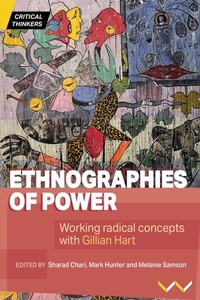
Ethnographies of Power
Description

In our time of rampant inequality, imperial-capitalist plunder, violence and ecocide, when radical concepts from the past seem inadequate, how do researchers and students of ethnographic work decide what concepts to work with or renew?
Gillian Hart is a key thinker in radical political economy, geography, development studies, agrarian studies and Gramscian critique of postcolonial capitalism. In Ethnographies of Power each contributor engages her work and applies it to their own field of study.
A major contribution of this collection is the merging of theory with praxis, resulting in invaluable research tools for postgraduate students. These include applying 'gendered labour' practices among workers in South Africa, reading 'racial capitalism' through agrarian debates, using 'relational comparison' in an ethnography of schooling across Durban, reworking 'multiple socio-spatial trajectories' in Guatemala's Maya Biosphere Reserve, critiquing the notion of South Africa's 'second economy', revisiting 'development' processes and 'Development' discourses in US military contracting, reconsidering Gramsci's 'conjunctures' geographically, finding divergent 'articulations' in Cape Town land occupations, and exploring 'nationalism' as central to revaluing recyclables at a Soweto landfill. Together, the chapters show how important the ongoing reworking of radical concepts is to ethnographic critiques of power.
Ethnographies of Power offers an invaluable toolkit for activists and scholars engaged in sharpening their critical concepts for social and environmental change towards a collective future.
More details
Persons
Sharad Chari (Editor)
Sharad Chari is Associate Professor of Geography at the University of California at Berkeley, and Research Associate at the Wits Institute for Social and Economic Research (WiSER).
Mark Hunter (Editor)
Mark Hunter is Professor of Human Geography at the University of Toronto Scarborough.atal.
Melanie Samson (Editor)
Melanie Samson is Associate Professor of Sociology at the University of Johannesburg.
