

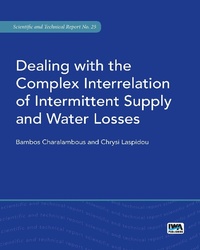
Dealing with the Complex Interrelation of Intermittent Supply and Water Losses
Published on 15. August 2017
162 pages
978-1-78040-707-4 (ISBN)
Description

The book provides a scientific approach into appraising Intermittent Water Supply (IWS) on a global scale through the analysis of available information and data based on a structured methodology for estimating the population affected by IWS worldwide both by country and by geographical regions. The root causes and the implications of IWS are dealt with in a concise manner providing a detailed account of the reasons for resistance to change towards 24x7 supply. A major contribution of the book is in providing an understanding of water losses in the context of IWS as well as the related difficulties in leakage detection and metering under such conditions. A methodology is presented for transitioning from IWS to continuous supply covering technical, social and communication issues which are considered of paramount importance for a successful transition. Relevant case studies from across the globe are included in the book to provide evidence based information and data relating to the many and diverse challenges faced daily by water utilities operating their networks under IWS.
More details
Language
English
Place of publication
London
United Kingdom
Target group
Professional and scholarly
File size
9,67 MB
ISBN-13
978-1-78040-707-4 (9781780407074)
Copyright in bibliographic data and cover images is held by Nielsen Book Services Limited or by the publishers or by their respective licensors: all rights reserved.
Schweitzer Classification
Other editions
Additional editions
Bambos Charalambous | Chrysi Laspidou
Dealing with the Complex Interrelation of Intermittent Supply and Water Losses
Book
08/2017
IWA Publishing
€126.48
Shipment within 3-4 weeks
Content
- Cover
- Copyright
- Contents
- List of Figures
- List of Tables
- List of Abbreviations
- Principal Authors
- Contributing Authors
- Acknowledgements
- Further Acknowledgements
- Preface
- Chapter 1: Introduction
- 1.1 10 Reasons Why IWS Should be Avoided
- 1.2 Definition: The Complexity of Defining and Measuring IWS
- 1.3 Water Use Under IWS and 24 × 7 Regime
- 1.4 References
- Chapter 2: Global dimensions of IWS - number of people affected worldwide
- 2.1 Disparate Information on IWS
- 2.2 Proposed Methodology for Estimating IWS-Affected Population Worldwide
- 2.3 Results
- 2.4 References
- Chapter 3: Root causes and implications of IWS
- 3.1 Root Causes
- 3.1.1 Water scarcity
- 3.1.2 Fast population growth in LAMI countries
- 3.1.3 Rapidly increasing demand due to urbanization
- 3.1.4 Alternatives are perceived as impossible
- 3.1.5 Lack of planning
- 3.1.6 Lack of awareness
- 3.2 Implications of IWS
- 3.2.1 Water contamination and health hazard
- 3.2.2 Water wastage
- 3.2.3 Systems do not operate as designed
- 3.2.4 Inequitable distribution within the network
- 3.2.5 Inconvenience and high coping costs to consumers
- 3.2.6 Seasonal dependence
- 3.2.7 Network deterioration
- 3.2.8 Increased difficulties in detecting and fixing leaks
- 3.2.9 Meter malfunctioning & accelerated wear & tear
- 3.2.10 Inefficient operations - more manpower
- 3.3 References
- Chapter 4: Reasons for resistance to change towards 24 × 7
- 4.1 The Utility Point of View
- 4.2 The Customer Point of View
- 4.3 Other Stakeholders and Vested Interests
- 4.4 References
- Chapter 5: Understanding water losses in the context of IWS
- 5.1 The Challenges in Having IWS
- 5.2 The Vicious Cycle of IWS
- 5.3 Myth Busters
- 5.4 The Challenge
- 5.5 The Need for a Standardised Approach
- 5.6 References
- Chapter 6: Transitioning from IWS to continuous 24 × 7
- 6.1 Approaches to Water Loss Reduction
- 6.2 Assessing Water Losses
- 6.3 Moving Away From "Business as Usual"
- 6.4 Developing a Water Loss Reduction Strategy
- 6.5 Water Supply Matrix
- 6.5.1 High water loss level, intermittent supply
- 6.5.2 Low water loss level, intermittent supply
- 6.5.3 High water loss level, continuous supply
- 6.5.4 Low water loss level, continuous supply
- 6.6 Preparing an "IWS To 24 × 7" Transitioning Plan
- 6.6.1 Introduction
- 6.6.1.1 Step 1: IWS problem analysis
- 6.6.1.2 Step 2: Initial water audit
- 6.6.1.3 Step 3: Water loss performance indicators
- 6.6.1.4 Step 4: Volumetric assessment
- 6.6.1.5 Step 5: Planning the transitioning from IWS to 24 × 7
- 6.7 References
- Chapter 7: Leakage detection under IWS
- 7.1 Case Studies
- 7.1.1 Middle East 1
- 7.1.2 Middle East 2
- 7.1.3 Middle East 3
- 7.1.4 Asia
- 7.1.5 Africa
- 7.1.6 Conclusion
- 7.2 Methodology for Leakage Detection Activities
- 7.2.1 Important issues
- 7.2.2 Further considerations and recommendations
- 7.2.3 Trunk main leak detection
- 7.3 Scenarios for Leakage Detection
- 7.3.1 Scenario A: IWS regime of at least 4 hours and higher
- 7.3.2 Scenario B: IWS regime to temporarily 24 hours in an urban environment
- 7.3.3 Scenario C: IWS regime to temporarily 24 hours in a rural environment
- Chapter 8: Metering under IWS
- 8.1 Domestic Water Meters
- 8.2 Bulk Water Meters (DMA Meters) Types
- 8.3 How Air in the Network Affects the Meters
- 8.4 Observations Under IWS Conditions
- 8.4.1 Domestic (household) meters
- 8.4.1.1 Velocity meters
- 8.4.1.2 Volumetric meters
- 8.4.1.3 Smart meters
- 8.4.2 Bulk meters
- 8.5 Repercussions of Air on Meters
- 8.6 Factors Affecting Accurate Flow Measurements
- Chapter 9: Communication with stakeholders
- 9.1 Why Stakeholder Engagement?
- 9.2 Basic Principles of Engagement
- 9.3 Stakeholders
- 9.3.1 Stakeholder analysis
- 9.3.2 Stakeholders
- 9. 4 References
- Chapter 10: Case studies
- 10.1 Brazil: Intermittent Water Supply - The Real Bill Comes Later
- 10.1.1 Abstract
- 10.1.2 Scenario
- 10.1.3 Emergency water supply plan
- 10.1.4 Water supply characteristics
- 10.1.5 Pressure reduction program implementation
- 10.1.6 Data analysis of reported and unreported leaks
- 10.1.7 Effects of operational rules
- 10.1.8 Conclusions
- 10.2 Cyprus: The Effects of Intermittent Supply on Water Distribution Networks
- 10.2.1 Abstract
- 10.2.2 Introduction
- 10.2.3 Water loss minimisation
- 10.2.4 The water board of lemesos case study
- 10.2.5 Cost of intermittent supply
- 10.2.6 Conclusions
- 10.3 Ghana: The Challenges of Transitioning to 24 × 7
- 10.3.1 Introduction
- 10.3.2 Challenges of intermittent water supply
- 10.3.3 Intermittent water supply and water losses
- 10.3.4 Transitioning from intermittent water supply to 24 × 7
- 10.3.5 Lessons learnt
- 10.3.6 Project characteristics
- 10.4 Italy: Action Plan to Face Water Crisis - Moving from IWS to 24 × 7
- 10.4.1 Introduction
- 10.4.2 The current situation of the water distribution network - initial audit
- 10.4.3 Activities carried out
- 10.4.4 Transitioning from IWS to 24 × 7
- 10.4.5 Lesson learnt
- 10.5 South Africa: The Dangers of Intermittent Supply as a Measure to Save Water
- 10.5.1 Abstract
- 10.5.2 Introduction
- 10.5.3 Intermittent water supply
- 10.5.4 Health issues
- 10.5.5 Reducing consumption through intermittent supply
- 10.5.6 Conclusions
- 10.5.7 Recommendations
- 10.6 Sri Lanka: Intermittent Water Supply and Water Losses
- 10.6.1 Introduction
- 10.6.2 Challenges of intermittent water supply
- 10.6.3 Intermittent water supply and water losses
- 10.6.4 Transitioning from intermittent water supply to 24 × 7
- 10.6.5 Lessons learnt
- 10.6.6 Project characteristics
- 10.7 References
- Index
