

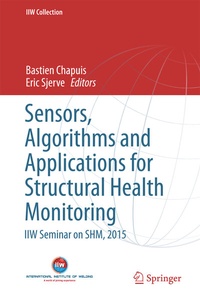
Sensors, Algorithms and Applications for Structural Health Monitoring
Description

This book provides insights into sensor development for structural health monitoring. Current technological advances mean that the field is changing rapidly, making standardization an ongoing challenge.
As such, the book gathers several essential contributions in the area of sensor development, including macro-fiber composite sensors for crack detection and optical fiber Bragg gratings for flaw detection. It also discusses the use of the welds in the structure as sensors, and probability estimation of detection for various sensor configurations. In addition, it presents methods based on vibration signal variations to detect small defects in composite components or to monitor large structures. Last but not least, the book includes special structural health monitoring applications in industrial components such as a nuclear boiler support spines and industrial presses as well as in corrosion monitoring of pipes.
More details
Other editions
Additional editions
Persons
Eric Sjerve holds a B.Sc. in Physics from the University of British Columbia (1990), and a Ph.D. from the University of Toronto in the field of applied laser physics (1996). He has been involved with the commercialization of NDT and related technologies for over 20 years, primarily in the petrochemical sector in Western Canada. This time has primarily been spent working on practically-oriented technique development for field usage in a variety of different NDT methods. More recently, his work has centred on integrating engineering and robotics into the services IRISNDT offers. Eric is also the IIW Commission V Chairman on NDT and Quality Assurance of Welded Products, where his work has been focused on publication of IIW Handbooks on automated ultrasonic testing, austenitic weld inspection and phased arrays, ISO standardization of inspection techniques and more recently NDT applied to additive manufacturing. His position at IRISNDT is Chief Technology Officer where he leads innovation activities within the company.
