

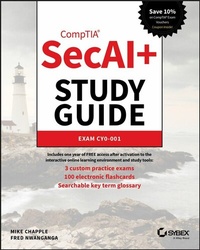
CompTIA SecAI+ Study Guide
Description

Master every exam objective and AI cybersecurity concept for the CompTIA SecAI+ CY0-001 exam, complete with an online test bank, hundreds of practice questions, and digital flashcards
In CompTIA SecAI+ Study Guide: Exam CY0-001, veteran cybersecurity and AI professionals Mike Chapple and Fred Nwanganga deliver easy-to-follow coverage of the security concepts critical to AI use and development. You'll examine basic AI concepts as they relate to cybersecurity, how to secure AI systems, AI-assisted cybersecurity techniques, and AI governance, risk, and compliance issues necessary for working professionals in a variety of technical roles.
This book provides authoritative discussions of the relevant issues you need to understand before you start a new career - or advance in your current one - in cybersecurity, with efficient and accurate content. You'll also find:
- Three custom practice exams that get you ready to succeed on your first try at the CY0-001 and help you overcome test anxiety
- Hundreds of review questions that measure your readiness for the certification exam, help you retain and remember key concepts, and identify knowledge gaps you need to address before you take the SecAI+ exam
- Complimentary access to the online Sybex learning environment, complete with hundreds of additional practice questions (including two full-length practice exams), flashcards, and a glossary of key terms, all supported by Wiley's support agents who are available 24x7 via email or live chat to assist with access and login questions
Perfect for everyone planning to take the CompTIA CY0-001 exam or interested in pursuing a higher-level certification like the SecurityX, CISSP, or CISA, the CompTIA SecAI+ Study Guide is also a must-read for working cybersecurity professionals who want to brush up on AI-specific concepts and for everyone who's ever wondered if IT security is right for them.
More details
Other editions
Additional editions
Persons
ABOUT THE AUTHORS
MIKE CHAPPLE, PhD, Data+ Security+, CISSP, is the author of the bestselling CompTIA Security+ Study Guide, the CompTIA CySA+ Study Guide, and the CISSP ISC2 Certified Information Systems Security Professional Official Study Guide.
FRED NWANGANGA, PhD, is a data scientist and professor in the IT, Analytics, and Operations Department within the University of Notre Dame Mendoza College of Business. He teaches courses in Python, Machine Learning, Generative AI, and Unstructured Data Analytics. He is also the author of the CompTIA DataX (now known as DataAI) study guide and several LinkedIn Learning courses in machine learning and AI.
Content
Acknowledgments viii
About the Authors ix
About the Technical Editor x
Introduction xxi
Assessment Test xxvii
Answers to Assessment Test xxxii
Chapter 1 AI in Cybersecurity 1
Chapter 2 Security and the AI Life Cycle 27
Chapter 3 AI Threats and Attacks 57
Chapter 4 AI Security Controls 87
Chapter 5 AI Monitoring and Auditing 119
Chapter 6 AI-Enhanced Attacks 147
Chapter 7 Enabling Security With AI 167
Chapter 8 AI Governance, Risk, and Compliance 195
Appendix: Answers to the Review Questions 229
Index 255
Introduction
CompTIA SecAI+ Study Guide provides accessible explanations and real-world knowledge about the exam objectives that make up the SecAI+ certification. This book will help you to assess your knowledge before taking the exam, as well as provide a stepping-stone to further learning in areas where you may want to expand your skillset or expertise.
Before you tackle the SecAI+ exam, you should already be a security practitioner. CompTIA suggests that test-takers have three to four years of IT experience and two years of hands-on cybersecurity experience.
CompTIA
CompTIA is a trade association that offers certification in a variety of IT areas, ranging from the skills that a PC support technician needs, which are covered in the A+ exam, to advanced certifications like the CompTIA SecurityX certification. The SecAI+ exam is intended for professionals with hands-on cybersecurity experience.
Many CompTIA certifications are ISO/ANAB accredited, and they are used throughout multiple industries as a measure of technical skill and knowledge.
The SecAI+ Exam
The SecAI+ exam is designed to be a vendor-neutral certification for cybersecurity professionals. It focuses on AI concepts related to cybersecurity, including securing AI systems, automating tasks carried out by security professionals, as well as governance, risk, and compliance (GRC) concepts. It covers four major domains: Basic AI Concepts Related to Cybersecurity, Securing AI Systems, AI-Assisted Security, AI Governance, Risk, and Compliance. These four areas cover AI types, using AI threat-modeling resources, implementing controls for AI systems, automating security tasks with AI, and understanding AI risks.
The SecAI+ certification fits between the entry-level Security+ certification and the SecurityX certification, providing an AI security certification for cybersecurity professionals who are seeking the next step in their career path.
The SecAI+ exam is conducted in a format that CompTIA calls "performance-based assessment." This means that the exam employs hands-on simulations using scenarios to perform tasks that match those found in the daily work of a security practitioner. Exam questions may include several types of questions such as multiple-choice, fill-in-the-blank, multiple-response, drag-and-drop, and image-based problems.
CompTIA recommends that test-takers have three to four years of IT experience and two years of hands-on cybersecurity experience before taking this exam.
Study and Exam Preparation Tips
A test preparation book like this cannot teach you every possible scenario or specific technology that may appear on the exam. Instead, you should focus on whether you are familiar with the type or category of technology, tool, process, or scenario as you read the book. If you identify a gap, you may want to find additional tools to help you learn more about those topics.
Since the exam uses scenario-based learning, expect the questions to involve analysis and thought, rather than relying on simple memorization. As you might expect, it is impossible to replicate that experience in a book, so the questions here are intended to help you be confident that you know the topic well enough to think through hands-on exercises.
Taking the Exam
Once you are fully prepared to take the exam, you can visit the CompTIA website to purchase your exam voucher:
www.comptia.org Currently, CompTIA offers two options for taking the exam: an in-person exam at a testing center and an online proctored exam that you take on your own computer.
This book includes a coupon that you may use to save 10 percent on your CompTIA exam registration.
In-Person Exams
CompTIA partners with Pearson VUE's testing centers, so your next step will be to locate a testing center near you. In the United States, you can do this based on your address or your ZIP code, while non-U.S. test takers may find it easier to enter their city and country. Set up a CompTIA Central account on the CompTIA website and schedule an exam.
On the day of the exam, take two forms of identification, and make sure to show up with plenty of time before the exam starts. Remember that you will not be able to take your notes, electronic devices (including smartphones and watches), or other materials in with you.
Online Exams
CompTIA also offers an online testing option that uses the Pearson VUE OnVUE remote proctoring service. Candidates using this approach will take the exam at their home or office and be proctored over a webcam by a remote proctor.
Exam policies can change from time to time. We highly recommend that you check both the CompTIA and Pearson VUE sites for the most up-to-date information when you begin your preparing, when you register, and again a few days before your scheduled exam date.
After the SecAI+ Exam
Once you have taken the exam, you will be notified of your score immediately, so you'll know if you passed the test right away. You should keep track of your score report with your exam registration records and the email address you used to register for the exam.
Maintaining Your Certification
CompTIA certifications must be renewed on a periodic basis. To renew your certification, you can either pass the most current version of the exam, earn a qualifying higher-level CompTIA or industry certification, or complete sufficient continuing education activities to earn enough continuing education units (CEUs) to renew it.
CompTIA provides information on renewals via their website at
www.comptia.org/en-us/resources/ce When you sign up to renew your certification, you will be asked to agree to the CE program's Code of Ethics, pay a renewal fee, and submit the materials required for your chosen renewal method.
What Does This Book Cover?
This book is designed to cover the four domains included in the SecAI+ exam.
Chapter 1: AI in Cybersecurity The book starts by teaching you about the different types of AI, model training, and prompt engineering.
Chapter 2: Security and the AI Life Cycle This chapter covers data security and the life cycle of AI and its security. Data security topics include data processing, data types, watermarking, and retrieval-augmented generation. Topics around the life cycle of AI include business use case, data collection and preparation, model development, evaluation, deployment, validation, and monitoring and maintenance. Additionally, feedback and iteration as well as human-centric design are covered.
Chapter 3: AI Threats and Attacks The chapter covers threat-modeling as related to AI including attack evidence analysis. Threat modeling covers topics such as OWASP Top 10, MIT AI Risk Repository, MITRE ATLAS, CVE AI Working Group, and threat-modeling frameworks. The chapter covers various attacks and compensating controls.
Chapter 4: AI Security Controls This chapter covers security and access controls, including model controls, gateway controls, guardrail testing, and validation. Also included are encryption requirements and data safety.
Chapter 5: AI Monitoring and Auditing This chapter covers AI system monitoring and auditing, including prompt monitoring, log monitoring, log sanitization, log protection, response confidence level, rate monitoring, cost monitoring, and quality and compliance auditing.
Chapter 6: AI-Enhanced Attacks This chapter covers attack vectors, including AI-generated content, adversarial networks, reconnaissance, social engineering, obfuscation, automated data correlation, and generation.
Chapter 7: Enabling Security With AI This chapter covers AI tools used for security tasks as well as their automation. Included are use cases, change management, AI agents, and CI/CD.
Chapter 8: AI Governance, Risk, and Compliance This chapter covers organizational governance structures, AI risks, and compliance.
Appendix: Answers to Review Questions The appendix has answers to the review questions you will find at the end of each chapter.
Study Guide Elements
This study guide uses a number of common elements to help you prepare. These include the following:
Summaries The Summary section of each chapter briefly explains the chapter, allowing you to easily understand what it covers.
Exam Essentials The Exam Essentials focus on major exam topics and critical knowledge that you should take into the test. The Exam Essentials focus on the exam objectives provided by CompTIA.
Review Questions A set of questions at the end of each chapter will help you assess your knowledge and if you are ready to take the exam based on your knowledge of that chapter's topics.
Interactive Online Learning Environment and TestBank
This book comes with a number of additional study tools to help you prepare for the exam. They include the following.
Go to www.wiley.com/go/Sybextestprep to register and gain access to this interactive online learning environment and test bank with study tools.
Studying the material in the CompTIA SecAI+ Study Guide is an important part of preparing for the SecAI+ certification exam but we provide additional tools to help you prepare. The online TestBank will help you understand the...
