

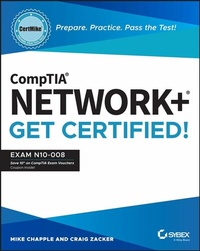
CompTIA Network+ CertMike
Prepare. Practice. Pass the Test! Get Certified!: Exam N10-008
1st Edition
Published on 31. March 2023
368 pages
978-1-119-89817-7 (ISBN)
Description

A laser-focused and job-ready blueprint for success on the CompTIA Network+ exam and a running start on your first (or next) job in tech
CompTIA Network+ CertMike: Prepare. Practice. Pass the Test! Get Certified! Exam N10-008 delivers a no-nonsense, straight-to-business guide to acing the CompTIA Network+ test on your first attempt. Veteran tech experts and educators Mike Chapple and Craig Zacker walk you through every step you'll need to take on the N10-008 exam, from networking fundamentals, implementations, and operations to network security and troubleshooting. Ace the test using the proven CertMike approach:
* Prepare -- CertMike is your personal study coach, guiding you through all the exam objectives and helping you gain an understanding of how they apply to on-the-job tasks!
* Practice -- Each chapter includes two multiple choice practice questions. Work through the detailed explanations to evaluate each answer option and understand the reason for the best answer!
* Pass -- On exam day, use the critical knowledge you've learned when you're ready to take the test. You'll feel ready and confident to pass the exam and earn your certification!
The book skips the fluff and gets right to the point of getting you familiar with network basics and on the road to an in-demand certification and a new career as a network technician or admin. You'll also get complimentary access to additional Sybex online study tools, including a bonus practice exam and audio recordings of the book's CertMike Exam Essentials.
A can't-miss roadmap to success on the Network+ exam, CompTIA Network+ CertMike: Prepare. Practice. Pass the Test! Get Certified! Exam N10-008 is the job-focused and practical guide you've been looking for to help you hone your networking skills.
CompTIA Network+ CertMike: Prepare. Practice. Pass the Test! Get Certified! Exam N10-008 delivers a no-nonsense, straight-to-business guide to acing the CompTIA Network+ test on your first attempt. Veteran tech experts and educators Mike Chapple and Craig Zacker walk you through every step you'll need to take on the N10-008 exam, from networking fundamentals, implementations, and operations to network security and troubleshooting. Ace the test using the proven CertMike approach:
* Prepare -- CertMike is your personal study coach, guiding you through all the exam objectives and helping you gain an understanding of how they apply to on-the-job tasks!
* Practice -- Each chapter includes two multiple choice practice questions. Work through the detailed explanations to evaluate each answer option and understand the reason for the best answer!
* Pass -- On exam day, use the critical knowledge you've learned when you're ready to take the test. You'll feel ready and confident to pass the exam and earn your certification!
The book skips the fluff and gets right to the point of getting you familiar with network basics and on the road to an in-demand certification and a new career as a network technician or admin. You'll also get complimentary access to additional Sybex online study tools, including a bonus practice exam and audio recordings of the book's CertMike Exam Essentials.
A can't-miss roadmap to success on the Network+ exam, CompTIA Network+ CertMike: Prepare. Practice. Pass the Test! Get Certified! Exam N10-008 is the job-focused and practical guide you've been looking for to help you hone your networking skills.
More details
Other editions
Additional editions
Chapple
CompTIA Network+ CertMike: Prepare. Practice. Pass the Test! Get Certified! Exam N10-008
Exam N10-008
Book
06/2023
1st Edition
Sybex Inc.,U.S.
€37.50
Shipment within 15-20 days
Content
- Cover
- Title Page
- Copyright Page
- Contents at a Glance
- Contents
- Introduction
- The Network+ Certification
- What Does This Book Cover?
- Exam N10-008 Exam Objectives
- N10-008 Certification Exam Objective Map
- How to Contact the Publisher
- Part I Domain 1.0: Networking Fundamentals
- Chapter 1 OSI Model
- OSI Model
- Data Encapsulation
- Chapter 2 Network Topologies
- Network Topologies
- Network Types and Characteristics
- Network Roles
- Service-Related Entry Points
- Virtual Network Concepts
- Provider Links
- Chapter 3 Cables and Connectors
- Cable Types
- Connector Types
- Cable Management
- Ethernet Standards
- Chapter 4 IP Addressing
- IP Addresses
- IPv4 vs. IPv6
- Chapter 5 Ports and Protocols
- IP Protocol Types
- Application Layer Protocols
- Chapter 6 Network Services
- DHCP
- DNS
- NTP
- Chapter 7 Network Architecture
- Three-Tiered Architecture
- Software-Defined Networking
- Spine and Leaf Architecture
- Traffic Flows
- Data Center Locations
- Storage Area Networking
- Chapter 8 Cloud Computing
- Deployment Models
- Service Models
- Part II Domain 2.0: Network Implementations
- Chapter 9 Network Devices
- Networking Devices
- Networked Devices
- Chapter 10 Routing and Bandwidth Management
- Routing
- Bandwidth Management
- Chapter 11 Switching
- Ethernet Basics
- Switching
- Chapter 12 Wireless Standards
- Wireless Networking
- Cellular Technologies
- Part III Domain 3.0: Network Operations
- Chapter 13 Network Availability
- Performance Metrics
- SNMP
- Network Device Logs
- Interface Errors or Alerts
- Environmental Sensors
- Baselines
- Uptime/Downtime
- Chapter 14 Organizational Documents and Policies
- Plans and Procedures
- Hardening and Security Policies
- Common Documentation
- Common Agreements
- Chapter 15 High Availability and Disaster Recovery
- Load Balancing
- Multipathing
- NIC Teaming
- Redundant Hardware/Clusters
- Facilities and Infrastructure Support
- Redundancy and High Availability Concepts
- Network Device Backup/Restore
- Part IV Domain 4.0: Network Security
- Chapter 16 Security Concepts
- Confidentiality, Integrity, and Availability
- Threats
- Vulnerabilities
- Exploits
- Least Privilege
- Role-Based Access
- Zero Trust
- Defense in Depth
- Authentication Methods
- Risk Management
- SIEM
- Chapter 17 Network Attacks
- Technology-Based Attacks
- Human and Environmental Attacks
- Chapter 18 Network Hardening
- Best Practices
- Wireless Security
- IoT Access Considerations
- Chapter 19 Remote Access
- Virtual Private Networks
- Remote Desktop Gateway
- Virtual Network Computing (VNC)
- Virtual Desktop
- Authentication and Authorization Considerations
- In-band vs. Out-of-band Management
- Chapter 20 Physical Security
- Detection Methods
- Prevention Methods
- Asset Disposal
- Part V Domain 5.0: Network Troubleshooting
- Chapter 21 Network Troubleshooting Methodology
- Identify the Problem
- Establish a Theory of Probable Cause
- Test the Theory to Determine the Cause
- Establish a Plan of Action to Resolve the Problem and Identify Potential Effects
- Implement the Solution or Escalate as Necessary
- Verify Full System Functionality and, if Applicable, Implement Preventive Measures
- Document Findings, Actions, Outcomes, and Lessons Learned
- Chapter 22 Troubleshooting Cable Connectivity
- Specifications and Limitations
- Cable Considerations
- Cable Application
- Common Issues
- Common Tools
- Chapter 23 Network Software Tools and Commands
- Software Tools
- Command-Line Tools
- Basic Network Platform Commands
- Chapter 24 Troubleshooting Wireless Connectivity
- Specifications and Limitations
- Considerations
- Common Issues
- Chapter 25 Troubleshooting Network Issues
- Considerations
- Common Issues
- Index
- EULA
