

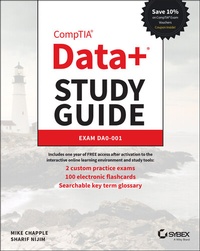
CompTIA Data+ Study Guide
Description

CompTIA Data+ Study Guide: Exam DA0-001 delivers easily accessible and actionable instruction for achieving data analysis competencies required for the job and on the CompTIA Data+ certification exam. You'll learn to collect, analyze, and report on various types of commonly used data, transforming raw data into usable information for stakeholders and decision makers.
With comprehensive coverage of data concepts and environments, data mining, data analysis, visualization, and data governance, quality, and controls, this Study Guide offers:
* All the information necessary to succeed on the exam for a widely accepted, entry-level credential that unlocks lucrative new data analytics and data science career opportunities
* 100% coverage of objectives for the NEW CompTIA Data+ exam
* Access to the Sybex online learning resources, with review questions, full-length practice exam, hundreds of electronic flashcards, and a glossary of key terms
Ideal for anyone seeking a new career in data analysis, to improve their current data science skills, or hoping to achieve the coveted CompTIA Data+ certification credential, CompTIA Data+ Study Guide: Exam DA0-001 provides an invaluable head start to beginning or accelerating a career as an in-demand data analyst.
More details
Other editions
New editions
Additional editions
Persons
Mike Chapple, PhD, is Teaching Professor of IT, Analytics, and Operations at the University of Notre Dame. He's a technology professional and educator with over 20 years of experience. Mike provides certification resources at his website, CertMike.com.
Sharif Nijim is Assistant Teaching Professor of IT, Analytics, and Operations in the Mendoza College of Business at the University of Notre Dame. He teaches undergraduate and graduate courses on cloud computing, business analytics, and information technology.
Content
- Cover
- Title Page
- Copyright Page
- Contents at a Glance
- Contents
- Introduction
- The Data+ Exam
- Taking the Exam
- After the Data+ Exam
- What Does This Book Cover?
- Study Guide Elements
- Interactive Online Learning Environment and Test Bank
- Exam DA0-001 Exam Objectives
- DA0-001 Certification Exam Objective Map
- Assessment Test
- Answers to Assessment Test
- Chapter 1 Today's Data Analyst
- Welcome to the World of Analytics
- Data
- Storage
- Computing Power
- Careers in Analytics
- The Analytics Process
- Data Acquisition
- Cleaning and Manipulation
- Analysis
- Visualization
- Reporting and Communication
- Analytics Techniques
- Descriptive Analytics
- Predictive Analytics
- Prescriptive Analytics
- Machine Learning, Artificial Intelligence, and Deep Learning
- Data Governance
- Analytics Tools
- Summary
- Chapter 2 Understanding Data
- Exploring Data Types
- Structured Data Types
- Unstructured Data Types
- Categories of Data
- Common Data Structures
- Structured Data
- Unstructured Data
- Semi-structured Data
- Common File Formats
- Text Files
- JavaScript Object Notation
- Extensible Markup Language (XML)
- HyperText Markup Language (HTML)
- Summary
- Exam Essentials
- Review Questions
- Chapter 3 Databases and Data Acquisition
- Exploring Databases
- The Relational Model
- Relational Databases
- Nonrelational Databases
- Database Use Cases
- Online Transactional Processing
- Online Analytical Processing
- Schema Concepts
- Data Acquisition Concepts
- Integration
- Data Collection Methods
- Working with Data
- Data Manipulation
- Query Optimization
- Summary
- Exam Essentials
- Review Questions
- Chapter 4 Data Quality
- Data Quality Challenges
- Duplicate Data
- Redundant Data
- Missing Values
- Invalid Data
- Nonparametric data
- Data Outliers
- Specification Mismatch
- Data Type Validation
- Data Manipulation Techniques
- Recoding Data
- Derived Variables
- Data Merge
- Data Blending
- Concatenation
- Data Append
- Imputation
- Reduction
- Aggregation
- Transposition
- Normalization
- Parsing/String Manipulation
- Managing Data Quality
- Circumstances to Check for Quality
- Automated Validation
- Data Quality Dimensions
- Data Quality Rules and Metrics
- Methods to Validate Quality
- Summary
- Exam Essentials
- Review Questions
- Chapter 5 Data Analysis and Statistics
- Fundamentals of Statistics
- Common Symbols in Statistics
- Descriptive Statistics
- Measures of Frequency
- Measures of Central Tendency
- Measures of Dispersion
- Measures of Position
- Inferential Statistics
- Confidence Intervals
- Hypothesis Testing
- Simple Linear Regression
- Analysis Techniques
- Determine Type of Analysis
- Types of Analysis
- Exploratory Data Analysis
- Summary
- Exam Essentials
- Review Questions
- Chapter 6 Data Analytics Tools
- Spreadsheets
- Microsoft Excel
- Programming Languages
- R
- Python
- Structured Query Language (SQL)
- Statistics Packages
- IBM SPSS
- SAS
- Stata
- Minitab
- Machine Learning
- IBM SPSS Modeler
- RapidMiner
- Analytics Suites
- IBM Cognos
- Power BI
- MicroStrategy
- Domo
- Datorama
- AWS QuickSight
- Tableau
- Qlik
- BusinessObjects
- Summary
- Exam Essentials
- Review Questions
- Chapter 7 Data Visualization with Reports and Dashboards
- Understanding Business Requirements
- Understanding Report Design Elements
- Report Cover Page
- Executive Summary
- Design Elements
- Documentation Elements
- Understanding Dashboard Development Methods
- Consumer Types
- Data Source Considerations
- Data Type Considerations
- Development Process
- Delivery Considerations
- Operational Considerations
- Exploring Visualization Types
- Charts
- Maps
- Waterfall
- Infographic
- Word Cloud
- Comparing Report Types
- Static and Dynamic
- Ad Hoc
- Self-Service (On-Demand)
- Recurring Reports
- Tactical and Research
- Summary
- Exam Essentials
- Review Questions
- Chapter 8 Data Governance
- Data Governance Concepts
- Data Governance Roles
- Access Requirements
- Security Requirements
- Storage Environment Requirements
- Use Requirements
- Entity Relationship Requirements
- Data Classification Requirements
- Jurisdiction Requirements
- Breach Reporting Requirements
- Understanding Master Data Management
- Processes
- Circumstances
- Summary
- Exam Essentials
- Review Questions
- Appendix Answers to the Review Questions
- Chapter 2: Understanding Data
- Chapter 3: Databases and Data Acquisition
- Chapter 4: Data Quality
- Chapter 5: Data Analysis and Statistics
- Chapter 6: Data Analytics Tools
- Chapter 7: Data Visualization with Reports and Dashboards
- Chapter 8: Data Governance
- Index
- EULA
Introduction
If you're preparing to take the Data+ exam, you'll undoubtedly want to find as much information as you can about data and analytics. The more information you have at your disposal and the more hands-on experience you gain, the better off you'll be when attempting the exam. This study guide was written with that in mind. The goal was to provide enough information to prepare you for the test, but not so much that you'll be overloaded with information that's outside the scope of the exam.
We've included review questions at the end of each chapter to give you a taste of what it's like to take the exam. If you're already working in the data field, we recommend that you check out these questions first to gauge your level of expertise. You can then use the book mainly to fill in the gaps in your current knowledge. This study guide will help you round out your knowledge base before tackling the exam.
If you can answer 90 percent or more of the review questions correctly for a given chapter, you can feel safe moving on to the next chapter. If you're unable to answer that many correctly, reread the chapter and try the questions again. Your score should improve.
Don't just study the questions and answers! The questions on the actual exam will be different from the practice questions included in this book. The exam is designed to test your knowledge of a concept or objective, so use this book to learn the objectives behind the questions.
The Data+ Exam
The Data+ exam is designed to be a vendor-neutral certification for data professionals and those seeking to enter the field. CompTIA recommends this certification for those currently working, or aspiring to work, in data analyst and business intelligence reporting roles.
The exam covers five major domains:
- Data Concepts and Environments
- Data Mining
- Data Analysis
- Visualization
- Data Governance, Quality, and Controls
These five areas include a range of topics, from data types to statistical analysis and from data visualization to tools and techniques, while focusing heavily on scenario-based learning. That's why CompTIA recommends that those attempting the exam have 18-24 months of hands-on work experience, although many individuals pass the exam before moving into their first data analysis role.
The Data+ exam is conducted in a format that CompTIA calls "performance-based assessment." This means that the exam combines standard multiple-choice questions with other, interactive question formats. Your exam may include several types of questions such as multiple-choice, fill-in-the-blank, multiple-response, drag-and-drop, and image-based problems. More details about the Data+ exam and how to take it can be found here:
http://www.comptia.org/certifications/data
You'll have 90 minutes to take the exam and will be asked to answer 90 questions during that time period. Your exam will be scored on a scale ranging from 100 to 900, with a passing score of 675.
You should also know that CompTIA is notorious for including vague questions on all of its exams. You might see a question for which two of the possible four answers are correct-but you can choose only one. Use your knowledge, logic, and intuition to choose the best answer and then move on. Sometimes, the questions are worded in ways that would make English majors cringe-a typo here, an incorrect verb there. Don't let this frustrate you; answer the question and move on to the next one.
CompTIA frequently does what is called item seeding, which is the practice of including unscored questions on exams. It does so to gather psychometric data, which is then used when developing new versions of the exam. Before you take the exam, you will be told that your exam may include these unscored questions. So, if you come across a question that does not appear to map to any of the exam objectives-or for that matter, does not appear to belong in the exam-it is likely a seeded question. You never really know whether or not a question is seeded, however, so always make your best effort to answer every question.
Taking the Exam
Once you are fully prepared to take the exam, you can visit the CompTIA website to purchase your exam voucher:
https://store.comptia.org/Certification-Vouchers/c/11293
Currently, CompTIA offers two options for taking the exam: an in-person exam at a testing center and an at-home exam that you take on your own computer.
This book includes a coupon that you may use to save 10 percent on your CompTIA exam registration.
In-Person Exams
CompTIA partners with Pearson VUE's testing centers, so your next step will be to locate a testing center near you. In the United States, you can do this based on your address or your ZIP code, while non-U.S. test takers may find it easier to enter their city and country. You can search for a test center near you at the Pearson Vue website, where you will need to navigate to "Find a test center."
http://www.pearsonvue.com/comptia
Now that you know where you'd like to take the exam, simply set up a Pearson VUE testing account and schedule an exam on their site.
On the day of the test, take two forms of identification, and make sure to show up with plenty of time before the exam starts. Remember that you will not be able to take your notes, electronic devices (including smartphones and watches), or other materials in with you.
At-Home Exams
CompTIA began offering online exam proctoring in response to the coronavirus pandemic. As of the time this book went to press, the at-home testing option was still available and appears likely to continue. Candidates using this approach will take the exam at their home or office and be proctored over a webcam by a remote proctor.
Due to the rapidly changing nature of the at-home testing experience, candidates wishing to pursue this option should check the CompTIA website for the latest details.
After the Data+ Exam
Once you have taken the exam, you will be notified of your score immediately, so you'll know if you passed the test right away. You should keep track of your score report with your exam registration records and the email address you used to register for the exam.
What Does This Book Cover?
This book covers everything you need to know to pass the Data+ exam.
- Chapter 1: Today's Data Analyst
- Chapter 2: Understanding Data
- Chapter 3: Databases and Data Acquisition
- Chapter 4: Data Quality
- Chapter 5: Data Analysis and Statistics
- Chapter 6: Data Analytics Tools
- Chapter 7: Data Visualization with Reports and Dashboards
- Chapter 8: Data Governance
- Practice Exam 1
- Practice Exam 2
- Appendix: Answers to the Review Questions
Study Guide Elements
This study guide uses a number of common elements to help you prepare. These include the following:
- Summaries The summary section of each chapter briefly explains the chapter, allowing you to easily understand what it covers.
- Exam Essentials The exam essentials focus on major exam topics and critical knowledge that you should take into the test. The exam essentials focus on the exam objectives provided by CompTIA.
- Chapter Review Questions A set of questions at the end of each chapter will help you assess your knowledge and whether you are ready to take the exam based on your knowledge of that chapter's topics.
Interactive Online Learning Environment and Test Bank
This book comes with a number of additional study tools to help you prepare for the exam. They include the following.
Go to https://www.wiley.com/go/sybextestprep to register and gain access to this interactive online learning environment and test bank with study tools.
Sybex Test Preparation Software
Sybex's test preparation software lets you prepare with electronic test versions of the review questions from each chapter, the practice exam, and the bonus exam that are included in this book. You can build and take tests on specific domains, by chapter, or cover the entire set of Data+ exam objectives using randomized tests.
Electronic Flashcards
Our electronic flashcards are designed to help you prepare for the exam. Over 100 flashcards will ensure that you know critical terms and concepts.
Glossary of Terms
Sybex provides a full glossary of terms in PDF format, allowing quick searches and easy reference to materials in this book.
Bonus Practice Exams
In addition to the practice questions for each chapter, this book includes two full 90-question practice exams. We recommend that you use them both to test your preparedness for the certification exam.
Like all exams, the Data+ certification from CompTIA is updated periodically and may eventually be retired or replaced. At some point after CompTIA is no longer offering this exam, the old editions of our books and online tools will be retired. If you have purchased this book after the exam was retired or are attempting to register in the Sybex online...
