

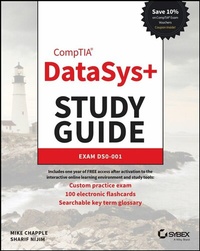
CompTIA DataSys+ Study Guide
Description

In CompTIA DataSys+ Study Guide: Exam DS0-001, a team of accomplished IT experts delivers a practical and hands-on roadmap to succeeding on the challenging DS0-001 exam and in a new or existing career as a data systems professional. In the book, you'll explore the essentials of databases, their deployment, management, maintenance, security, and more.
Whether you're preparing for your first attempt at the CompTIA DataSys+ exam or for your first day on the job at a new database-related IT position, this book walks you through the foundational and intermediate skills you need to have to succeed. It covers every objective tested by the DS0-001 and skills commonly required in the real-world.
You'll also find:
* Practice test questions that measure your readiness for the real exam and your ability to handle the challenges of a new data systems position
* Examples and scenarios drawn from real life, as well as challenging chapter review questions
* Complimentary access to Sybex's interactive online learning environment and test bank, accessible from multiple devices, and including electronic flashcards and a searchable glossary, all supported by Wiley's support agents who are available 24x7 via email or live chat to assist with access and login questions
Perfect for anyone getting ready to write the DS0-001 certification exam, CompTIA DataSys+ Study Guide: Exam DS0-001 is also an essential resource for everyone seeking the foundational knowledge and skills required to move into a database administrator role.
More details
Other editions
Additional editions
Persons
Mike Chapple, PhD, Security+, CySA+, CISSP, is Teaching Professor of Information Technology, Analytics, and Operations at Notre Dame's Mendoza College of Business. He is a bestselling author of over 30 books and serves as the Academic Director of the University's Master of Science in Business Analytics program. He holds multiple additional certifications, including the CISSP (Certified Information Systems Security Professional), CompTIA Data+, CIPP/US (Certified Information Privacy Professional), CompTIA PenTest+, and CompTIA Security+. Mike provides IT certification resources at his website, CertMike.com.
Sharif Nijim is an Associate Teaching Professor of IT, Analytics, and Operations at Notre Dame's Mendoza College of Business, where he also serves as the Academic co-Director of the residential Master of Science in Business Analytics program. Prior to Notre Dame, Sharif co-founded and served on the board of a customer data integration company serving the airline industry.
Content
Introduction
If you're preparing to take the CompTIA DataSys+ exam, you'll undoubtedly want to find as much information as you can about data and analytics. The more information you have at your disposal and the more hands-on experience you gain, the better off you'll be when attempting the exam. This study guide was written with that in mind. The goal was to provide enough information to prepare you for the test, but not so much that you'll be overloaded with information that's outside the scope of the exam.
We've included review questions at the end of each chapter to give you a taste of what it's like to take the exam. If you're already working in the data field, we recommend that you check out these questions first to gauge your level of expertise. You can then use the book mainly to fill in the gaps in your current knowledge. This study guide will help you round out your knowledge base before tackling the exam.
If you can answer 90 percent or more of the review questions correctly for a given chapter, you can feel safe moving on to the next chapter. If you're unable to answer that many correctly, reread the chapter and try the questions again. Your score should improve.
Don't just study the questions and answers! The questions on the actual exam will be different from the practice questions included in this book. The exam is designed to test your knowledge of a concept or objective, so use this book to learn the objectives behind the questions.
The DataSys+ Exam
The DataSys+ exam is designed to be a vendor-neutral certification for data systems professionals and those seeking to enter the field. CompTIA recommends this certification for those currently working, or aspiring to work, in data systems and database administration roles.
The exam covers five major domains.
- Database Fundamentals
- Database Deployment
- Database Management and Maintenance
- Data and Database Security
- Business Continuity
These five areas include a range of topics, from Structured Query Language (SQL) to scripting and from data security to business continuity, while focusing heavily on scenario-based learning. That's why CompTIA recommends that those attempting the exam have 2-3 years of hands-on work experience, although many individuals pass the exam before moving into their first database administration role.
The DataSys+ exam is conducted in a format that CompTIA calls "performance-based assessment." This means the exam combines standard multiple-choice questions with other, interactive question formats. Your exam may include several types of questions such as multiple-choice, fill-in-the-blank, multiple-response, drag-and-drop, and image-based problems.
The exam costs $358 in the United States, with roughly equivalent prices in other locations around the globe. More details about the DataSys+ exam and how to take it can be found here:
www.comptia.org/certifications/datasys
You'll have 90 minutes to take the exam and will be asked to answer up to 90 questions during that time period. Your exam will be scored on a scale ranging from 100 to 900, with a passing score of 700.
You should also know that CompTIA is notorious for including vague questions on all of its exams. You might see a question for which two of the possible four answers are correct-but you can choose only one. Use your knowledge, logic, and intuition to choose the best answer and then move on. Sometimes, the questions are worded in ways that would make English majors cringe-a typo here, an incorrect verb there. Don't let this frustrate you; answer the question and move on to the next one.
CompTIA frequently does what is called item seeding, which is the practice of including unscored questions on exams. It does so to gather psychometric data, which is then used when developing new versions of the exam. Before you take the exam, you will be told that your exam may include these unscored questions. So, if you come across a question that does not appear to map to any of the exam objectives-or for that matter, does not appear to belong in the exam-it is likely a seeded question. You never really know whether a question is seeded, however, so always make your best effort to answer every question.
Taking the Exam
Once you are fully prepared to take the exam, you can visit the CompTIA website to purchase your exam voucher.
https://store.comptia.org/Certification-Vouchers/c/11293
Currently, CompTIA offers two options for taking the exam: an in-person exam at a testing center and an at-home exam that you take on your own computer.
This book includes a coupon that you may use to save 10 percent on your CompTIA exam registration.
In-Person Exams
CompTIA partners with Pearson VUE's testing centers, so your next step will be to locate a testing center near you. In the United States, you can do this based on your address or your ZIP code, while non-U.S. test takers may find it easier to enter their city and country. You can search for a test center near you at the Pearson Vue website, where you will need to navigate to "Find a test center."
Now that you know where you'd like to take the exam, simply set up a Pearson VUE testing account and schedule an exam on their site.
On the day of the test, take two forms of identification, and make sure to show up with plenty of time before the exam starts. Remember that you will not be able to take your notes, electronic devices (including smartphones and watches), or other materials in with you.
Be sure to review the Candidate Identification policy at www.comptia.org/testing/testing-policies-procedures/test-policies/candidate-id-policy to learn what types of ID are acceptable.
At-Home Exams
CompTIA began offering online exam proctoring in response to the coronavirus pandemic. As of the time this book went to press, the at-home testing option was still available and appears likely to continue. Candidates using this approach will take the exam at their home or office and be proctored over a webcam by a remote proctor.
Because of the rapidly changing nature of the at-home testing experience, candidates who want to pursue this option should check the CompTIA website for the latest details.
After the Data Systems Exam
Once you have taken the exam, you will be notified of your score immediately, so you'll know if you passed the test right away. You should keep track of your score report with your exam registration records and the email address you used to register for the exam.
What Does This Book Cover?
This book covers everything you need to know to pass the Data Systems exam.
- Chapter 1: Today's Data Systems Professional
- Chapter 2: Database Fundamentals
- Chapter 3: SQL and Scripting
- Chapter 4: Database Deployment
- Chapter 5: Database Management and Maintenance
- Chapter 6: Governance, Security, and Compliance
- Chapter 7: Database Security
- Chapter 8: Business Continuity
- Appendix: Answers to Review Questions
Study Guide Elements
This study guide uses a number of common elements to help you prepare. These include the following:
- Summaries The summary section of each chapter briefly explains the chapter, allowing you to easily understand what it covers.
- Exam Essentials The exam essentials focus on major exam topics and critical knowledge that you should take into the test. The exam essentials focus on the exam objectives provided by CompTIA.
- Chapter Review Questions A set of questions at the end of each chapter will help you assess your knowledge and if you are ready to take the exam based on your knowledge of that chapter's topics.
Interactive Online Learning Environment and Test Bank
The authors have worked hard to create some really great tools to help you with your certification process. The interactive online learning environment that accompanies the CompTIA DataSys+ Study Guide: Exam DS0-001 includes a test bank with study tools to help you prepare for the certification exam-and increase your chances of passing it the first time! The test bank includes the following:
- Sample tests All the questions in this book are included online, including the assessment test at the end of this Introduction and the review questions at the end of each chapter. In addition, there is a custom practice exam with 90 questions. Use these questions to assess how you're likely to perform on the real exam. The online test bank runs on multiple devices.
- Flashcards The online text bank includes more than 100 flashcards specifically written to hit you hard, so don't get discouraged if you don't ace your way through them at first. They're there to ensure that you're really ready for the exam. And no worries-armed with the review questions, practice exams, and flashcards, you'll be more than prepared when exam day comes. Questions are provided in digital flashcard format (a question followed by a single correct answer). You can use...
