

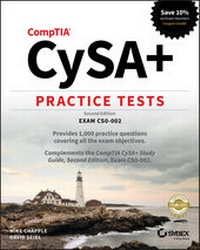
CompTIA CySA+ Practice Tests
Description

CompTIA CySA+ Practice Tests: Exam CS0-002, 2nd Edition offers readers the fastest and best way to prepare for the CompTIA Cybersecurity Analyst exam. With five unique chapter tests and two additional practice exams for a total of 1000 practice questions, this book covers topics including:
* Threat and Vulnerability Management
* Software and Systems Security
* Security Operations and Monitoring
* Incident Response
* Compliance and Assessment
The new edition of CompTIA CySA+ Practice Tests is designed to equip the reader to tackle the qualification test for one of the most sought-after and in-demand certifications in the information technology field today.
The authors are seasoned cybersecurity professionals and leaders who guide readers through the broad spectrum of security concepts and technologies they will be required to master before they can achieve success on the CompTIA CySA exam. The book also tests and develops the critical thinking skills and judgment the reader will need to demonstrate on the exam.
More details
Other editions
Additional editions
Persons
DAVID SEIDL, CySA+, CISSP, PenTest+, is Vice President for Information Technology and CIO at Miami University. David co-led Notre Dame's move to the cloud, and has written multiple cybersecurity certification books.
Content
Chapter 1 Domain 1.0: Threat and Vulnerability Management 1
Chapter 2 Domain 2.0: Software and Systems Security 105
Chapter 3 Domain 3.0: Security Operations and Monitoring 151
Chapter 4 Domain 4.0: Incident Response 207
Chapter 5 Domain 5.0: Compliance and Assessment 265
Chapter 6 Practice Exam 1 289
Chapter 7 Practice Exam 2 315
Appendix Answers to Review Questions 347
Answers to Chapter 1: Domain 1.0: Threat and Vulnerability Management 348
Answers to Chapter 2: Domain 2.0: Software and Systems Security 381
Answers to Chapter 3: Domain 3.0: Security Operations and Monitoring 403
Answers to Chapter 4: Domain 4.0: Incident Response 425
Answers to Chapter 5: Domain 5.0: Compliance and Assessment 450
Answers to Chapter 6: Practice Exam 1 461
Answers to Chapter 7: Practice Exam 2 470
Index 481
Introduction
CompTIA CySA+ (Cybersecurity Analyst) Practice Tests, Second Edition is a companion volume to the CompTIA CySA+ Study Guide, Second Edition (Sybex, 2020, Chapple/Seidl). If you're looking to test your knowledge before you take the CySA+ exam, this book will help you by providing a combination of 1,000 questions that cover the CySA+ domains and easy-to-understand explanations of both right and wrong answers.
If you're just starting to prepare for the CySA+ exam, we highly recommend that you use the Cybersecurity Analyst+ (CySA+) Study Guide, Second Edition to help you learn about each of the domains covered by the CySA+ exam. Once you're ready to test your knowledge, use this book to help find places where you may need to study more or to practice for the exam itself.
Since this is a companion to the CySA+ Study Guide, this book is designed to be similar to taking the CySA+ exam. It contains multipart scenarios as well as standard multiple-choice questions similar to those you may encounter in the certification exam itself. The book itself is broken up into seven chapters: five domain-centric chapters with questions about each domain, and two chapters that contain 85-question practice tests to simulate taking the CySA+ exam itself.
CompTIA
CompTIA is a nonprofit trade organization that offers certification in a variety of IT areas, ranging from the skills that a PC support technician needs, which are covered in the A+ exam, to advanced certifications like the CompTIA Advanced Security Practitioner, or CASP certification. CompTIA recommends that practitioners follow a cybersecurity career path as shown here:
The Cybersecurity Analyst+ exam is a more advanced exam, intended for professionals with hands-on experience and who possess the knowledge covered by the prior exams.
CompTIA certifications are ISO and ANSI accredited, and they are used throughout multiple industries as a measure of technical skill and knowledge. In addition, CompTIA certifications, including the CySA+, the Security+ and the CASP certifications, have been approved by the U.S. government as Information Assurance baseline certifications and are included in the State Department's Skills Incentive Program.
The Cybersecurity Analyst+ Exam
The Cybersecurity Analyst+ exam, which CompTIA refers to as CySA+, is designed to be a vendor-neutral certification for cybersecurity, threat, and vulnerability analysts. The CySA+ certification is designed for security analysts and engineers as well as security operations center (SOC) staff, vulnerability analysts, and threat intelligence analysts. It focuses on security analytics and practical use of security tools in real-world scenarios. It covers five major domains: Threat and Vulnerability Management, Software and Systems Security, Security Operations and Monitoring, Incident Response, and Compliance and Assessment. These five areas include a range of topics, from reconnaissance to incident response and forensics, while focusing heavily on scenario-based learning.
The CySA+ exam fits between the entry-level Security+ exam and the CompTIA Advanced Security Practitioner (CASP) certification, providing a mid-career certification for those who are seeking the next step in their certification and career path.
The CySA+ exam is conducted in a format that CompTIA calls "performance-based assessment." This means that the exam uses hands-on simulations using actual security tools and scenarios to perform tasks that match those found in the daily work of a security practitioner. Exam questions may include multiple types of questions such as multiple-choice, fill-in-the-blank, multiple-response, drag-and-drop, and image-based problems.
CompTIA recommends that test takers have four years of information security-related experience before taking this exam. The exam costs $359 in the United States, with roughly equivalent prices in other locations around the globe. More details about the CySA+ exam and how to take it can be found at certification.comptia.org/certifications/cybersecurity-analyst.
Study and Exam Preparation Tips
We recommend you use this book in conjunction with the Cybersecurity Analyst+ (CySA+) Study Guide, Second Edition. Read through chapters in the study guide and then try your hand at the practice questions associated with each domain in this book.
You should also keep in mind that the CySA+ certification is designed to test practical experience, so you should also make sure that you get some hands-on time with the security tools covered on the exam. CompTIA recommends the use of NetWars-style simulations, penetration testing and defensive cybersecurity simulations, and incident response training to prepare for the CySA+.
Additional resources for hands-on exercises include the following:
- Exploit-Exercises.com provides virtual machines, documentation, and challenges covering a wide range of security issues at
exploit-exercises.lains.space. - Hacking-Lab provides capture-the-flag (CTF) exercises in a variety of fields at
www.hacking-lab.com/index.html. - PentesterLab provides a subscription-based access to penetration testing exercises at
www.pentesterlab.com/exercises/. - The InfoSec Institute provides online capture-the-flag activities with bounties for written explanations of successful hacks at
ctf.infosecinstitute.com.
Since the exam uses scenario-based learning, expect the questions to involve analysis and thought, rather than relying on simple memorization. As you might expect, it is impossible to replicate that experience in a book, so the questions here are intended to help you be confident that you know the topic well enough to think through hands-on exercises.
Taking the Exam
Once you are fully prepared to take the exam, you can visit the CompTIA website to purchase your exam voucher:
www.comptiastore.com/Articles.asp?ID=265&category=vouchers
CompTIA partners with Pearson VUE's testing centers, so your next step will be to locate a testing center near you. In the United States, you can do this based on your address or your ZIP code, while non-U.S. test takers may find it easier to enter their city and country. You can search for a test center near you at the Pearson Vue website, where you will need to navigate to "Find a test center":
Now that you know where you'd like to take the exam, simply set up a Pearson VUE testing account and schedule an exam:
www.comptia.org/testing/testing-options/take-in-person-exam
On the day of the test, bring two forms of identification, and make sure to show up with plenty of time before the exam starts. Remember that you will not be able to take your notes, electronic devices (including smartphones and watches), or other materials in with you.
After the Cybersecurity Analyst+ Exam
Once you have taken the exam, you will be notified of your score immediately, so you'll know if you passed the test right away. You should keep track of your score report with your exam registration records and the email address you used to register for the exam.
Maintaining Your Certification
CompTIA certifications must be renewed on a periodic basis. To renew your certification, you can either pass the most current version of the exam, earn a qualifying higher-level CompTIA or industry certification, or complete sufficient continuing education activities to earn enough continuing education units (CEUs) to renew it.
CompTIA provides information on renewals via their website at
www.comptia.org/continuing-education
When you sign up to renew your certification, you will be asked to agree to the CE program's Code of Ethics, to pay a renewal fee, and to submit the materials required for your chosen renewal method.
A full list of the industry certifications you can use to acquire CEUs toward renewing the CySA+ can be found at
Using This Book to Practice
This book is composed of seven chapters. Each of the first five chapters covers a domain, with a variety of questions that can help you test your knowledge of real-world, scenario, and best practices-based security knowledge. The final two chapters are complete practice exams that can serve as timed practice tests to help determine whether you're ready for the CySA+ exam.
We recommend taking the first practice exam to help identify where you may need to spend more study time and then using the domain-specific chapters to test your domain knowledge where it is weak. Once you're ready, take the second practice exam to make sure you've covered all the material and are ready to attempt the CySA+ exam.
As you work through questions in this book, you will encounter tools and technology that you may not be familiar with. If you find that you are facing a consistent gap or that a domain is particularly challenging, we recommend spending some time with books and materials that tackle that domain in depth. This can help you fill in gaps and help you be more prepared for the exam.
