

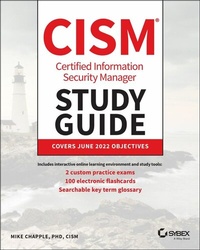
CISM Certified Information Security Manager Study Guide
Description

As cybersecurity becomes an increasingly mission-critical issue, more and more employers and professionals are turning to ISACA's trusted and recognized Certified Information Security Manager qualification as a tried-and-true indicator of information security management expertise.
In Wiley's Certified Information Security Manager (CISM) Study Guide, you'll get the information you need to succeed on the demanding CISM exam. You'll also develop the IT security skills and confidence you need to prove yourself where it really counts: on the job.
Chapters are organized intuitively and by exam objective so you can easily keep track of what you've covered and what you still need to study. You'll also get access to a pre-assessment, so you can find out where you stand before you take your studies further.
Sharpen your skills with Exam Essentials and chapter review questions with detailed explanations in all four of the CISM exam domains: Information Security Governance, Information Security Risk Management, Information Security Program, and Incident Management.
In this essential resource, you'll also:
* Grab a head start to an in-demand certification used across the information security industry
* Expand your career opportunities to include rewarding and challenging new roles only accessible to those with a CISM credential
* Access the Sybex online learning center, with chapter review questions, full-length practice exams, hundreds of electronic flashcards, and a glossary of key terms
Perfect for anyone prepping for the challenging CISM exam or looking for a new role in the information security field, the Certified Information Security Manager (CISM) Study Guide is an indispensable resource that will put you on the fast track to success on the test and in your next job.
More details
Other editions
Additional editions
Person
MIKE CHAPPLE, PhD, CISM, is Teaching Professor of Information Technology, Analytics, and Operations at Notre Dame's Mendoza College of Business. He is a bestselling author of over 25 books and serves as the Academic Director of the University's Master of Science in Business Analytics program. He holds multiple additional certifications, including the CISSP (Certified Information Systems Security Professional), CySA+ (CompTIA Cybersecurity Analyst), CIPP/US (Certified Information Privacy Professional), CompTIA PenTest+, and CompTIA Security+. Mike provides cybersecurity certification resources at his website, CertMike.com
Content
- Cover
- Title Page
- Copyright Page
- Acknowledgments
- About the Author
- About the Technical Editor
- Contents at a Glance
- Contents
- Introduction
- The CISM Exam
- Taking the Exam
- After the CISM Exam
- Study Guide Elements
- Additional Study Tools
- CISM Exam Objectives
- CISM Certification Exam Objective Map
- Topic Mapping
- Supporting Task Mapping
- Assessment Test
- Answers to Assessment Test
- Chapter 1 Today's Information Security Manager
- Information Security Objectives
- Role of the Information Security Manager
- Chief Information Security Officer
- Lines of Authority
- Organizing the Security Team
- Roles and Responsibilities
- Information Security Risks
- The DAD Triad
- Incident Impact
- Building an Information Security Strategy
- Threat Research
- SWOT Analysis
- Gap Analysis
- Creating SMART Goals
- Alignment with Business Strategy
- Leadership Support
- Internal and External Influences
- Cybersecurity Responsibilities
- Communication
- Action Plans
- Implementing Security Controls
- Security Control Categories
- Security Control Types
- Data Protection
- Summary
- Exam Essentials
- Review Questions
- Chapter 2 Information Security Governance and Compliance
- Governance
- Corporate Governance
- Governance, Risk, and Compliance Programs
- Information Security Governance
- Developing Business Cases
- Third-Party Relationships
- Understanding Policy Documents
- Policies
- Standards
- Procedures
- Guidelines
- Exceptions and Compensating Controls
- Developing Policies
- Complying with Laws and Regulations
- Adopting Standard Frameworks
- COBIT
- NIST Cybersecurity Framework
- NIST Risk Management Framework
- ISO Standards
- Benchmarks and Secure Configuration Guides
- Security Control Verification and Quality Control
- Summary
- Exam Essentials
- Review Questions
- Chapter 3 Information Risk Management
- Analyzing Risk
- Risk Identification
- Risk Calculation
- Risk Assessment
- Risk Treatment and Response
- Risk Mitigation
- Risk Avoidance
- Risk Transference
- Risk Acceptance
- Risk Analysis
- Disaster Recovery Planning
- Disaster Types
- Business Impact Analysis
- Privacy
- Sensitive Information Inventory
- Information Classification
- Data Roles and Responsibilities
- Information Lifecycle
- Privacy-Enhancing Technologies
- Privacy and Data Breach Notification
- Summary
- Exam Essentials
- Review Questions
- Chapter 4 Cybersecurity Threats
- Exploring Cybersecurity Threats
- Classifying Cybersecurity Threats
- Threat Actors
- Threat Vectors
- Threat Data and Intelligence
- Open Source Intelligence
- Proprietary and Closed Source Intelligence
- Assessing Threat Intelligence
- Threat Indicator Management and Exchange
- Public and Private Information Sharing Centers
- Conducting Your Own Research
- Summary
- Exam Essentials
- Review Questions
- Chapter 5 Information Security Program Development and Management
- Information Security Programs
- Establishing a New Program
- Maintaining an Existing Program
- Security Awareness and Training
- User Training
- Role-Based Training
- Ongoing Awareness Efforts
- Managing the Information Security Team
- Hiring Team Members
- Developing the Security Team
- Managing the Security Budget
- Organizational Budgeting
- Fiscal Years
- Expense Types
- Budget Monitoring
- Integrating Security with Other Business Functions
- Procurement
- Accounting
- Human Resources
- Information Technology
- Audit
- Summary
- Exam Essentials
- Review Questions
- Chapter 6 Security Assessment and Testing
- Vulnerability Management
- Identifying Scan Targets
- Determining Scan Frequency
- Configuring Vulnerability Scans
- Scanner Maintenance
- Vulnerability Scanning Tools
- Reviewing and Interpreting Scan Reports
- Validating Scan Results
- Security Vulnerabilities
- Patch Management
- Legacy Platforms
- Weak Configurations
- Error Messages
- Insecure Protocols
- Weak Encryption
- Penetration Testing
- Adopting the Hacker Mindset
- Reasons for Penetration Testing
- Benefits of Penetration Testing
- Penetration Test Types
- Rules of Engagement
- Reconnaissance
- Running the Test
- Cleaning Up
- Training and Exercises
- Summary
- Exam Essentials
- Review Questions
- Chapter 7 Cybersecurity Technology
- Endpoint Security
- Malware Prevention
- Endpoint Detection and Response
- Data Loss Prevention
- Change and Configuration Management
- Patch Management
- System Hardening
- Network Security
- Network Segmentation
- Network Device Security
- Network Security Tools
- Cloud Computing Security
- Benefits of the Cloud
- Cloud Roles
- Cloud Service Models
- Cloud Deployment Models
- Shared Responsibility Model
- Cloud Standards and Guidelines
- Cloud Security Issues
- Cloud Security Controls
- Cryptography
- Goals of Cryptography
- Symmetric Key Algorithms
- Asymmetric Cryptography
- Hash Functions
- Digital Signatures
- Digital Certificates
- Certificate Generation and Destruction
- Code Security
- Software Development Life Cycle
- Software Development Phases
- Software Development Models
- DevSecOps and DevOps
- Code Review
- Software Security Testing
- Identity and Access Management
- Identification, Authentication, and Authorization
- Authentication Techniques
- Authentication Errors
- Single-Sign On and Federation
- Provisioning and Deprovisioning
- Account Monitoring
- Summary
- Exam Essentials
- Review Questions
- Chapter 8 Incident Response
- Security Incidents
- Phases of Incident Response
- Preparation
- Detection and Analysis
- Containment, Eradication, and Recovery
- Post-Incident Activity
- Building the Incident Response Plan
- Policy
- Procedures and Playbooks
- Documenting the Incident Response Plan
- Creating an Incident Response Team
- Incident Response Providers
- CSIRT Scope of Control
- Coordination and Information Sharing
- Internal Communications
- External Communications
- Classifying Incidents
- Threat Classification
- Severity Classification
- Conducting Investigations
- Investigation Types
- Evidence
- Plan Training, Testing, and Evaluation
- Summary
- Exam Essentials
- Review Questions
- Chapter 9 Business Continuity and Disaster Recovery
- Planning for Business Continuity
- Project Scope and Planning
- Organizational Review
- BCP Team Selection
- Resource Requirements
- Legal and Regulatory Requirements
- Business Impact Analysis
- Identifying Priorities
- Risk Identification
- Likelihood Assessment
- Impact Analysis
- Resource Prioritization
- Continuity Planning
- Strategy Development
- Provisions and Processes
- Plan Approval and Implementation
- Plan Approval
- Plan Implementation
- Training and Education
- BCP Documentation
- The Nature of Disaster
- Natural Disasters
- Human-Made Disasters
- System Resilience, High Availability, and Fault Tolerance
- Protecting Hard Drives
- Protecting Servers
- Protecting Power Sources
- Recovery Strategy
- Business Unit and Functional Priorities
- Crisis Management
- Emergency Communications
- Workgroup Recovery
- Alternate Processing Sites
- Database Recovery
- Recovery Plan Development
- Emergency Response
- Personnel and Communications
- Assessment
- Backups and Offsite Storage
- Utilities
- Logistics and Supplies
- Training, Awareness, and Documentation
- Testing and Maintenance
- Read-Through Test
- Structured Walk-Through
- Simulation Test
- Parallel Test
- Full-Interruption Test
- Lessons Learned
- Maintenance
- Summary
- Exam Essentials
- Review Questions
- Appendix Answers to the Review Questions
- Chapter 1: Today's Information Security Manager
- Chapter 2: Information Security Governance and Compliance
- Chapter 3: Information Risk Management
- Chapter 4: Cybersecurity Threats
- Chapter 5: Information Security Program Development and Management
- Chapter 6: Security Assessment and Testing
- Chapter 7: Cybersecurity Technology
- Chapter 8: Incident Response
- Chapter 9: Business Continuity and Disaster Recovery
- Index
- EULA
Introduction
If you're preparing to take the Certified Information Security Manager (CISM) exam, you'll undoubtedly want to find as much information as you can about information security and the art of leading and managing security teams. The more information you have at your disposal, the better off you'll be when taking the exam. This study guide was written with that in mind. The goal was to provide enough information to prepare you for the test, but not so much that you'll be overloaded with information that's outside the scope of the exam.
This book presents the material at an intermediate technical level. Experience with and knowledge of security concepts, operating systems, and application systems will help you get a full understanding of the challenges you'll face as a security manager.
I've included review questions at the end of each chapter to give you a taste of what it's like to take the exam. I recommend that you check out these questions first to gauge your level of expertise. You can then use the book mainly to fill in the gaps in your current knowledge. This study guide will help you round out your knowledge base before tackling the exam.
If you can answer 90 percent or more of the review questions correctly for a given chapter, you can feel safe moving on to the next chapter. If you're unable to answer that many correctly, reread the chapter and try the questions again. Your score should improve.
Don't just study the questions and answers! The questions on the actual exam will be different from the practice questions included in this book. The exam is designed to test your knowledge of a concept or objective, so use this book to learn the objectives behind the questions.
The CISM Exam
The CISM exam is designed to be a vendor-neutral certification for cybersecurity managers. ISACA recommends this certification for those who already have technical experience in the information security field and are either already serving in management roles or who want to shift from being an individual contributor into a management role.
The exam covers four major domains:
- Information Security Governance
- Information Security Risk Management
- Information Security Program
- Incident Management
These four areas include a range of topics, from enterprise risk management to responding to cybersecurity incidents. They focus heavily on scenario-based learning and the role of the information security manager in various scenarios. There's a lot of information that you'll need to learn, but you'll be well rewarded for possessing this credential. ISACA reports that the average salary of CISM credential holders is over $118,000.
The CISM exam includes only standard multiple-choice questions. Each question has four possible answer choices and only one of those answer choices is the correct answer. When you're taking the test, you'll likely find some questions where you think multiple answers might be correct. In those cases, remember that you're looking for the best possible answer to the question!
The exam costs $575 for ISACA members and $760 for nonmembers. More details about the CISM exam and how to take it can be found at:
www.isaca.org/credentialing/cism
You'll have four hours to take the exam and will be asked to answer 150 questions during that time period. Your exam will be scored on a scale ranging from 200 to 800, with a passing score of 450.
ISACA frequently does what is called item seeding, which is the practice of including unscored questions on exams. It does so to gather psychometric data, which is then used when developing new versions of the exam. Before you take the exam, you will be told that your exam may include these unscored questions. So, if you come across a question that does not appear to map to any of the exam objectives-or for that matter, does not appear to belong in the exam-it is likely a seeded question. You never really know whether or not a question is seeded, however, so always make your best effort to answer every question.
Taking the Exam
Once you are fully prepared to take the exam, you can visit the ISACA website to register. Currently, ISACA offers two options for taking the exam: an in-person exam at a testing center and an at-home exam that you take on your own computer through a remote proctoring service.
In-Person Exams
ISACA partners with PSI Exams testing centers, so your next step will be to locate a testing center near you. In the United States, you can do this based on your address or your ZIP code, while non-U.S. test takers may find it easier to enter their city and country. You can search for a test center near you at the PSI Exams website:
https://isacaavailability.psiexams.com
Now that you know where you'd like to take the exam, simply set up a PSI testing account and schedule an exam on their site.
On the day of the test, bring a government-issued identification card or passport that contains your full name (exactly matching the name on your exam registration), your signature, and your photograph. Make sure to show up with plenty of time before the exam starts. Remember that you will not be able to take your notes, electronic devices (including smartphones and watches), or other materials in with you.
At-Home Exams
ISACA began offering online exam proctoring in 2020 in response to the coronavirus pandemic. When this book went to press, the at-home testing option was still available and appears likely to continue. Candidates using this approach will take the exam at their home or office and be proctored over a webcam by a remote proctor.
Due to the rapidly changing nature of the at-home testing experience, candidates wishing to pursue this option should check the ISACA website for the latest details. In fact, checking the ISACA website for exam policy changes is a good idea for all test takers.
After the CISM Exam
Once you have taken the exam, you will be notified of your score immediately, so you'll know if you passed the test right away. You should keep track of your score report with your exam registration records and the email address you used to register for the exam.
Meeting the Experience Requirement
The CISM program is designed to demonstrate that an individual is a qualified information security manager. That requires more than just passing a test-it also requires real hands-on work experience managing cybersecurity teams.
The CISM work experience requirement has two different components:
- You must have five years of information security work experience.
- You must have at least three years of information security management work experience. That work experience must come from at least three of the four CISM domains.
If you're a current information security manager, you may find it easy to meet these requirements. If you've been in the field for five years and have been a manager for at least three of those years, you're probably good to go because your time as an information security manager also counts toward your general information security experience requirement.
There are some waivers available that can knock one or two years off your experience requirement. All of these waivers apply only to the general information security work experience requirement, not the management requirement.
If you hold any of the following credentials, you qualify for a two-year reduction in the experience requirement:
- Certified Information Systems Security Professional (CISSP)
- Certified Information Systems Auditor (CISA)
- Master of Business Administration (MBA) degree
- Master's degree in information security or a related field
One year experience requirement waivers are available for holders of:
- Skill-based or general security certifications (such as the CompTIA Security+ credential)
- Bachelor's degree in information security or a related field
- One full year of general information systems management experience
- One full year of general security management experience
You must have earned all of the experience used toward your requirement within the 10 years preceding your application or within 5 years of the date you pass the exam.
Maintaining Your Certification
Information security is a constantly evolving field with new threats and controls arising regularly. All CISM holders must complete continuing professional education on an annual basis to keep their knowledge current and their skills sharp. The guidelines around continuing professional education are somewhat complicated, but they boil down to two main requirements:
- You must complete 120 hours of credit every three years to remain certified.
- You must have a minimum of 20 hours of credit every year during that cycle.
You must meet both of these requirements. For example, if you earn 120 credit hours during the first year of your certification cycle, you still must earn 20 additional credits in each of the next two years.
Continuing education requirements follow calendar years, and your clock will begin ticking on January 1 of the year after you earn your certification. You are allowed to begin earning credits immediately after you're certified. They'll just...
