

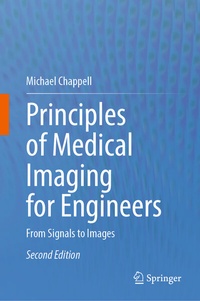
Principles of Medical Imaging for Engineers
Description

This textbook is a concise introduction to medical imaging aimed at physical scientists and engineers, including budding biomedical engineers and biophysicists. The book introduces fundamental concepts related to how we "see" inside the body using medical imaging technology and what is needed to obtain useful images.
The text first considers the underlying physical principles by which information about tissues within the body can be extracted in the form of signals, examining the major principles used: transmission, reflection, emission, and resonance. It then explains how these signals can be converted into images, i.e., full 3D volumes, demonstrating how common methods of "reconstruction" are shared by some imaging techniques, despite relying on different physics to generate the "signals." Finally, it explores how medical imaging can be used to generate more than just pictures, but genuine quantitative measurements, and increasingly, measurements of physiological processes at every point within the 3D volume using methods such as tracers and advanced dynamic acquisitions.
Now in its second, fully updated and expanded edition, the textbook contains new sections on image analysis concepts, covers a wide range of techniques used to enhance and interpret medical imaging, and includes concise introductions to optimization and machine learning in their application to medical imaging . The second edition also includes expanded discussions on quantitative, functional, physiological, and metabolic imaging.
'Principles of Medical Imaging for Engineers' second edition will be invaluable to students and graduate students in engineering and physical sciences with an interest in biomedical engineering, as well as to their professors.
More details
Other editions
Additional editions
Person
Michael Chappell is Professor of Biomedical Imaging in the Sir Peter Mansfield Imaging Centre and School of Medicine, University of Nottingham. He is also Chief Scientific Officer for Quantified Imaging and Honorary Research Fellow at the Wellcome Centre for Integrative Neuroimaging, University of Oxford. Previously he was Associate Professor of Engineering Science at the Institute of Biomedical Engineering, University of Oxford. Michael has a background in the mathematical modelling of physiology, Bayesian inference methods, machine learning techniques, and the development of image analysis algorithms. Much of his recent research has focused on the quantitative spatial mapping of physiological quantities, such as perfusion, from medical imaging devices for use in clinical research and practice. Michael read Engineering Science in Oxford, specialising in information engineering topics and completing a project on the detection of landmines. He completed a doctorate on SCUBA diving, primarily using mathematical models to explore the development of bubbles from dissolved gases under decompression in the body - the resulting sickness commonly referred to as 'the bends'. Finally, he found his way into magnetic resonance imaging, working at the interface between physical and medical sciences. Michael is co-author of Physiology for Engineers, the author of the Principles of Medical Imaging for Engineers and is a series editor for the Oxford Neuroimaging Primers.
Content
Part I: From Signals.- 1. Introduction.- 2. Transmission - X-rays.- 3. Reflection - Ultrasound.- 4. Emission - SPECT/PET.- 5. Resonance - Nuclear Magnetic Resonance.- Part II: To Images.- 6. Imaging.- 7. Timing-based Reconstruction - Ultrasound.- 8. Back-projection Reconstruction - X-ray and PET/SPECT.- 9. Fourier Reconstruction - MRI.- 10. Principles of Reconstruction.- Part III: And Beyond.- 11. Generating and Enhancing Contrast.- 12. Beyond Contrast: Quantitative, Physiological and Functional Imaging.-13. Image Analysis Concepts.- 14. Image Processing.- 15. Modelling.- Part IV: Reference.- 16: Optimization and Inference.- 17: Machine Learning.- Supplementary Material.- Exercise Solutions.
