

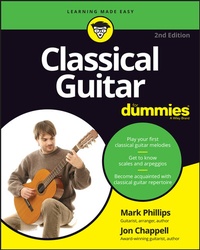
Classical Guitar For Dummies
2nd Edition
Published on 2. February 2022
352 pages
978-1-119-87316-7 (ISBN)
Description

Discover the magic of classical guitar with this fun and easy guide
The perfect starting point to learning classical guitar, Classical Guitar For Dummies, walks you through the steps, techniques, and styles you'll need to finger-pick your way around some of the most beautiful songs ever written.
Whether you're a first timer looking to add your very first classical guitar to your collection or you've already made the jump to the classical style want to pick up some priceless tips, this book is the easy-to-read companion you'll want at your side. You can even play along with audio and video examples at dummies.com that will help you on your journey toward classical guitar mastery.
In Classical Guitar For Dummies, you'll find:
* Foundational and advanced techniques, from adapting your playing posture to coloring your tone with vibrato
* Tips and tricks on playing classical guitar favorites, like Cavatina by Stanley Myers
* Explorations of classical scales, up and down the guitar neck
Classical Guitar For Dummies is an essential aid for new and aspiring classical guitarists just beginning to learn their craft. More experienced guitarists seeking to improve their fundamentals and learn some new strategies for creating amazing music will also find a ton of useful info inside.
The perfect starting point to learning classical guitar, Classical Guitar For Dummies, walks you through the steps, techniques, and styles you'll need to finger-pick your way around some of the most beautiful songs ever written.
Whether you're a first timer looking to add your very first classical guitar to your collection or you've already made the jump to the classical style want to pick up some priceless tips, this book is the easy-to-read companion you'll want at your side. You can even play along with audio and video examples at dummies.com that will help you on your journey toward classical guitar mastery.
In Classical Guitar For Dummies, you'll find:
* Foundational and advanced techniques, from adapting your playing posture to coloring your tone with vibrato
* Tips and tricks on playing classical guitar favorites, like Cavatina by Stanley Myers
* Explorations of classical scales, up and down the guitar neck
Classical Guitar For Dummies is an essential aid for new and aspiring classical guitarists just beginning to learn their craft. More experienced guitarists seeking to improve their fundamentals and learn some new strategies for creating amazing music will also find a ton of useful info inside.
More details
Other editions
Additional editions
Jon Chappell | Mark Phillips
Classical Guitar For Dummies
Book
05/2022
Wiley
€22.50
Shipment within 15-20 days
Persons
Mark Phillips is an author and former director of music at Cherry Lane Music. He has served as music editor of Guitar and Guitar One magazines.
Jon Chappell is a guitarist, author, and former editor-in-chief of Guitar and Home Recording magazines. His work has appeared in Guitar Shop, Keyboard, Electronic Musician, and Guitar Player.
Jon Chappell is a guitarist, author, and former editor-in-chief of Guitar and Home Recording magazines. His work has appeared in Guitar Shop, Keyboard, Electronic Musician, and Guitar Player.
Content
- Intro
- Title Page
- Copyright Page
- Table of Contents
- Introduction
- About This Book
- Foolish Assumptions
- Icons Used in This Book
- Beyond This Book
- Where to Go from Here
- Part 1 Getting to Know the Classical Guitar
- Chapter 1 An Acoustic Guitar in a League of Its Own
- Defining What a Classical Guitar Is (and Isn't)
- Knowing What a Classical Guitar Looks Like
- Recognizing How a Classical Guitar Physically Differs from Its Peers
- Beyond Physique: Identifying Other Unique Attributes of Classical Guitar
- Player's form and technique
- Musical knowledge and skills
- Chapter 2 Getting Ready to Play
- Situating Yourself
- Taking your seat
- Supporting the guitar: Leg position
- Embracing the guitar: Arm support
- Placing your hands correctly
- Approaching the Strings with Your Hands
- Fretting the strings: Left-hand form
- Preparing to pluck: Right-hand form
- Stroking the strings: Basic right-hand technique
- Tuning Up
- Adjusting the string tension to raise or lower pitch
- Tuning visually with an electronic tuner
- Tuning by ear
- Chapter 3 Deciphering Music Notation and Tablature
- Knowing the Ropes of Standard Music Notation
- The composer's canvas: The staff, clef, measures, and bar lines
- Pitch: The highs and lows of music
- Duration: How long to hold a note, what determines rhythm, and so on
- Expression, articulation, and other symbols
- Relating the Notes on the Staff to the Fretboard
- Relishing the Usefulness of Guitar-Specific Notation
- Fingering indications for the right and left hands
- Stepping up to the barre
- Taking on tablature, a nice complement to standard notation
- Part 2 Starting to Play: The Basics
- Chapter 4 One Note at a Time: Playing Simple Melodies
- Practicing Notes on One String
- Exercising your fingers: Strings 1, 2, and 3
- Workin' (mostly) the thumb: Strings 6, 5, and 4
- Playing across Three Strings
- Finger fun on the first three strings
- All thumbs again on the three lower strings
- Cruising through All Six Strings
- No thumbs allowed!
- Fingers and thumb, unite!
- Flowing through Melodic Pieces Using All Six Strings
- Chapter 5 Rolling the Notes of a Chord: Arpeggio Technique
- Playing the Notes of an Arpeggio: The Basics
- Working Your Way across the Strings: The Thumb and Fingers in Order
- Keeping it simple: One digit per string
- Moving the thumb around
- Varying Your Right-Hand Strokes
- Changing the finger order
- Alternating the thumb and fingers
- Adding Harmony to Select Notes
- Feeling the pinch with your thumb and fingers
- Doubling up two fingers at once
- Playing Pieces with Arpeggios
- Chapter 6 Practicing Scales in First and Second Position
- Introducing Scales, the Necessary Evils
- Why scales are important
- How you name them: Applying key signatures
- Where they start and end: A primer on positions
- Playing Major Scales in 1st Position
- The one-octave C major scale
- The two-octave G major scale
- The two-octave F major scale
- The two-octave E major scale
- The two-octave A major scale
- Playing Minor Scales in 1st Position
- The one-octave A minor scale
- The two-octave E minor scale
- The two-octave F minor scale
- Playing Scales in 2nd Position
- The D major scale in 2nd position using open strings
- The D major scale in 2nd position using all fretted notes
- The G major scale in 2nd position using all fretted notes
- The B minor scale in 2nd position using all fretted notes
- Applying Scales in Simple Pieces
- Chapter 7 Exploring Musical Textures
- Coordinating Contrapuntal Music: Layered Melodies
- Playing two melodies in sync rhythmically
- Opposing forces: Separating the thumb and fingers rhythmically
- Thickening the upper part by adding double-stops
- Melody and Accompaniment: Using All Your Fingers
- Matching rhythm between accompaniment and melody
- Getting creative with the flow: Two parts, two rhythms
- Playing Easy Pieces in Different Textural Styles
- Part 3 Improving Your Technique
- Chapter 8 Flat-Fingered Fretting with Barres
- Discovering How to Play Barres
- Half barre
- Full barre
- Practicing Barres in Musical Context
- Half barre
- Full barre
- Playing Pieces with Barres
- Chapter 9 Getting a Smooth Sound with Slurs and Trills
- Connecting Your Notes with Slurs
- Hammering and pulling: Exploring slurs
- Slurring in the context of a larger musical phrase
- Fluttering a Note with a Trill
- Playing trills on their own
- Practicing trills in context
- Playing Pieces Using Slurs and Trills
- Chapter 10 Coloring Your Sound with Tone-Production Techniques
- Creating Tones That Ring like Bells: Harmonics
- Playing harmonics
- Practicing harmonics in context
- Varying the Tone with Vibrato
- Playing vibrato
- Practicing vibrato in context
- Brightening or Darkening Your Sound by Changing Timbre
- Implementing tonal changes
- Practicing changing tone in context
- Tremolo: The Classical Guitar Machine Gun of Sorts
- Playing tremolo
- Practicing tremolo in context
- Playing Pieces Using Tone-Production Techniques
- Chapter 11 Scaling the Musical Ladder beyond Second Position
- Introducing Scales and Skills in This Chapter
- Getting to know the higher positions
- Strengthening your technical skill with practice variations
- Playing Scales That Stay in 5th Position
- The F major scale
- The B major scale
- The D minor scale
- Playing Scales That Stay in 9th Position
- The A major scale
- The D major scale
- The F minor scale
- Playing Scales That Require Shifting Positions
- The E major scale - one position shift
- The A major scale - two position shifts
- The C minor scale - one position shift
- The G minor scale - two position shifts
- Playing Some Pieces Using Scales Up the Neck
- Chapter 12 Combining Arpeggios and Melody
- Grasping the Combination in Context
- Downtown: Melody in the Bass
- Playing a melody within arpeggios in the bass
- Practicing making a bass melody stand out
- Moving Uptown: Melody in the Treble
- Playing a treble melody within arpeggios
- Practicing making a treble melody stand out
- Mixing Up Your Melodic Moves: The Thumb and Fingers Take Turns
- Playing a shifting treble-and-bass melody within arpeggios
- Practicing making a shifting melody stand out
- Playing Pieces That Combine Arpeggios and Melodies
- Chapter 13 Combining Left-Hand Techniques While Playing up the Neck
- Layering Melodies and Using Barres up the Neck: Counterpoint
- Combining Melody and Accompaniment with Barres and Slurs up the Neck
- Playing Pieces up the Neck with Left-Hand Techniques
- Part 4 Mastering Classical Guitar Repertoire
- Chapter 14 Playing Pieces by the Guitar Greats
- Getting Acquainted with the Master Guitar Composers
- Concentrating on Music by the Spanish Composers
- Saying hello to Sor
- Tackling Tárrega
- Focusing on Music by the Italian Composers
- Gelling with Giuliani
- Cozying Up to Carcassi
- Playing Pieces by All the Master Guitar Composers
- Chapter 15 Early Guitar Music from the Renaissance and Baroque Eras
- Getting an Overview of the Styles
- The Renaissance
- The Baroque era
- Identifying Some Renaissance Composers
- Traditional 16th-century melodies by anonymous composers
- John Dowland and other great lutenists
- Recognizing Some Baroque Composers
- Back to Bach
- Getting a handle on Handel
- Playing Pieces from the Renaissance and Baroque Eras
- Chapter 16 The Guitar Comes of Age: The Classical, Romantic, and Modern Eras
- The Classical Era: Mozart's Muse
- Getting in Touch with Beethoven, the Classical Hopeless Romantic
- Letting the Inside Out with the Romantics: Brahms
- Dreaming with Debussy: Music Becomes Modern
- Playing Pieces from the Classical, Romantic, and Modern Eras
- Part 5 The Part of Tens
- Chapter 17 Ten (Or So) Classical Guitarists You Should Know
- Andrés Segovia (1893-1987)
- Julian Bream (b. 1933-2020)
- Oscar Ghiglia (b. 1938)
- John Williams (b. 1941)
- Pepe Romero and Angel Romero (b. 1944, 1946)
- Christopher Parkening (b. 1947)
- David Starobin (b. 1951)
- Manuel Barrueco (b. 1952)
- Eliot Fisk (b. 1954)
- Benjamin Verdery (b. 1955)
- Sharon Isbin (b. 1956)
- Chapter 18 Ten Things to Do When Shopping for a Classical Guitar
- Go Retail if You Aren't 100 Percent Sure What You Want
- Bring a Friend Along
- Decide on a Price Range Before You Go
- Know Your Materials
- Evaluate the Construction and Workmanship
- Get a Feel for the Guitar
- Check the Intonation
- Listen to the Sound
- Judge the Aesthetics
- Determine a Guitar's Growth Potential
- Part 6 Appendixes
- Appendix A Basic Guitar Care and Maintenance
- Keeping Your Guitar Comfortable
- Temperature
- Humidity
- Protection, both at home and on the road
- Cleaning Your Guitar
- Changing the Strings on Your Classical Guitar
- Step one: Remove the old string
- Step two: Tie off the string at the bridge
- Step three: Secure the string to the roller
- Making Minor Repairs
- Appendix B About the Online Tracks and Videos
- Relating the Text to the Online Files
- Listening to the Tracks
- Watching the Videos
- Index
- EULA
