

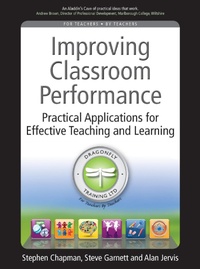
Improving Classroom Performance
Spoon Feed No More, Practical Applications For Effective Teaching and Learning
Published on 28. April 2011
200 pages
978-1-84590-739-6 (ISBN)
Description

A Long awaited first book from one of the biggest teacher training companies in the UK. Dragonfly Training was founded in 1999 and has established an excellent reputation internationally for providing inspiring, realistic and practical training courses for teachers. In this, their first book, three of their top trainers provide some of the very best hands-on approaches to teaching. Dragonfly's six key principles are: Promote effective starters and plenaries; Provide constant reinforcement as a means of embedding knowledge and provide on-going revision; Introduce a variety of ideas; Do first, teach after - whenever possible; Encourage students to create teaching materials themselves; Demonstrate and articulate success by modelling the desired outcomes.
More details
Language
English
Place of publication
Carmarthen
United Kingdom
Target group
College/higher education
Professional and scholarly
File size
13,12 MB
ISBN-13
978-1-84590-739-6 (9781845907396)
Copyright in bibliographic data and cover images is held by Nielsen Book Services Limited or by the publishers or by their respective licensors: all rights reserved.
Schweitzer Classification
Other editions
Additional editions
Stephen Chapman | Steve Garnett | Alan Jervis
Improving Classroom Performance
Spoon Feed No More, Practical Applications For Effective Teaching and Learning
Book
04/2011
Crown House Publishing
€33.60
Shipment within 3-4 weeks
Persons
Stephen Chapman is the Managing Director of Dragonfly Training Ltd and has delivered CPD at hundreds of schools in the UK and internationally. Formerly an innovative history teacher, Stephen has a proven track record of success in schools in London, Nairobi and The Bahamas. As with so much in life a book is a fantastic start but if you want to take things further then it's probably best to experience it for yourself. Improving Classroom Performance has been delivered as a training day to hundreds of schools. Each of the three authors can deliver this training day, and you can be sure that it will conform to the Dragonfly promise of being totally practical, and delivered in a hands-on and entertaining manner. To book this course as an in school training session please contact Stephen Chapman, MD Dragonfly Training at info@dragonfly-training.co.uk or visit www.dragonfly-training.co.uk for further references. You may even like to call him on +44 (0) 29 2071 1787. Steve Garnett delivers innovative, exciting and inspirational learning and teaching focused INSET. Such is the demand for his work that it not only involves working across the UK but regularly involves international commitments in Europe, the Middle East and South East Asia too. As with so much in life a book is a fantastic start but if you want to take things further then it's probably best to experience it for yourself. Improving Classroom Performance has been delivered as a training day to hundreds of schools. Each of the three authors can deliver this training day, and you can be sure that it will conform to the Dragonfly promise of being totally practical, and delivered in a hands-on and entertaining manner. To book this course as an in school training session please contact Stephen Chapman, MD Dragonfly Training at info@dragonfly-training.co.uk or visit www.dragonfly-training.co.uk for further references. You may even like to call him on +44 (0) 29 2071 1787. Alan Jervis taught in seven different high schools over a period of more than 28 years. He has delivered over 600 courses to teachers in Britain on brain based learning, delivering outstanding lessons, thinking skills, emotional intelligence and Assessment for Learning. He has also trained teachers in Europe, the Middle East and the Far East.
Content
- Cover
- Title Page
- Dedication
- Preface
- Table of Contents
- Part 1 : Key Principles
- Key Principle 1 : Introducing effective starters and plenaries as well as 'da Vinci moments'
- Key Principle 2 : Delivering constant reinforcement as a means of embedding knowledge and providing on-going revision
- Key Principle 3 : Introducing variety - the spice of life
- Key Principle 4 : 'Do first, teach after' whenever possible
- Key Principle 5 : Encouraging students to create teaching materials themselves
- Key Principle 6 : Demonstrating and articulating success by modelling the desired outcomes
- Part 2 : At the Chalkface
- How to present yourself in the classroom
- Rules, routines and rituals for establishing effective learning patterns in your lessons
- Strategies to make your teaching life easier
- Marking
- Making your classroom the one every student wants to be in
- Using ICT to its maximum
- Part 3 : Tools of the Trade
- Forty-five teaching ideas to dramatically improve learning in your classroom
- 1 : Getting to Know You
- 2 : Back-to-Back Diagrams
- 3 : Cliff-Hanger or Soap Opera Lesson
- 4 : Concept Cartoons
- 5 : Dingbats
- 6 : An Errors List
- 7 : Finger Puppets
- 8 : Educational Taboo
- 9 : Heads and Tails
- 10 : Living Graph
- 11 : Fuzzy Boards
- 12 : Making the Most of a Picture
- 13 : Multi-Stranded Mystery
- 14 : I Went Shopping and .
- 15 : Pairs Game
- 16 : Title Pages
- 17 : Pyramids
- 18 : Silent Movies
- 19 : Snowballing
- 20 : Songs
- 21 : Speed Dating
- 22 : Triangles
- 23 : Word 'Splat'
- 24 : Seven Monkeys
- 25 : Venn Diagrams
- 26 : Using Show-me Boards® in Pairs
- 27 : Word Memory Game
- 28 : Stand Up/Sit Down
- 29 : What's the Question?
- 30 : Educational Trump Cards
- 31 : Relational Diagrams
- 32 : Spot the Odd One Out - With a Difference!
- 33 : Option-Based Learning
- 34 : Carousel
- 35 : Using the Spotlight Tool to Reveal a Picture
- 36 : Using Colour to Hide and Reveal
- 37 : Mixed Doubles
- 38 : Summarising Using Shapes
- 39 : Multi-Sensory Worksheet
- 40 : Jigsaws
- 41 : Probing Questions
- 42 : Spiderman
- 43 : Thinking Maps
- 44 : Collective Memory
- 45 : Alphabet Soup
- Part 4 : The A to Z of Teaching
- An alphabetically wonderful collection of insights and ideas
- Epilogue
- Acknowledgements
- Personal thanks from the authors
- Praise for Improving Classroom Performance
- Copyright
