

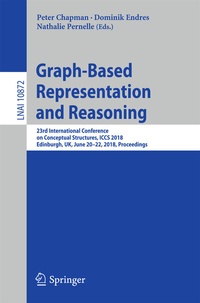
Graph-Based Representation and Reasoning
23rd International Conference on Conceptual Structures, ICCS 2018, Edinburgh, UK, June 20-22, 2018, Proceedings
Published on 7. June 2018
XII, 201 pages
978-3-319-91379-7 (ISBN)
Description

This book constitutes the proceedings of the 23rd International Conference on Conceptual Structures, ICCS 2018, held in Edinburgh, UK, in June 2018.
The 10 full papers, 2 short papers and 2 posters presented were carefully reviewed and selected from 21 submissions. They are organized in the following topical sections: graph- and concept-based inference; computer- human interaction and human cognition; and graph visualization.
The 10 full papers, 2 short papers and 2 posters presented were carefully reviewed and selected from 21 submissions. They are organized in the following topical sections: graph- and concept-based inference; computer- human interaction and human cognition; and graph visualization.
More details
Other editions
Additional editions

Peter Chapman | Dominik Endres | Nathalie Pernelle
Graph-Based Representation and Reasoning
23rd International Conference on Conceptual Structures, ICCS 2018, Edinburgh, UK, June 20-22, 2018, Proceedings
Book
05/2018
Springer
€53.49
Shipment within 10-15 days
Content
- Intro
- Preface
- Organization
- Diagrams and Nonmonotonic Logic: What is the Cognitive Relation? (Abstract)
- Contents
- Invited Keynote
- Modular Ontologies as a Bridge Between Human Conceptualization and Data
- 1 The Case for Modular Ontologies
- 2 Ontology Design Patterns
- 3 The Future of Modular Ontology Engineering
- References
- Graph- and Concept-Based Inference
- Using Analogical Complexes to Improve Human Reasoning and Decision Making in Electronic Health Record Systems
- 1 Introduction
- 2 Preliminaries
- 2.1 Formal Concept Analysis
- 2.2 Proportional Analogies for Formal Concepts
- 3 Motivation
- 4 Experiments
- 5 Conclusions and Future Work
- References
- An Efficient Approximation of Concept Stability Using Low-Discrepancy Sampling
- 1 Introduction
- 2 Background
- 2.1 Formal Concept Analysis
- 2.2 Stability Index
- 2.3 Approximating Stability
- 3 LDS for Stability
- 3.1 LDS Framework
- 3.2 Generating Low-Discrepancy Sequences
- 3.3 LDS Algorithm for Estimating Stability
- 3.4 LDS Versus MCS
- 4 Experimental Evaluation
- 4.1 Methodology
- 4.2 Results and Discussion
- 5 Conclusion
- References
- Lifted Most Probable Explanation
- 1 Introduction
- 2 Preliminaries
- 2.1 Parameterised Models
- 2.2 Query Answering Algorithms
- 3 Lifted Algorithms for Most Probable Explanations
- 3.1 Most Probable Explanation with LVE
- 3.2 Most Probable Explanation with LJT
- 3.3 Discussion
- 4 Case Study: Risk Analysis
- 5 Conclusion
- References
- Lifted Dynamic Junction Tree Algorithm
- 1 Introduction
- 2 Parameterised Probabilistic Dynamic Models
- 2.1 Parameterised Probabilistic Models
- 2.2 Parameterised Probabilistic Dynamic Models
- 3 Lifted Dynamic Junction Tree Algorithm
- 3.1 Lifted Junction Tree Algorithm
- 3.2 Interface Algorithm
- 3.3 LDJT: Overview
- 3.4 LDJT: FO Jtree Construction for PDMs
- 3.5 LDJT: Reasoning with FO Jtrees from PDMs
- 4 Evaluation
- 5 Conclusion
- References
- Computer Human Interaction and Human Cognition
- Defining Argumentation Attacks in Practice: An Experiment in Food Packaging Consumer Expectations
- 1 Introduction
- 2 Argumentation Primer
- 3 Case Study
- 4 Experimentation Protocol
- 5 Discussion
- 6 Conclusion
- References
- Empirically Evaluating the Similarity Model of Geist, Lengnink and Wille
- 1 Introduction
- 2 Similarity Models
- 2.1 Contrast Model
- 2.2 GLW Model
- 3 Experimental Test of the GLW Model
- 3.1 Feature List Experiment
- 3.2 Main Experiment
- 4 Discussion
- References
- Combining and Contrasting Formal Concept Analysis and APOS Theory
- 1 Introduction
- 2 A Short Description of the Two Theories
- 2.1 Formal Concept Analysis (FCA)
- 2.2 APOS Theory
- 3 Interiorisation and Conceptualisation
- 4 Encapsulation and Switching to a Meta-Level
- 5 Conclusion
- References
- Musical Descriptions Based on Formal Concept Analysis and Mathematical Morphology
- 1 Introduction
- 2 Lattice of Interval Structures
- 3 Mathematical Morphology Operations on Musical Concept Lattices
- 3.1 Preliminaries
- 3.2 Dilations and Erosions from the Decomposition into Join or Meet Irreducible Elements
- 3.3 Dilations and Erosions Based on Structuring Elements Derived from a Valuation
- 4 Harmonico-Morphological Descriptors Based on Congruence Relations
- 4.1 Definitions
- 4.2 Algorithm
- 4.3 Example on Ligeti's String Quartet No. 2
- 5 Conclusion
- References
- Towards Collaborative Conceptual Exploration
- 1 Introduction
- 2 Related Work
- 3 Attribute Exploration and FCA Basics
- 3.1 Setting
- 3.2 Attribute Exploration
- 4 Consortium
- 5 Exploration with Consortial Experts
- 5.1 Correcting Falsely Accepted Implications
- 5.2 Consistency
- 5.3 Abilities and Limitations of a Consortium
- 5.4 Extensions
- 6 Conclusion and Outlook
- References
- Graph Visualization
- A Visual Analytics Technique for Exploring Gene Expression in the Developing Mouse Embryo
- 1 Introduction
- 2 The e-Mouse Atlas Project
- 3 Creating a Formal Context of Gene Expression
- 3.1 Inferred Gene Expression Results
- 3.2 An Algorithm for Creating Formal Contexts of Gene Expression from EMAGE Data
- 4 Concept Lattices of Gene Expression
- 5 Related Work
- 6 Conclusions and Further Work
- References
- Exploring Heterogeneous Sequential Data on River Networks with Relational Concept Analysis
- 1 Introduction
- 2 Preliminaries
- 2.1 Heterogeneous CPO-Patterns
- 2.2 RCA
- 3 Heterogeneous Hydro-Ecological Data
- 4 Data Modelling
- 5 Exploration of Heterogeneous Data by Using RCA
- 6 Extraction of Heterogeneous CPO-Patterns Organised into a Hierarchy
- 7 Results and Evaluation
- 8 Related Work
- 9 Conclusion
- References
- Conceptual Graphs Based Modeling of Semi-structured Data
- 1 Introduction and Related Work
- 2 Graphic Representation of Semi-structured Data Model by Conceptual Graphs
- 3 CG Based Representation of XML Data Structure
- 4 An Example to Illustrate the Representation of XML Schema with Conceptual Graphs
- 5 The Visual Interface
- 6 Conclusions and Future Work
- References
- Using Conceptual Structures in Enterprise Architecture to Develop a New Way of Thinking and Working for Organisations
- 1 Introduction
- 2 Understanding Architectural Layers in Organisations
- 2.1 An Illustration
- 3 Conceptual Structures
- 3.1 The Business Layer
- 3.2 The Information Systems Layer
- 4 The Whole Meta-Model
- 5 Conclusions
- References
- Posters
- Visualizing Conceptual Structures Using FCA Tools Bundle
- 1 Introduction
- 2 Related Work
- 3 FCA Tools Bundle - Description and Features
- 4 Conclusions and Future Work
- References
- Node-Link Diagrams as Lenses for Organizational Knowledge Sharing on a Social Business Platform
- 1 Introduction
- 2 Method
- 3 Towards More Insightful Node-Link Diagrams
- References
- Author Index
