

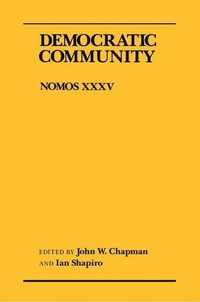
Democratic Community
Nomos XXXV
1st Edition
Published on 1. June 1995
277 pages
978-0-8147-2363-0 (ISBN)
Description

A state-of-the-art meditation on relations, theoretical and practical, among a familiar triad of themes: comunitarianism, liberalism, and democracy.
--American Political Science Review
A collection of distinguished contributors, from a wide range of disciplines, examine the implications of the resurgence of interest in community. The chapters in Democratic Community consider the fundamental issues that divide liberals and communitarians, as well as the structure of communities, the roles of freedom and democratic institutions in sustaining one another, the place of a democratic civil society in a democratic polity, and the contributions of feminist thinking.
This thirty-fifth volume in the American Society of Political and Legal Philosophy series is devoted, as is each volume in the series, to a single topic-- in this case, the implications for human nature and democratic theory of the resurgence of interest in community. Democratic Community deals not only with fundamental issues that divide liberals and communitarians, but is also concerned with the structure of communities, the roles of freedom and democratic institutions in sustaining one another, the place of a democratic civil society in a democratic polity, and the contributions of feminist thinking to the great debate. The collection of distinguished contributors, from a wide range of disciplines, includes: Richard J. Arneson (University of California, San Diego), Jean Baechler (University of Paris, Sorbonne), Christopher J. Berry (University of Glasgow), Robert A. Dahl (Yale University), Martin P. Golding (Duke University), Carol C. Gould (Stevens Institute of Technology), Amy Gutmann (Princeton University), Jane Mansbridge (Northwestern University), Kenneth Minogue (London School of Economics), Robert C. Post (University of California, Berkeley), David A. J. Richards (New York University), Gerald N. Rosenberg (University of Chicago), Bruce K. Rutherford (Yale University), Alan Ryan (Princeton University), and Carmen Sirianni (Brandeis University).
--American Political Science Review
A collection of distinguished contributors, from a wide range of disciplines, examine the implications of the resurgence of interest in community. The chapters in Democratic Community consider the fundamental issues that divide liberals and communitarians, as well as the structure of communities, the roles of freedom and democratic institutions in sustaining one another, the place of a democratic civil society in a democratic polity, and the contributions of feminist thinking.
This thirty-fifth volume in the American Society of Political and Legal Philosophy series is devoted, as is each volume in the series, to a single topic-- in this case, the implications for human nature and democratic theory of the resurgence of interest in community. Democratic Community deals not only with fundamental issues that divide liberals and communitarians, but is also concerned with the structure of communities, the roles of freedom and democratic institutions in sustaining one another, the place of a democratic civil society in a democratic polity, and the contributions of feminist thinking to the great debate. The collection of distinguished contributors, from a wide range of disciplines, includes: Richard J. Arneson (University of California, San Diego), Jean Baechler (University of Paris, Sorbonne), Christopher J. Berry (University of Glasgow), Robert A. Dahl (Yale University), Martin P. Golding (Duke University), Carol C. Gould (Stevens Institute of Technology), Amy Gutmann (Princeton University), Jane Mansbridge (Northwestern University), Kenneth Minogue (London School of Economics), Robert C. Post (University of California, Berkeley), David A. J. Richards (New York University), Gerald N. Rosenberg (University of Chicago), Bruce K. Rutherford (Yale University), Alan Ryan (Princeton University), and Carmen Sirianni (Brandeis University).
Reviews / Votes
"A state-of-the-art meditation on relations, theoretical and practical, among a familiar triad of themes: comunitarianism, liberalism, and democracy." (American Political Science Review)More details
Series
Language
English
Place of publication
New York
United States
Target group
Professional and scholarly
File size
82,35 MB
ISBN-13
978-0-8147-2363-0 (9780814723630)
Copyright in bibliographic data and cover images is held by Nielsen Book Services Limited or by the publishers or by their respective licensors: all rights reserved.
Schweitzer Classification
Other editions
Additional editions
Book
06/1995
New York University Press
€36.50
Shipment within 15-20 days
Ian Shapiro
Democratic Community
Book
05/1993
New York University Press
€65.81
Article exhausted; check different version
Persons
John W. Chapman is retired from the University of Pittsburgh where he taught political science.
Ian Shapiro is Sterling Professor of Political Science at Yale University, where he also serves as Henry R. Luce Director of the Yale Center for International and Area Studies. He is the editor or author of numerous books, most recently Political Contingency (NYU Press) and Rethinking Political Institutions (NYU Press).
Ian Shapiro is Sterling Professor of Political Science at Yale University, where he also serves as Henry R. Luce Director of the Yale Center for International and Area Studies. He is the editor or author of numerous books, most recently Political Contingency (NYU Press) and Rethinking Political Institutions (NYU Press).
Content
- Intro
- Cover Page
- Title Page
- Copyright Page
- Contents
- Preface
- Contributors
- Introduction
- PART I: LIBERALISM AND COMMUNITARIANISM
- 1. Individual, Group, and Democracy
- 2. Ideal Communities and the Problem of Moral Identity
- 3. Shared Understanding and the Democratic Way of Life
- PART II: LIBERTY, AUTONOMY, AND DEMOCRATIC COMMUNITY
- 4. The Liberal Community
- 5. Communities and the Liberal Community: Some Comments and Questions
- 6. The Disharmony of Democracy
- PART III: DEMOCRATIC COMMUNITY AND THE CONSTITUTION
- 7. Between Democracy and Community: The Legal Constitution of Social Form
- 8. Liberal Democratic Community
- 9. The Real World of Democratic Community
- PART IV: SOME EMPIRICAL CONSIDERATIONS
- 10. Why All Democratic Countries Have Mixed Economies
- 11. Learning Pluralism: Democracy and Diversity in Feminist Organizations
- 12. Can an Islamic Group Aid Democratization?
- PART V: FEMINIST PERSPECTIVES
- 13. Feminism and Democratic Community
- 14. Feminism and Democratic Community Revisited
- 15. Political Theory and the Aims of Feminism
- Index
