

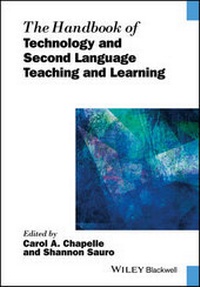
The Handbook of Technology and Second Language Teaching and Learning
Description

More details
Other editions
Additional editions
Persons
Content
Notes on Contributors
Robert J. Blake (PhD University of Texas) is Distinguished Professor of Spanish linguistics and director of the Spanish Language Program at the University of California, Davis. He has developed online Spanish courses for the first and second years, authored Brave New Digital Classroom (2013, GUP), and co-authored El español y la lingüística aplicada (2016, GUP). He was inducted as a member of the North American Academic of the Spanish Language in 2004.
Thierry Chanier is Professor of Applied Linguistics at Université Blaise Pascal, Clermont-Ferrand, France. His main research interest over the past 25 years has been CALL and, since 1999, online learning in telecollaborative situations. He coordinated the Mulce project which developed an open-access repository of Learning and Teaching Corpora
Carol A. Chapelle is Distinguished Professor of Liberal Arts and Sciences at Iowa State University. She is editor of the Encyclopedia of Applied Linguistics (Wiley, 2013) as well as co-editor of Language Testing and of the Cambridge Applied Linguistics Series. She is past-president of the American Association for Applied Linguistics and former editor of TESOL Quarterly. Her research investigates the use of technology in language learning and assessment, the topic of many of her books and research articles.
Dorothy M. Chun is Professor of Applied Linguistics at the University of California, Santa Barbara. Her research areas include: L2 phonology and intonation, L2 reading and vocabulary acquisition, computer-assisted language learning (CALL) and telecollaboration for intercultural learning. She has conducted studies on cognitive process in learning with multimedia, has authored courseware for language and culture acquisition, and recently edited a volume on intercultural learning via telecollaboration. She edits the journal Language Learning & Technology.
Yoo-Ree Chung is a Postdoctoral Research Associate at the Center for Communication Excellence at Iowa State University. She coordinates the International Teaching Assistants (ITA) program, which includes the administration and management of the Oral English Certification Testing for ITAs enrolled in the university. Her research interests include validity/validation, computer-assisted language testing, assessment of productive grammatical writing ability, speaking assessment, learning-oriented language testing, and interfaces between language testing and second language acquisition research.
Elena Cotos is Assistant Professor in the English Department and the Director of the Center for Communication Excellence of the Graduate College, Iowa State University. Her research interests include EAP/ESP genre analysis, automated writing evaluation, CALL, learner corpora and language assessment. Her work was published in a number of professional journals, edited volumes, and a book-length monograph.
Melinda Dooly holds a Serra Húnter fellowship as teacher and researcher at the Education Faculty of the Universitat Autònoma de Barcelona (Spain) where she teaches English as a Foreign Language Methodology (TEFL) and research methods courses. Her principal research addresses technology enhanced project-based language learning in teacher preparation. Her current research interest is in project-based telecollaborative language learning and very young learners.
Ahmet Dursun is the Assessment Coordinator at the University of Chicago Language Center's Office of Language Assessment, where he is responsible for developing and managing the University's language assessment programs. His research interests include language assessment, language assessment through technology, test design, test development and validation, and CALL. He has presented his work at a number of professional conferences, including TESOL, CALICO, AAAL, EALTA, and MwALT.
Kathryn English is a Maître de conférences at the Université Panthéon Assas (Paris II) and the École Polytechnique. She holds a PhD in Sciences du Langage and has designed, co-authored and participated in cross-cultural, computer-mediated language teaching projects based in the United States, France, Finland and Taiwan. She also worked as a conference interpreter for the European Union, German Television and Radio, the French National Assembly.
Maja Grgurovic is Clinical Assistant Professor and Clinical Director of the MA TESOL Program at the University of Illinois at Chicago. She holds a PhD in Applied Linguistics and Technology from Iowa State University. Maja has worked in the field of blended language learning as a researcher and teacher trainer for a number of years. Her other professional interests include CALL, language assessment, and language teacher education.
Volker Hegelheimer is Professor of English at Iowa State University. He researches applications of emerging technologies in language learning and language testing. His publications have appeared in journals such as Language Learning & Technology, Language Testing, System, Computer-Assisted Language Learning, ReCALL, CALICO Journal, and he contributed to several edited volumes on CALL. He co-edited the CALICO Journal special issue on automated writing evaluation and has presented at numerous national and international conferences.
Trude Heift is Professor of Linguistics in the Department of Linguistics at Simon Fraser University, Canada. Her research focuses on the design as well as the evaluation of CALL systems with a particular interest in learner-computer interactions and learner language. Her work has appeared in leading CALL/SLA journals and she is co-author, with Mathias Schulze, of Errors and Intelligence in Computer-Assisted Language Learning: Parsers and Pedagogues (Routledge). She is co-editor of Language Learning & Technology.
Philip Hubbard is Senior Lecturer in Linguistics and Director of English for Foreign Students in the Stanford University Language Center. He has published articles on CALL theory, research, methodology, courseware evaluation, teacher education, learner training, mobile learning, and listening. He is associate editor of Computer Assisted Language Learning and Language Learning & Technology. His current work focuses on content curation and learner training for technology environments with an emphasis on online listening.
Joan Jamieson, Professor of English at Northern Arizona University, teaches in the MA-TESL and PhD in Applied Linguistics programs. Her areas of specialty include second language testing, research design and statistics, and CALL.
Agnes Kukulska-Hulme is Professor of Learning Technology and Communication in the Institute of Educational Technology at the Open University and past-president of the International Association for Mobile Learning. She is on the editorial boards of the International Journal of Mobile and Blended Learning, ReCALL, and SYSTEM, and co-editor of Mobile Learning: The Next Generation. Her current research focuses on technology-supported learning for migrants, intelligent personal assistants, and language learning in smart cities.
Robert Godwin-Jones is Professor of World Languages and International Studies at Virginia Commonwealth University. His research is principally in applied linguistics, in the areas of language learning and technology, and intercultural communication. He has published four books, multiple articles and book chapters, and writes a regular column for Language Learning & Technology on emerging technologies for language learning.
Greg Kessler is the Director of the Language Resource Center and Associate Professor of Computer-Assisted Language Learning in the Department of Linguistics at Ohio University. He is also an affiliated faculty member in Instructional Technology in the Patton College of Education. His research addresses instructional technology, teacher preparation, language teaching, and associated human behavior. He has published widely and delivered featured talks around the world.
Marie-Noëlle Lamy is Emeritus Professor of Distance Language Learning at the Open University. She has more than 20 years' experience of designing and implementing courses involving synchronous voice-enabled e-tutorials. Her research focuses on methodologies for the description of online learning conversations, the co-construction of group cultures by language learners in social networking environments, and cultural hegemonies in global CALL.
Helen Lee has worked as a business language trainer for global organizations. She holds a Masters degree in TESOL and ICT from the University of Brighton and has presented at the University of Oxford, the British (BAAL), and the American Association for Applied Linguistics (AAAL). Helen is a member of the BAAL Special Interest Group in Language and New Media. Her doctoral research at the Open University focuses on language learning with mobiles.
Zhi Li is Language Assessment Specialist at Paragon Testing Enterprises, British Columbia, Canada. He holds a PhD in applied linguistics and technology from Iowa State University. His research interests include language assessment, CALL, corpus linguistics, and systemic functional linguistics....
