

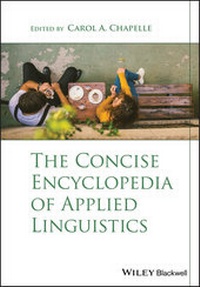
The Concise Encyclopedia of Applied Linguistics
Description

Applied linguistics is an interdisciplinary field that identifies, examines, and seeks solutions to real-life language-related issues. Such issues often occur in situations of language contact and technological innovation, where language problems can range from explaining misunderstandings in face-to-face oral conversation to designing automated speech recognition systems for business. The Concise Encyclopedia of Applied Linguistics includes entries on the fundamentals of the discipline, introducing readers to the concepts, research, and methods used by applied linguists working in the field. This succinct, reader-friendly volume offers a collection of entries on a range of language problems and the analytic approaches used to address them.
This abridged reference work has been compiled from the most-accessed entries from The Encyclopedia of Applied Linguistics (www.encyclopediaofappliedlinguistics.com), the more extensive volume which is available in print and digital format in 1000 libraries spanning 50 countries worldwide. Alphabetically-organized and updated entries help readers gain an understanding of the essentials of the field with entries on topics such as multilingualism, language policy and planning, language assessment and testing, translation and interpreting, and many others.
Accessible for readers who are new to applied linguistics, The Concise Encyclopedia of Applied Linguistics:
* Includes entries written by experts in a broad range of areas within applied linguistics
* Explains the theory and research approaches used in the field for analysis of language, language use, and contexts of language use
* Demonstrates the connections among theory, research, and practice in the study of language issues
* Provides a perfect starting point for pursuing essential topics in applied linguistics
Designed to offer readers an introduction to the range of topics and approaches within the field, The Concise Encyclopedia of Applied Linguistics is ideal for new students of applied linguistics and for researchers in the field.
More details
Other editions
Additional editions
Person
CAROL A. CHAPELLE is Distinguished Professor of Liberal Arts and Sciences at Iowa State University, USA. She is author of more than ten books, dozens of articles on topics in second language learning and assessment, and Editor-in-Chief of the ten-volume Encyclopedia of Applied Linguistics. She is recipient of the Lifetime Achievement Award in Language Testing and the American Association for Applied Linguistics Distinguished Service and Scholarship Award.
Content
Thematic List of Entries vii
Alphabetical List of Entries xiii
General Editor xvii
Contributors xix
Introduction to The Concise Encyclopedia of Applied Linguistics xxv
Acknowledgments xxxiii
A-Z 1
Index 1181
Contributors
Kathryn Accurso, University of Massachusetts, Amherst, USA
Rosa Alonso Alonso, University of Vigo, Spain
Jennifer Andrus, University of Utah, USA
Katy Arnett, St. Mary's College of Maryland, USA
Ilker Aytürk, Bilkent University, Turkey
Beverly A. Baker, University of Ottawa, Canada
Ana Maria Ferreira Barcelos, Federal University of Viçosa, Brazil
Helen Basturkmen, University of Auckland, New Zealand
Tony Berber Sardinha, São Paulo Catholic University, Brazil
Margie Berns, Purdue University, USA
Patricia Bou-Franch, Universitat de València, Spain
George Braine, Chinese University of Hong Kong, Hong Kong
Catherine E. Brouwer, University of Southern Denmark, Denmark
Adam Brown, AIS St Helens, Auckland, New Zealand
Kevin C. Browne, Yamanashi Prefectural University, Japan
Michael Byram, University of Durham, UK
Jasone Cenoz, University of the Basque Country, UPV/EHU, Spain
Carol A. Chapelle, Iowa State University, USA
Delia Chiaro, University of Bologna, Italy
YunDeok Choi, International Graduate School of Education, Republic of Korea
Dorothy M. Chun, University of California, Santa Barbara, USA
Eve V. Clark, Stanford University, USA
Begoña Clavel-Arroitia, Universitat de València, Spain
Joseph Collentine, Northern Arizona University, USA
Karina Collentine, Northern Arizona University, USA
Laura Collins, Concordia University, Canada
Vivian Cook, Newcastle University, UK
Elena Cotos, Iowa State University, USA
Averil Coxhead, Victoria University of Wellington, New Zealand
Graham Crookes, University of Hawai'i, USA
Sara T. Cushing, Georgia State University, USA
Diane Dagenais, Simon Fraser University, Canada
Jee Wha Dakin, Educational Testing Service, USA
Frank E. Daulton, Ryukoku University, Japan
Eduardo H. Diniz De Figueiredo, Universidade Federal do Paraná, Brazil
Anna De Fina, Georgetown University, USA
Annette M. B. De Groot, University of Amsterdam, Netherlands
Annick De Houwer, Universität Erfurt, Germany
Nivja H. de Jong, Leiden University, Netherlands
Simona Pekarek Doehler, Neuchâtel University, Switzerland
Patricia A. Duff, University of British Columbia, Canada
John Edwards, St Francis Xavier University, Canada, and Dalhousie University, Canada
Johanna Ennser-Kananen, University of Jyväskylä, Finland
Rosemary Erlam, University of Auckland, New Zealand
Hossein Farhady, Yeditepe University, Turkey
Hafiz Muhammad Fazalehaq, University of New Mexico, USA
Anna Filipi, Monash University, Australia
Kerstin Fischer, University of Southern Denmark, Denmark
John Flowerdew, Lancaster University, UK, and Birkbeck College, University of London, UK
Lynne Flowerdew, Birkbeck College, University of London, UK
William A. Foley, University of Sydney, Australia
Elena Forzani, Boston University, USA
Peter Franklin, Konstanz University of Applied Sciences, Germany
Eric Friginal, Georgia State University, USA
Haruna Fukui, Kansai University, Japan
Ofelia García, City University of New York, USA
Meg Gebhard, University of Massachusetts, Amherst, USA
Fred Genesee, McGill University, Canada
Roger Gilabert, University of Barcelona, Spain
Saran Kaur Gill, Universiti Kebangsaan Malaysia, Malaysia
April Ginther, Purdue University, USA
Andrea Golato, Texas State University, USA
Peter Golato, Texas State University, USA
Janet Goodwin, University of California, USA
Durk Gorter, University of the Basque Country, UPV/EHU, Spain
Margo Gottlieb, University of Wisconsin-Madison, USA
William Grabe, Northern Arizona University, USA
Sylviane Granger, University of Louvain, Belgium
Scott E. Grapin, New York University, USA
Laura Grassick, University of Leeds, UK
Anthony Green, University of Bedfordshire, UK
Stefan Th. Gries, University of California, Santa Barbara, USA
François Grosjean, Neuchâtel University, Switzerland
Yongqi Gu, Victoria University of Wellington, New Zealand
Matthew J. Hammill, Syracuse University, USA
Jing Hao, Hong Kong Polytechnic University, Hong Kong
Luke Harding, Lancaster University, UK
Victoria Hasko, University of Georgia, USA
Susan C. Herring, Indiana University, Bloomington, USA
Suzanne K. Hilgendorf, Simon Fraser University, Canada
Michael Hoey, University of Liverpool, UK
Elizabeth Holt, University of Huddersfield, UK
Juliane House, University of Hamburg, Germany
Alex Housen, University of Brussels, Belgium
Leo Francis Hoye, University of Hong Kong, Hong Kong
Susan Hunston, University of Birmingham, UK
Ken Hyland, University of East Anglia, UK
Kenneth Hyltenstam, Stockholm University, Sweden
Jane Jackson, Chinese University of Hong Kong, Hong Kong
Christopher Jenks, University of Hong Kong, Hong Kong
Jane Helen Johnson, University of Bologna, Italy
Rodney H. Jones, University of Reading, UK
Dániel Z. Kádár, Dalian University of Foreign Languages, China, and Research Institute for Linguistics of the Hungarian Academy of Sciences, Hungary
Paula Kalaja, University of Jyväskylä, Finland
Nkonko M. Kamwangamalu, Howard University, USA
David Katan, Universita del Salento, Italy, and University of South Africa, South Africa
Anne Katz, New School, USA
Casey Keck, Boise State University, USA
Friederike Kern, Bielefeld University, Germany
Carita Kiili, University of Oslo, Norway, and University of Jyväskylä, Finland
Dan Kim, Korea Educational Broadcasting System, Republic of Korea
Youmie J. Kim, Syracuse University, USA
Youn-Kyung Kim, Spalding University, USA
Kendall A. King, University of Minnesota, USA
Andy Kirkpatrick, Griffith University, Australia
Keiko Kitade, Ritsumeikan University, Japan
Tatyana Kleyn, City University of New York, USA
John S. Knox, Macquarie University, Australia
Keiko Koda, Carnegie Mellon University, USA
Almut Koester, Wirtschaftsuniversitat Wien, Institute for English Business Communication, Austria
Magdalena Kubanyiova, University of Leeds, UK
Agnes Kukulska-Hulme, The Open University, UK
Juliet Langman, University of Texas at San Antonio, USA
Diane Larsen-Freeman, University of Michigan, USA
David Lasagabaster, University of the Basque Country, UPV/EHU, Spain
Ronald P. Leow, Georgetown University, USA
Sirpa Leppänen, University of Jyväskylä, Finland
Donald J. Leu, University of Connecticut, USA
John Levis, Iowa State University, USA
Miriam A. Locher, University of Basel, Switzerland
Shawn Loewen, Michigan State University, USA
Michael H. Long, University of Maryland, USA
Roy Lyster, McGill University, Canada
Marijana Macis, Manchester Metropolitan University, UK
Elizabeth Stallman Madden, University of Minnesota, USA
Holbrook Mahn, University of New Mexico, USA
Roy C. Major, Stanford University, USA
Theodoros Marinis, University of Konstanz, Germany
Waldemar Martyniuk, Jagiellonian University, Poland
Aya Matsuda, Arizona State University, USA
J. Greg McVerry, Southern Connecticut State University, USA
Detmar Meurers, University of Tübingen, Germany
Tommaso M. Milani, University of Gothenburg, Sweden
Andrew Moody, University of Macau, Macau
Brian Morgan, York University, Canada
Paul Nation, Victoria University of Wellington, New Zealand
Phuong Nguyen, Iowa State University, USA
Catherine Nickerson, Zayed University, United Arab Emirates
Andrea Nini, University of Manchester, UK
Christiane Nord, University of the Free State, South Africa
Sigrid Norris, University of Freiburg, Germany, and Auckland University of Technology, New Zealand
Bonny Norton, University of British Columbia, Canada
W. Ian O'Byrne, College of Charleston, USA
Gary J. Ockey, Iowa State University, USA
Brian Paltridge, University of Sydney, Australia
Alan Partington, University of Bologna, Italy
Katie Patterson, University of Roehampton, UK
Saija Peuronen, University of Jyväskylä,...
