

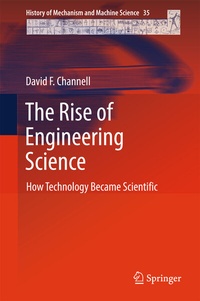
The Rise of Engineering Science
Description

The 18th and 19th centuries saw the emergence of new intermediary types of knowledge in areas such as applied mechanics, fluid mechanics and thermodynamics, which came to be labeled as engineering science, transforming technology into the scientific discipline that we know today. This book analyzes how the Scientific Revolution of the 16th and 17th centuries and the Industrial Revolution of the 18th and 19th centuries provided the intellectual, social, economic and institutional foundations for the emergence of engineering science. The book then traces the rise of engineering science from the 18th century through the 19th century and concludes by showing how it led to new technological developments in such areas as steel production, the invention of internal combustion engines, the creation of automobiles and airplanes, and the formulation of Mass Production and Scientific Management all of which brought about major transformations in the materials, power sources,transportation and production techniques that have come to shape our modern world.
More details
Other editions
Additional editions
Content
Acknowledgements.- Part I: Introduction.- 1 Changing Relationships between Science and Technology.- References.- Part II: The Roots of Engineering Science.- 2 The Intellectual Roots of Engineering Science.- 2.1 The Scientific Revolution - Overview.- 2.2 Roots of the Mechanical Philosophy.- 2.3 Roots of the Experimental Philosophy.- 2.4 The New Ideology of Science.- 2.5 Conclusions.- References.- 3 The Social and Economic Roots of Engineering Science.- 3.1 The Industrial Revolution - Overview.- 3.2 Iron Production.- 3.3 The Steam Engine.- 3.4 The Textile Revolution.- 3.5 Conclusions.- References.- 4 The Institutional Roots of Engineering Science.- 4.1 Great Britain.- 4.2 France.- 4.3 The German States.- 4.4 The United States.- 4.5 Conclusions.- References.- Part III: The Rise of Engineering Science.- 5 The Emergence of Engineering Science.- 5.1 AppliedMechanics.- 5.2 Fluid Mechanics.- 5.3 Thermodynamics.- 5.4 Conclusions.- References.- 6 The Establishment of Engineering Science: The Harmony of Theory and Practice.- 6.1 Theory and Practice in Great Britain.- 6.2 Theory and Practice in the German States.- 6.3 Theory and Practice in France.- 6.4 Theory and Practice in the United States.- 6.5 Conclusions.- References.- Part IV: Engineering Science-Based Industries.- 7 New Materials.- 7.1 Steel Production.- 7.2 Steel Construction.- 7.3 Conclusions.- References.- 8 New Power Sources.- 8.1 Internal Combustion Engines.- 8.2 Conclusions.- References.- 9 New Transportation Systems.- 9.1 The Automobile Industry.- 9.2 The Aeronautics Industry.- 9.3 Conclusions.- References.- 10 New Methods of Production.- 10.1 Mass Production - Fordism.- 10.2 Scientific Management - Taylorism.- 10.3 Conclusions.- References.- Part V: Epilogue.- 11 From Engineering Science to Technoscience.- References.- Name Index.
