

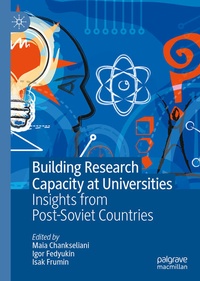
Building Research Capacity at Universities
Description

This edited volume represents a collective contribution to the current debates on developing university research capacity. The chapters in this volume offer empirical case studies from post-Soviet countries which share a common history, common policies and practices of higher education. These commonalities make the regional focus meaningful and analytically valid. At the same time, the case studies demonstrate divergence from the shared Soviet tradition and offer historical, sociological, and political analyses of how and in what ways universities in former Soviet countries internalised their research mission and developed the capacity to carry out this mission. This volume is the first of its kind to examine national and institutional resources, political will, and individual agency to understand how these influenced universities' motivation, expertise, and opportunities of undertaking research since the early 1990s, and how universities changed their structures and practices under these influences. The book will appeal to students and scholars in the fields of education, sociology, political science, and economics.
More details
Other editions
Additional editions
Persons
Maia Chankseliani is Associate Professor of Comparative and International Education at the University of Oxford, UK. She investigates societal, institutional, and policy forces that shape tertiary education and the potential of tertiary education and research for transforming societies.
Igor Fedyukin is Associate Professor of History at the HSE University in Moscow, Russia. He is the author of numerous publications and served as Vice-Minister of Education and Science of Russia in 2012-2013.
Isak Frumin is Head of Observatory of Innovations in Higher Education at Jacobs University Bremen and distinguished professor at the HSE University in Moscow, Russia. He is a Fellow of the International Academy of Education and promotes the study of post-socialist education as a source of new theory of education development.
