

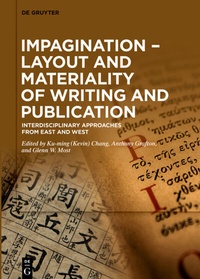
Impagination - Layout and Materiality of Writing and Publication
Description

This volume is a comparative study of the practice of impagination across different ages and civilizations. By impagination we mean the act of placing and arranging spatially textual and other information onto a material bearer that could be made of a variety of materials (papyrus, bamboo slips, palm leaf, parchment, paper, and the computer screen). This volume investigates three levels of impagination: what is the page or other unit of the material bearer, what is written or printed on it, and how is writing or print placed on it. It also examines the interrelations of two or all three of these levels. Collectively it examines the material and materiality of the page, the variety of imprints, cultural and historical conventions for impagination, interlinguistic encounters, the control of editors, scribes, publishers and readers over the page, inheritance, borrowing and innovation, economics, aesthetics and socialities of imprints and impagination, and the relationship of impagination to philology. This volume supplements studies on mise en page and layout - an important subject of codicology - first by including non-codex writings, second by taking a closer look at the page or other unit than at the codex (or book), and third by its aspiration to adopt a globally comparative approach. This volume brings together for comparison vast geographical realms of learning, including Europe, China, Tibet, Korea, Japan and the Near Eastern and European communities in which the Hebrew Bible was transmitted. This comparison is significant, for Europe, China, and India all developed great traditions of learning which came into intensive contact. The contributions to this volume are firmly rooted in local cultures and together address global, comparative themes that are significant for multiple disciplines, such as intellectual and cultural history of knowledge (both humanistic and scientific), global history, literary and media studies, aesthetics, and studies of material culture, among other fields.
More details
Other editions
Additional editions
Persons
K. Chang , Academia Sinica, Taiwan; G.W. Most , Scuola Norm. Superiore, Pisa, Italy/Univ. Chicago, USA; A. Grafton , Princeton Univ., USA
Content
- Intro
- Contents
- List of Figures
- List of Tables
- List of Contributors
- Introduction
- I Slips, Scrolls, and Leaves: Before the Codex
- Chapter 1. Text and Paratext in the Greek Classical Tradition
- Chapter 2. Tabernacles of Text: A Brief Visual History of the Hebrew Bible
- Chapter 3. Impagination, Reading, and Interpretation in Early Chinese Texts
- Chapter 4. Sutra Text in Pecha Format: Page Layout of the Tibetan Vimalakirtinirdesa
- Chapter 5. Between the Lines and in the Margins: Linguistic Change and Impagination Practices in South Asia
- II The Printed World
- Chapter 6. The Margin as Canvas: A Forgotten Function of the Early Printed Page
- Chapter 7. Page Layout and the Complex Semiotic System of Fifteenth- and Sixteenth-Century Choson's Samganghaengsildo
- Chapter 8. The Transformation of the Typical Page in the Handpress Era in the Southern Netherlands, 1473-c. 1800
- Chapter 9. Writer's Block or Printer's Block: The Book and Its Openings in Early Modern China
- Chapter 10. Placing Texts on Chinese Pages: From Bamboo Slips to Printed Paper
- Chapter 11. Recovering Translation Lost: Symbiosis and Ambilingual Design in Chinese/Manchu Language Reference Manuals of the Qing Dynasty
- Chapter 12. Japanophone Glosses (kunten) in Printed and Digitized Manuscripts
- III Beyond the Book
- Chapter 13. Beyond the Physical Page: Latest Practice of Scientific Publication
- Index
