

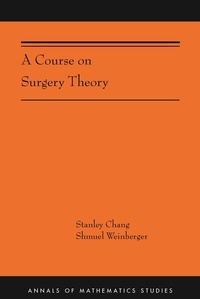
A Course on Surgery Theory
(AMS-211)
1st Edition
Published on 20. January 2021
472 pages
978-0-691-20035-4 (ISBN)
Description

An advanced treatment of surgery theory for graduate students and researchers
Surgery theory, a subfield of geometric topology, is the study of the classifications of manifolds. A Course on Surgery Theory offers a modern look at this important mathematical discipline and some of its applications. In this book, Stanley Chang and Shmuel Weinberger explain some of the triumphs of surgery theory during the past three decades, from both an algebraic and geometric point of view. They also provide an extensive treatment of basic ideas, main theorems, active applications, and recent literature. The authors methodically cover all aspects of surgery theory, connecting it to other relevant areas of mathematics, including geometry, homotopy theory, analysis, and algebra. Later chapters are self-contained, so readers can study them directly based on topic interest. Of significant use to high-dimensional topologists and researchers in noncommutative geometry and algebraic K-theory, A Course on Surgery Theory serves as an important resource for the mathematics community.
Surgery theory, a subfield of geometric topology, is the study of the classifications of manifolds. A Course on Surgery Theory offers a modern look at this important mathematical discipline and some of its applications. In this book, Stanley Chang and Shmuel Weinberger explain some of the triumphs of surgery theory during the past three decades, from both an algebraic and geometric point of view. They also provide an extensive treatment of basic ideas, main theorems, active applications, and recent literature. The authors methodically cover all aspects of surgery theory, connecting it to other relevant areas of mathematics, including geometry, homotopy theory, analysis, and algebra. Later chapters are self-contained, so readers can study them directly based on topic interest. Of significant use to high-dimensional topologists and researchers in noncommutative geometry and algebraic K-theory, A Course on Surgery Theory serves as an important resource for the mathematics community.
More details
Other editions
Additional editions
Stanley Chang | Shmuel Weinberger
A Course on Surgery Theory
Book
01/2021
Princeton University Press
€197.50
Article not available at the moment
Stanley Chang | Shmuel Weinberger
A Course on Surgery Theory
Book
01/2021
Princeton University Press
€88.00
Article not available at the moment
Persons
Stanley Chang is the Mildred Lane Kemper Professor of Mathematics at Wellesley College. Shmuel Weinberger is the Andrew MacLeish Distinguished Service Professor of Mathematics at the University of Chicago. Weinberger is the author of The Topological Classification of Stratified Spaces and Computers, Rigidity, and Moduli.
Content
- Cover
- Title
- Copyright
- Contents
- List of Figures
- Preface
- Introduction
- 1 The characterization of homotopy types
- 1.1 A review of surgery
- 1.2 Executing surgery
- 1.3 The p-p theorem and its applications
- 1.4 Propagation of group actions
- 1.5 Wall Chapter 9
- 1.6 Algebraic surgery theory
- 2 Some calculations of L-groups
- 2.1 Calculating L*(Z[e])
- 2.2 Elementary Witt theory
- 2.3 L-theory of finite groups
- 2.4 Odd L-groups and the Ranicki-Rothenberg sequence
- 2.5 Transfer and Dress induction
- 2.6 Squares
- 2.7 Using splitting theorems
- 3 Classical surgery theory
- 3.1 Low dimensions and smoothing theory
- 3.2 The homotopy groups of F/PL
- 3.3 Some PL and Diff examples
- 3.4 The homotopy type of F/PL
- 3.5 Finite H-spaces
- 3.6 PL tori
- 3.7 The Kirby-Siebenmann invariant
- 3.8 Nonrigidity of nonuniform arithmetic manifolds
- 4 Topological surgery and surgery spaces
- 4.1 Beginning the spacification
- 4.2 The surgery problem
- 4.3 Blocked surgery
- 4.4 Surgery spectra
- 4.5 Periodicity of structure sets
- 4.6 Smooth structures
- 5 Applications of the assembly map
- 5.1 The Borel conjecture and related questions
- 5.2 Applications of periodicity and functoriality
- 5.3 Automatic variability of characteristic classes
- 6 Beyond characteristic classes
- 6.1 A secondary signature invariant
- 6.2 Manifolds with fundamental group Z2
- 6.3 General splittability
- 6.4 Connected sums of projective spaces
- 6.5 Lens spaces
- 6.6 The topological space form problem
- 6.7 Oozing problem
- 6.8 Introduction to the Farrell-Jones conjecture
- 6.9 Propagation of group actions on closed manifolds
- 7 Flat and almost flat manifolds
- 7.1 The a-approximation theorem
- 7.2 Flat manifolds
- 7.3 Almost flat manifolds
- 8 Other surgery theories
- 8.1 Smooth surgery without usual normal data
- 8.2 Local surgery
- 8.3 Homology surgery
- 8.4 Proper and bounded surgery
- 8.5 Controlled surgery
- 8.6 Homology manifolds
- 8.7 Stratified surgery
- Appendix A: Some background in algebraic topology
- A.1 Obstruction theory
- A.2 Principal bundles and characteristic classes
- A.3 Generalized homology theories
- A.4 Localization
- A.5 Whitehead torsion
- Appendix B: Geometric preliminaries
- B.1 The smooth category
- B.2 The PL category
- B.3 The topological category
- List of Symbols
- Bibliography
- Index
