

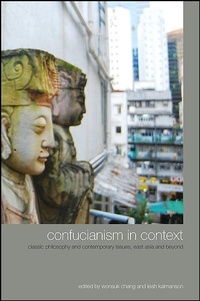
Confucianism in Context
Description

What is Confucianism? This book provides a wide-ranging view of the tradition and its contemporary relevance for Western readers. Discussing the development of Confucianism in China, the work goes on to show the deep impact of Korean and Japanese cultures on Confucian thinking. A dialogic way of thought, highly sensitive to locations and conditions, Confucianism is shown to be a valuable philosophical resource for a multicultural, globalizing world. In addition to discussing Confucianism' unique responses to traditional philosophical problems, such as the nature of self and society, Confucianism in Context shows how Confucian philosophy can contribute to contemporary issues such as democracy, human rights, feminism, and ecology.
Wonsuk Chang is Senior Researcher at the Academy of Korean Studies in South Korea. Leah Kalmanson is a PhD candidate in the Department of Philosophy at the University of Hawai'i at Manoa.
More details
Other editions
Additional editions
Persons
Wonsuk Chang is Senior Researcher at the Academy of Korean Studies in South Korea. Leah Kalmanson is a PhD candidate in the Department of Philosophy at the University of Hawai'i at Manoa.
Content
Acknowledgments
Foreword
Youngjin Choi
Introduction: The Confucian Tradition-an Evolving Narrative
Wonsuk Chang and Leah Kalmanson
1. Transmitting the Dao: Chinese Confucianism
John Berthrong
2. The History of Confucianism in Korea
Youngjin Choi
3. The History of Confucianism in Japan
Peter Nosco
4. What Is Confucianism?
Roger T. Amesi
5. Confucian Person in the Making
Wonsuk Chang
6. Confucianism and Democracy
Sor-hoon Tan
7. Confucianism and Human Rights
Sangjin Han
8. The Short Happy Life of Boston Confucianism
Robert Neville
9. A Feminist Appropriation of Confucianism
Li-Hsiang Lisa Rosenlee
10. Confucian Trajectories on Environmental Understanding
Michael C. Kalton
Appendix I: List of Names
Appendix II: Historical Periods
Glossary
Bibliography
List of Contributors
Index
