

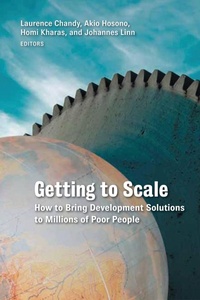
Getting to Scale
How to Bring Development Solutions to Millions of Poor People
1st Edition
Published on 10. April 2013
394 pages
978-0-8157-4441-2 (ISBN)
Description

The global development community is teeming with different ideas and interventions to improve the lives of the world's poorest people. Whether these succeed in having a transformative impact depends not just on their individual brilliance but on whether they can be brought to a scale where they reach millions of poor people.
Getting to Scale explores what it takes to expand the reach of development solutions beyond an individual village or pilot program so they serve poor people everywhere. Each chapter documents one or more contemporary case studies, which together provide a body of evidence on how scale can be pursued. The book suggests that the challenge of scaling up can be divided into two solutions: financing interventions at scale, and managing delivery to large numbers of beneficiaries. Neither governments, donors, charities, nor corporations are usually capable of overcoming these twin challenges alone, indicating that partnerships are key to success.
Scaling up is mission critical if extreme poverty is to be vanquished in our lifetime. Getting to Scale provides an invaluable resource for development practitioners, analysts, and students on a topic that remains largely unexplored and poorly understood. Contributors: Tessa Bold (Goethe University, Frankfurt), Wolfgang Fengler (World Bank, Nairobi), David Gartner (Arizona State University), Shunichiro Honda (JICA Research Institute), Michael Joseph (Vodafone), Hiroshi Kato (JICA), Mwangi Kimenyi (Brookings), Michael Kubzansky (Monitor Inclusive Markets), Germano Mwabu (University of Nairobi), Jane Nelson (Harvard Kennedy School), Alice Ng'ang'a (Strathmore University, Nairobi), Justin Sandefur (Center for Global Development), Pauline Vaughan (consultant), Chris West (Shell Foundation)
Getting to Scale explores what it takes to expand the reach of development solutions beyond an individual village or pilot program so they serve poor people everywhere. Each chapter documents one or more contemporary case studies, which together provide a body of evidence on how scale can be pursued. The book suggests that the challenge of scaling up can be divided into two solutions: financing interventions at scale, and managing delivery to large numbers of beneficiaries. Neither governments, donors, charities, nor corporations are usually capable of overcoming these twin challenges alone, indicating that partnerships are key to success.
Scaling up is mission critical if extreme poverty is to be vanquished in our lifetime. Getting to Scale provides an invaluable resource for development practitioners, analysts, and students on a topic that remains largely unexplored and poorly understood. Contributors: Tessa Bold (Goethe University, Frankfurt), Wolfgang Fengler (World Bank, Nairobi), David Gartner (Arizona State University), Shunichiro Honda (JICA Research Institute), Michael Joseph (Vodafone), Hiroshi Kato (JICA), Mwangi Kimenyi (Brookings), Michael Kubzansky (Monitor Inclusive Markets), Germano Mwabu (University of Nairobi), Jane Nelson (Harvard Kennedy School), Alice Ng'ang'a (Strathmore University, Nairobi), Justin Sandefur (Center for Global Development), Pauline Vaughan (consultant), Chris West (Shell Foundation)
More details
Edition
1. Auflage
Language
English
Place of publication
United States
Publishing group
Bloomsbury Publishing Plc
ISBN-13
978-0-8157-4441-2 (9780815744412)
Copyright in bibliographic data and cover images is held by Nielsen Book Services Limited or by the publishers or by their respective licensors: all rights reserved.
Schweitzer Classification
Other editions
Additional editions
Laurence Chandy | Akio Hosono | Homi Kharas
Getting to Scale
How to Bring Development Solutions to Millions of Poor People
Book
04/2013
Brookings Institution
€43.90
Shipment within 10-20 days
Persons
Laurence Chandy is a fellow, Homi Kharas is a senior fellow, and Johannes Linn is a nonresident fellow in the Global Economy and Development program at the Brookings Institution. Akio Hosono is director of the Research Institute of the Japanese International Cooperation Agency (JICA).
