

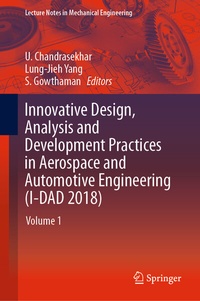
Innovative Design, Analysis and Development Practices in Aerospace and Automotive Engineering (I-DAD 2018)
Description

The book includes the best articles presented by researchers, academicians and industrial experts at the International Conference on "Innovative Design and Development Practices in Aerospace and Automotive Engineering (I-DAD 2018)". The book discusses new concept in designs, and analysis and manufacturing technologies for improved performance through specific and/or multi-functional design aspects to optimise the system size, weight-to-strength ratio, fuel efficiency and operational capability. Other aspects of the conference address the ways and means of numerical analysis, simulation and additive manufacturing to accelerate the product development cycles.Describing innovative methods, the book provides valuable reference material for educational and research organizations, as well as industry, wanting to undertake challenging projects of design engineering and product development.
More details
Other editions
Additional editions
Persons
Dr. U. Chandrasekhar is the pro vice chancellor of Vel Tech Dr.RR & Dr.SR Technical University, Chennai. He was director of the Engineering Staff College of India (ESCI), an autonomous organ of The Institution of Engineers (India), and prior to that he was an additional director at the Gas Turbine Research Establishment, a Ministry of Defence R&D organization. For the past 26 years, he has been involved in design, analysis, prototyping, rapid manufacturing, and testing of aero gas turbine engines. He set up the first-ever rapid prototyping laboratory in the country. He has received a commendation medal from the scientific advisor to the defence minister in recognition of his research efforts. He received his B.E. in Mechanical Engineering from NIT, Suratkal; M.Tech. in Design Stream from IIT, Madras; and his Ph.D. from VTU. For his academic excellence at IIT Madras, he received an award from the former president of India, Dr. A. P. J. Abdul Kalam. He trained RP and sensor technologies in Germany, the UK and Belgium. He is currently leading a critical technology development project on high-temperature thin film sensors in collaboration with NRC, Canada. He serves on the council of the Institution of Engineers and National Design and Research Forum. He was also chosen to represent India in the Young Leaders Convention of World Federation of Engineering Organisations at Geneva. He has been invited by several national and international professional bodies as the keynote speaker on advanced prototyping and sensor technologies.
Dr. Lung-Jieh Yang received his M.S. degree from Tamkang University, Taiwan in 1991 and Ph.D. degree from the Institute of Applied Mechanics, National Taiwan University in 1997. He was a visiting associate of Electrical Engineering, Caltech, USA from 2000 to 2001. He is currently a professor at the Department of Mechanical & Electromechanical Engineering and the director of the Instrument & Experiment Center at Tamkang University. He is also a member of IEEE and AIAA. His current research interests include flapping micro-aerial-vehicles (MAVs) and gelatin MEMS technology. His research areas are polymer composites, nanomaterials, high-temperature foams, experimental mechanics, sensors for health monitoring and energy harvesting.
Dr. S. Gowthaman is the director of R&D at Vel Tech Dr.RR & Dr.SR University and associate professor at the Department of Mechanical Engineering. He received his B.E. in Mechanical Engineering from Bharathidasan University (Shanmugha College of Engineering) and M.S. and Ph.D. in Mechanical Engineering from North Carolina A&T State University, USA. His research activities include polymer-based composite materials, experimental mechanics, nano-engineering and advanced materials providing solutions for structural and material needs in various applications. Before joining Vel Tech University in 2013, Dr. Gowthaman worked at Nanyang Technological University (NTU), Singapore and the Center for Aviation Safety (CAS) at NC A&T State University (USA). He has worked in research projects sponsored by various agencies like NASA (USA), US Army (USA), ONR (USA), Wright Materials Research (USA), DSTA (Singapore), DST-SERB (India), DRDO-ERIPR (India) and DST-TDT (India). He has collaborated and is collaborating with a number of national and international institutes and research labs. He has published more than 30 research papers in international journals and conference proceedings. He is a member of several committees and societies including AIAA Materials Technical Committee (USA), and serves as a reviewer for various journals, including Composites Part A, Journal of Reinforced Plastics and Composites, AIAA Journal and IE Springer Journal, and is a member of the editorial boards for international conferences like I-DAD and ICAM-3D. Dr. Gowthaman has received several awards from NC A&T State University (USA) and Bharathidasan University for his academic and research achievements, including a NTU (Singapore) Post Doctorate Fellowship and DST-SERB (India) Early Career Research project award.
Content
2 - Contents [Seite 8]
3 - About the Editors [Seite 14]
4 - 1 Performance Analysis of Semi-active Suspension System Based on Suspension Working Space and Dynamic Tire Deflection [Seite 16]
4.1 - 1 Introduction [Seite 16]
4.2 - 2 Quarter Car Model [Seite 17]
4.2.1 - 2.1 Road Inputs [Seite 18]
4.2.1.1 - 2.1.1 Bump Input [Seite 18]
4.2.1.2 - 2.1.2 Sine Wave Input [Seite 19]
4.3 - 3 Control Strategies of Semi-active Suspension [Seite 19]
4.3.1 - 3.1 Skyhook Control [Seite 19]
4.3.2 - 3.2 Groundhook Control [Seite 20]
4.3.3 - 3.3 Hybrid Control [Seite 20]
4.3.4 - 3.4 Fuzzy Logic Control [Seite 21]
4.4 - 4 Simulation Results and Discussion [Seite 22]
4.5 - 5 Conclusion [Seite 26]
4.6 - Appendix [Seite 27]
4.7 - References [Seite 30]
5 - 2 Study on Wear Behavior of Al-Based Hybrid Metal Matrix Composites Reinforced with Al2O3/SiC Particles [Seite 31]
5.1 - 1 Introduction [Seite 31]
5.2 - 2 Experimental Set-up and Methodology [Seite 32]
5.2.1 - 2.1 Material Selection [Seite 32]
5.2.2 - 2.2 Fabrication of HMMCs by Stir Casting Process [Seite 32]
5.2.3 - 2.3 Density and Hardness [Seite 33]
5.2.4 - 2.4 Sand Abrasion Test Using Taguchi Technique [Seite 33]
5.2.4.1 - 2.4.1 Design of Experiment (DOE) [Seite 34]
5.3 - 3 Results and Discussion [Seite 35]
5.3.1 - 3.1 Density and Vickers Hardness [Seite 35]
5.3.2 - 3.2 Three-Body Sand Abrasion Wear Test [Seite 35]
5.3.3 - 3.3 Effect of Composition and Revolutions on S/N Ratio [Seite 37]
5.4 - 4 Conclusions [Seite 37]
5.5 - References [Seite 38]
6 - 3 Development of Simulation Model for Effective Testing and Verification of Servo Vacuum Booster [Seite 40]
6.1 - 1 Introduction [Seite 40]
6.2 - 2 LabVIEW Simulation [Seite 41]
6.3 - 3 Result Analysis [Seite 44]
6.4 - 4 Conclusion [Seite 45]
6.5 - References [Seite 45]
7 - 4 Investigation of Relation Between Ignition Timing and Advance Angle to Improve Engine Performance [Seite 46]
7.1 - 1 Introduction [Seite 46]
7.2 - 2 System Description [Seite 47]
7.2.1 - 2.1 Mechanical Design [Seite 47]
7.2.2 - 2.2 Electrical Design [Seite 47]
7.2.3 - 2.3 PCB Development [Seite 48]
7.3 - 3 Algorithm [Seite 48]
7.4 - 4 Experimental Setup [Seite 48]
7.5 - 5 Algorithm for Spark Timing [Seite 49]
7.6 - 6 System Features [Seite 50]
7.6.1 - 6.1 Microcontroller Features [Seite 50]
7.6.2 - 6.2 Electrical Components List [Seite 50]
7.6.3 - 6.3 Control Panel [Seite 51]
7.7 - 7 Conclusion [Seite 51]
7.8 - References [Seite 52]
8 - 5 Experimental Investigation of Vapour Absorption Refrigeration Cycle for Automobile Cabin Cooling [Seite 53]
8.1 - 1 Introduction [Seite 53]
8.2 - 2 Literature Review [Seite 54]
8.3 - 3 System Description [Seite 56]
8.4 - 4 Results and Discussion [Seite 57]
8.5 - 5 Conclusions [Seite 61]
8.6 - References [Seite 62]
9 - 6 Effects of Nano- and Micro-Filler on Water Diffusion and Leakage Current of GRP Composites [Seite 64]
9.1 - 1 Introduction [Seite 64]
9.2 - 2 Materials and Methods [Seite 65]
9.2.1 - 2.1 Materials [Seite 65]
9.2.2 - 2.2 Fabrication of Composites [Seite 65]
9.2.3 - 2.3 Experiments/Measurements [Seite 67]
9.3 - 3 Results and Discussion [Seite 68]
9.3.1 - 3.1 X-Ray Diffraction Analysis [Seite 68]
9.3.2 - 3.2 Morphology [Seite 69]
9.3.3 - 3.3 Surface Composition Analysis [Seite 69]
9.3.4 - 3.4 Dye Penetration [Seite 69]
9.3.5 - 3.5 Water Diffusion Electrical Test [Seite 70]
9.3.6 - 3.6 Leakage Current of GRP Composite Rod [Seite 71]
9.4 - 4 Conclusions [Seite 71]
9.5 - Acknowledgements [Seite 72]
9.6 - References [Seite 72]
10 - 7 Effect of Interleaving and Low Velocity Impact on the Dielectric Properties of Composite Laminates [Seite 73]
10.1 - 1 Introduction [Seite 73]
10.2 - 2 Experimental Method [Seite 74]
10.2.1 - 2.1 Materials [Seite 74]
10.2.2 - 2.2 Fabrication of Laminates [Seite 74]
10.3 - 3 Measurements [Seite 75]
10.3.1 - 3.1 Morphology [Seite 75]
10.3.2 - 3.2 Low Velocity Impact Test [Seite 75]
10.3.3 - 3.3 Dielectric Property [Seite 75]
10.4 - 4 Results and Discussion [Seite 75]
10.4.1 - 4.1 SEM Analysis [Seite 75]
10.4.2 - 4.2 Low Velocity Impact Test [Seite 76]
10.4.3 - 4.3 Dielectric Constant [Seite 76]
10.4.4 - 4.4 Dissipation Factor [Seite 78]
10.4.5 - 4.5 AC Conductivity [Seite 79]
10.5 - 5 Conclusion [Seite 80]
10.6 - Acknowledgements [Seite 81]
10.7 - References [Seite 81]
11 - 8 Numerical Modeling and Study of Vaporization of Single Droplet and Mono-dispersed Spray Under Mixed Convection Conditions [Seite 82]
11.1 - 1 Introduction [Seite 82]
11.2 - 2 Solution Methodology [Seite 83]
11.3 - 3 Vaporization: Without Droplet Dynamics [Seite 83]
11.3.1 - 3.1 Numerical Methodology [Seite 83]
11.4 - 4 Vaporization: With Droplet Dynamics [Seite 84]
11.4.1 - 4.1 Computational Domain, Boundary Conditions and Initial Conditions [Seite 84]
11.4.2 - 4.2 Grid Independence Study [Seite 85]
11.5 - 5 Results and Discussions [Seite 86]
11.5.1 - 5.1 Initial Red/Grd?=?0.09 Case: High Evaporation Rate [Seite 86]
11.5.2 - 5.2 Initial Red/Grd?=?2.12 Case: Medium Evaporation Rate [Seite 87]
11.5.3 - 5.3 Initial Red/Grd?=?60 Case: Low Evaporation Rate [Seite 88]
11.6 - 6 Conclusions [Seite 90]
11.7 - References [Seite 91]
12 - 9 Incremental Sheet Forming: An Experimental Study on the Geometric Accuracy of Formed Parts [Seite 92]
12.1 - 1 Introduction [Seite 92]
12.2 - 2 Experimental Plan and Methodology [Seite 93]
12.3 - 3 Result and Discussion [Seite 94]
12.4 - 4 Conclusion [Seite 97]
12.5 - References [Seite 97]
13 - 10 Experimental Analysis of Implementing Roughness on NACA 0018 Airfoil [Seite 99]
13.1 - 1 Introduction [Seite 99]
13.2 - 2 Research Methodology [Seite 100]
13.2.1 - 2.1 Tunnel Facility [Seite 100]
13.2.2 - 2.2 Selection of Silicon Carbide Sheet [Seite 101]
13.2.3 - 2.3 Airfoil [Seite 101]
13.2.4 - 2.4 Pressure Transducer [Seite 102]
13.3 - 3 Results and Discussion [Seite 102]
13.4 - 4 Conclusion [Seite 103]
13.5 - Acknowledgements [Seite 104]
13.6 - References [Seite 104]
14 - 11 Numerical Investigation of Siting the Wind Turbine on Vel Tech University Campus [Seite 105]
14.1 - 1 Introduction [Seite 105]
14.2 - 2 Problem Statement and Modelling [Seite 107]
14.3 - 3 Computational Study of Urban Physics [Seite 108]
14.3.1 - 3.1 Computational Domain and Grid [Seite 108]
14.3.2 - 3.2 Boundary Condition [Seite 111]
14.3.3 - 3.3 Simulation Physics [Seite 114]
14.4 - 4 Results [Seite 114]
14.5 - 5 Discussion [Seite 115]
14.6 - 6 Conclusion [Seite 116]
14.7 - Acknowledgements [Seite 117]
14.8 - References [Seite 117]
15 - 12 An Improved Unsteady CFD Analysis of Pitching Airfoil Using OpenFOAM [Seite 119]
15.1 - 1 Introduction [Seite 119]
15.2 - 2 Methods [Seite 120]
15.2.1 - 2.1 Problem Setup and Method of Solution [Seite 120]
15.2.2 - 2.2 Boundary and Initial Conditions [Seite 120]
15.2.3 - 2.3 Turbulence Model [Seite 121]
15.2.4 - 2.4 New Methodology [Seite 121]
15.3 - 3 Results and Discussion [Seite 121]
15.4 - 4 Conclusion [Seite 124]
15.5 - References [Seite 125]
16 - 13 Development of 12 Channel Temperature Acquisition System for Heat Exchanger Using MAX6675 and Arduino Interface [Seite 126]
16.1 - 1 Introduction [Seite 126]
16.2 - 2 Literature Review [Seite 127]
16.3 - 3 Control System Design and Mechatronics Interface [Seite 127]
16.4 - 4 Analysis of Heat Exchanger Device [Seite 129]
16.5 - 5 Experimentation and Testing [Seite 130]
16.6 - 6 Results, Validation, and Discussion [Seite 131]
16.7 - 7 Conclusion [Seite 131]
16.8 - References [Seite 132]
17 - 14 Optimization of Clutch Cover Mounting Base Plate Through Twin Threaded Grub Screw [Seite 133]
17.1 - 1 Introduction [Seite 133]
17.2 - 2 Problem Identification [Seite 134]
17.3 - 3 Proposed Methodology [Seite 134]
17.4 - 4 Scope of Work [Seite 134]
17.5 - 5 Merits of Grub Screw [Seite 134]
17.6 - 6 Design [Seite 135]
17.7 - 7 Conclusion [Seite 138]
17.8 - References [Seite 139]
18 - 15 Active Vortex Shedding Control for Flow Over a Circular Cylinder Using Rearward Jet Injection at Low Reynolds Number [Seite 140]
18.1 - 1 Introduction [Seite 140]
18.2 - 2 Computational Methodology [Seite 140]
18.3 - 3 Results and Discussion [Seite 141]
18.4 - 4 Conclusion [Seite 145]
18.5 - References [Seite 145]
19 - 16 Performance Augmentation of Boron-HTPB-Based Solid Fuels by Energetic Additives for Hybrid Gas Generator in Ducted Rocket Applications [Seite 147]
19.1 - 1 Introduction [Seite 147]
19.2 - 2 Experimental Methods [Seite 150]
19.2.1 - 2.1 Composition, Characterization, and Preparation of Solid Fuel Sample [Seite 150]
19.2.2 - 2.2 OFBS Design and Experimental Procedures [Seite 152]
19.3 - 3 Results and Discussion [Seite 153]
19.3.1 - 3.1 Characterization of Boron Particles and Calorific Evaluation of Fuels [Seite 153]
19.3.2 - 3.2 Sample Homogeneity of B-Mg- and B-Ti-Based Solid Fuel Combinations [Seite 155]
19.3.3 - 3.3 Flame Visualization and Regression Rate Estimation [Seite 155]
19.3.4 - 3.4 Characterization of Condensed Combustion Products [Seite 158]
19.4 - 4 Conclusions [Seite 159]
19.5 - Acknowledgements [Seite 160]
19.6 - References [Seite 160]
20 - 17 Experimental Investigation of Wear and Hardness Test Over AA2219 with Reinforcement of Tungsten Carbide [Seite 162]
20.1 - 1 Introduction [Seite 162]
20.2 - 2 Materials and Methodology [Seite 163]
20.3 - 3 Result and Discussion [Seite 163]
20.3.1 - 3.1 Hardness [Seite 163]
20.3.2 - 3.2 Wear Test [Seite 164]
20.3.3 - 3.3 Characterization [Seite 165]
20.3.4 - 3.4 Characterization by SEM [Seite 166]
20.4 - 4 Conclusion [Seite 167]
20.5 - References [Seite 168]
21 - 18 Pedagogical Evaluation of Mechanical Engineering Education Using Additive Manufacturing [Seite 169]
21.1 - 1 Introduction [Seite 169]
21.2 - 2 Scenario of Additive Manufacturing in Engineering Education [Seite 170]
21.3 - 3 Additive Manufacturing in Mechanical Engineering Education [Seite 170]
21.4 - 4 Additive Manufacturing Case Study [Seite 171]
21.5 - 5 Comparison of Parameters [Seite 172]
21.6 - 6 Conclusion [Seite 174]
21.7 - References [Seite 174]
22 - 19 Numerical Investigation of Cu-H2O Nanofluid in a Differentially Heated Square Cavity with Conducting Square Cylinder Placed at Arbitrary Locations [Seite 175]
22.1 - 1 Introduction [Seite 175]
22.2 - 2 Mathematical Formulation [Seite 177]
22.3 - 3 Results and Discussions [Seite 177]
22.4 - 4 Conclusion [Seite 180]
22.5 - Acknowledgements [Seite 180]
22.6 - References [Seite 180]
23 - 20 Numerical Investigation of Single Ramp Scramjet Inlet Characteristics at Mach Number 5.96 Due to Shock Wave-Boundary Layer Interaction [Seite 182]
23.1 - 1 Introduction [Seite 182]
23.2 - 2 Inlet Model and Computational Method [Seite 183]
23.2.1 - 2.1 Inlet Model [Seite 183]
23.2.2 - 2.2 Computational Methods [Seite 183]
23.3 - 3 Results and Discussion [Seite 183]
23.3.1 - 3.1 Steady Analysis [Seite 183]
23.3.2 - 3.2 Unsteady Analysis [Seite 185]
23.4 - 4 Conclusion [Seite 186]
23.5 - References [Seite 187]
24 - 21 Numerical Analysis of Discrete Element Camber Morphing Airfoil in the Reynolds Number of Conventional Flyers [Seite 188]
24.1 - 1 Introduction [Seite 188]
24.2 - 2 Geometry of Airfoils and Computational Setup [Seite 189]
24.2.1 - 2.1 Camber Morphing [Seite 189]
24.2.2 - 2.2 Computational Model and Validation [Seite 190]
24.3 - 3 Results and Discussion [Seite 190]
24.3.1 - 3.1 Aerodynamic Performance of Morphed Airfoils [Seite 190]
24.4 - 4 Conclusions [Seite 193]
24.5 - References [Seite 193]
25 - 22 Comparison of Quarter Car Suspension Model Using Two Different Controllers [Seite 195]
25.1 - 1 Introduction [Seite 195]
25.2 - 2 Mathematical Modeling [Seite 196]
25.2.1 - 2.1 Passive System [Seite 198]
25.2.2 - 2.2 Active System [Seite 198]
25.3 - 3 Controller Design [Seite 199]
25.3.1 - 3.1 PID [Seite 199]
25.3.2 - 3.2 LQR [Seite 200]
25.4 - 4 Results and Discussion [Seite 202]
25.5 - 5 Conclusion [Seite 204]
25.6 - Acknowledgements [Seite 204]
25.7 - References [Seite 204]
26 - 23 Hot Forging Characteristics of Powder Metallurgy Duplex Stainless Steels Developed from 304L and 430L Pre-alloyed Powders [Seite 205]
26.1 - 1 Introduction [Seite 205]
26.2 - 2 Experimental Procedure [Seite 206]
26.3 - 3 Results and Discussions [Seite 208]
26.3.1 - 3.1 Density of Duplex Stainless Steel [Seite 208]
26.3.2 - 3.2 Microstructure [Seite 208]
26.3.3 - 3.3 Tensile Strength and Hardness Evaluation [Seite 209]
26.4 - 4 Conclusions [Seite 210]
26.5 - References [Seite 210]
27 - 24 Machinability Studies of TiAlN-/AlCrN-Coated and Uncoated Tungsten Carbide Tools on Turning EN25 Alloy Steel [Seite 212]
27.1 - 1 Introduction [Seite 212]
27.2 - 2 Experimental Details [Seite 213]
27.3 - 3 Result and Discussions [Seite 214]
27.3.1 - 3.1 Tool Wear Analysis [Seite 214]
27.3.2 - 3.2 Surface Roughness Analysis [Seite 215]
27.3.3 - 3.3 The Taguchi Method Evaluation Results [Seite 217]
27.4 - 4 Conclusion [Seite 219]
27.5 - References [Seite 220]
28 - 25 Study on Temperature Indicating Paint for Surface Temperature Measurement-A Review [Seite 221]
28.1 - 1 Introduction [Seite 221]
28.2 - 2 Global Temperature Measurement Techniques [Seite 222]
28.2.1 - 2.1 Discrete Sensor Arrays [Seite 222]
28.2.2 - 2.2 Liquid Crystal Thermometers or TLC [Seite 222]
28.2.3 - 2.3 IR Thermography [Seite 222]
28.2.4 - 2.4 Thermal Phosphors [Seite 222]
28.3 - 3 Irreversible Thermal Paints or Temperature Indicating Paints (TIPs) [Seite 223]
28.4 - 4 Thermal Paint Chemistry [Seite 223]
28.5 - 5 Chemistry Behind Colour Transition [Seite 224]
28.6 - 6 Calibration Methodology [Seite 225]
28.7 - 7 Recent Research Works Using TIP [Seite 226]
28.8 - 8 Conclusion [Seite 228]
28.9 - References [Seite 228]
29 - 26 Inflight Parameter Estimation Framework for Fixed-Wing UAV [Seite 230]
29.1 - 1 Introduction [Seite 230]
29.2 - 2 Flight Instrumentation: Airframe Assembly [Seite 231]
29.3 - 3 Flight Instrumentation: DAQ System Integration [Seite 232]
29.4 - 4 Flight Instrumentation: Selection of Sensors [Seite 234]
29.5 - 5 Inflight Test Results [Seite 236]
29.6 - 6 Conclusion [Seite 236]
29.7 - References [Seite 236]
30 - 27 Experimental Studies on Surface Roughness of H12 Tool Steel in EDM Using Different Tool Materials [Seite 238]
30.1 - 1 Introduction [Seite 238]
30.2 - 2 Experimental Work [Seite 239]
30.3 - 3 Method of Analysis [Seite 239]
30.3.1 - 3.1 Taguchi and ANOVA Method [Seite 239]
30.3.2 - 3.2 Measurement of Surface Roughness [Seite 240]
30.4 - 4 Results and Discussion [Seite 240]
30.4.1 - 4.1 Analysis of Surface Roughness [Seite 240]
30.5 - 5 Conclusions [Seite 242]
30.6 - References [Seite 243]
31 - 28 Effect of Equivalence Ratio on Parameters of Coal-Fired Updraft Gasifier [Seite 245]
31.1 - 1 Introduction [Seite 245]
31.2 - 2 Mathematical Modeling [Seite 246]
31.2.1 - 2.1 Geometry [Seite 246]
31.2.2 - 2.2 Assumptions [Seite 247]
31.2.3 - 2.3 Discrete Phase Modeling [Seite 247]
31.2.4 - 2.4 Chemical Reactions [Seite 248]
31.2.5 - 2.5 Boundary Conditions [Seite 250]
31.2.6 - 2.6 Numerical Considerations [Seite 250]
31.3 - 3 Results and Discussion [Seite 250]
31.3.1 - 3.1 Gasification Phenomena [Seite 251]
31.3.2 - 3.2 Effect of Equivalence Ratio [Seite 252]
31.4 - 4 Conclusion [Seite 253]
31.5 - References [Seite 253]
32 - 29 Numerical Analysis of Two-Phase Blood Flow in Idealized Artery with Blockage [Seite 254]
32.1 - 1 Introduction [Seite 254]
32.2 - 2 Mathematical Modeling [Seite 255]
32.2.1 - 2.1 Continuity Equation [Seite 255]
32.2.2 - 2.2 Momentum Equation [Seite 255]
32.2.3 - 2.3 Blood Rheology [Seite 256]
32.3 - 3 Numerical Considerations [Seite 256]
32.4 - 4 Results [Seite 257]
32.5 - 5 Conclusion [Seite 261]
32.6 - References [Seite 261]
33 - 30 Generalized Design of Experiments for Structural Optimization [Seite 263]
33.1 - 1 Introduction [Seite 263]
33.2 - 2 Pre-optimization Analysis [Seite 264]
33.3 - 3 Sensitivity Analysis [Seite 265]
33.3.1 - 3.1 Observation from Sensitivity Analysis [Seite 266]
33.3.2 - 3.2 Design Points and Response Surfaces [Seite 267]
33.4 - 4 Interpolation Model [Seite 267]
33.4.1 - 4.1 Multidimensional Bi-section [Seite 268]
33.5 - 5 Results and Conclusion [Seite 269]
33.6 - References [Seite 270]
34 - 31 Numerical Prediction of Performance of a Double-Acting ?-Type Stirling Engine [Seite 271]
34.1 - 1 Introduction [Seite 271]
34.2 - 2 Numerical Simulation Methods and Theory [Seite 273]
34.2.1 - 2.1 Basic Assumptions [Seite 273]
34.2.2 - 2.2 Governing Equations [Seite 273]
34.2.3 - 2.3 Porous Medium Theory [Seite 274]
34.2.4 - 2.4 Computation Model [Seite 275]
34.3 - 3 Numerical Simulation Model [Seite 276]
34.3.1 - 3.1 Working Fluid Domain Geometry and Mesh Model [Seite 276]
34.3.2 - 3.2 Piston Displacement Function [Seite 276]
34.3.3 - 3.3 Boundary Conditions Setup [Seite 277]
34.3.4 - 3.4 Charged Mass Setup [Seite 277]
34.3.5 - 3.5 Engine Performance Evaluation [Seite 277]
34.4 - 4 Simulation Results and Discussion [Seite 278]
34.4.1 - 4.1 Baseline Case Results and Discussion [Seite 278]
34.4.2 - 4.2 Effects of Heating Temperature and Engine Speed on Engine Performance [Seite 279]
34.4.3 - 4.3 Effects of Regenerator's Porosity on Engine Performance [Seite 280]
34.5 - 5 Conclusions [Seite 282]
34.6 - References [Seite 282]
35 - 32 Design Optimization, Automation and Testing Analysis of Dust Cleaning Mechanism for Solar Photovoltaic Power Plant [Seite 283]
35.1 - 1 Introduction [Seite 283]
35.2 - 2 Design Optimizations of Dust Cleaning Mechanism [Seite 284]
35.3 - 3 Drawing of Dust Cleaning Mechanism [Seite 285]
35.4 - 4 Automation of Dust Cleaning Mechanism [Seite 286]
35.4.1 - 4.1 Selection of Electronic and Electrical Components and Brief History [Seite 286]
35.5 - 5 Test Setup and Testing [Seite 287]
35.6 - 6 Result and Discussion [Seite 290]
35.6.1 - 6.1 Energy Required for Dust Cleaning Mechanism [Seite 290]
35.7 - 7 Conclusion [Seite 292]
35.8 - References [Seite 293]
36 - 33 Optimization of a Dual-Stepped Cone Inlet for Scramjet Applications [Seite 294]
36.1 - 1 Introduction [Seite 294]
36.2 - 2 Ramp Selections [Seite 295]
36.2.1 - 2.1 Ramp 1 Selection [Seite 295]
36.2.2 - 2.2 Ramp 2 Selections [Seite 295]
36.3 - 3 CFD Analysis [Seite 296]
36.3.1 - 3.1 CFD Analysis-Mach 7 [Seite 297]
36.3.2 - 3.2 Mach 2 [Seite 297]
36.4 - 4 Conclusion [Seite 298]
36.5 - References [Seite 299]
37 - 34 Experimental Investigations for Improving the Strength of Parts Manufactured Using FDM Process [Seite 300]
37.1 - 1 Introduction [Seite 300]
37.1.1 - 1.1 Fused Deposition Modeling (FDM) [Seite 300]
37.1.2 - 1.2 Machine Used for FDM Process [Seite 301]
37.2 - 2 Materials Used for Printing Test Specimens [Seite 302]
37.3 - 3 Experimental Testing [Seite 302]
37.3.1 - 3.1 Printing/Preparation of Specimens for Experimental Testing [Seite 303]
37.3.2 - 3.2 Tests and Results [Seite 303]
37.4 - 4 Gray Relational Analysis (GRA) [Seite 304]
37.5 - References [Seite 306]
38 - 35 Effects of Wall Thinning Behaviour During Pipe Bending Process-An Experimental Study [Seite 307]
38.1 - 1 Introduction [Seite 307]
38.2 - 2 Wall Thinning [Seite 308]
38.2.1 - 2.1 Control of Wall Thinning [Seite 309]
38.3 - 3 Bending at Atmospheric (Cold) and Elevated (Hot) Temperature [Seite 309]
38.3.1 - 3.1 Cold Bending [Seite 310]
38.3.2 - 3.2 Incremental Hot Bending [Seite 311]
38.4 - 4 Results and Discussion [Seite 312]
38.5 - 5 Conclusion [Seite 312]
38.6 - Appendix 1: Pipe Bending Terminologies and Types [Seite 313]
38.7 - Types of Pipe Bending [Seite 314]
38.8 - Appendix 2: Pipe Benders [Seite 314]
38.8.1 - Hydraulic Bender [Seite 314]
38.8.2 - Incremental Bender [Seite 315]
38.9 - References [Seite 316]
39 - 36 Computational Simulation of Wind Flow Behavior Around a Building Structure [Seite 317]
39.1 - 1 Introduction [Seite 317]
39.2 - 2 Methodology [Seite 318]
39.2.1 - 2.1 Setup Description [Seite 318]
39.3 - 3 Numerical Model [Seite 319]
39.3.1 - 3.1 Turbulence Model [Seite 319]
39.3.2 - 3.2 Computational Setting and Parameters [Seite 319]
39.4 - 4 Results [Seite 320]
39.5 - 5 Conclusion [Seite 321]
39.6 - References [Seite 322]
40 - 37 Numerical Analysis of Bubble Hydrodynamics in a Steam Reactor Chemical Looping Reforming System [Seite 324]
40.1 - 1 Introduction [Seite 324]
40.2 - 2 Numerical Considerations [Seite 326]
40.3 - 3 Results and Discussions [Seite 327]
40.3.1 - 3.1 Unsteady and Quasi-steady Bubble Hydrodynamics [Seite 328]
40.3.2 - 3.2 Effect of Particle Size of Oxygen Carrier [Seite 330]
40.4 - 4 Conclusion [Seite 330]
40.5 - References [Seite 331]
41 - 38 Numerical Study of Flow Field Investigation of Air Jet Impingement on Different Solid Block Size [Seite 333]
41.1 - 1 Introduction [Seite 333]
41.2 - 2 Mathematical Formulation [Seite 334]
41.2.1 - 2.1 Problem Description [Seite 334]
41.2.2 - 2.2 Governing Equations [Seite 335]
41.2.3 - 2.3 Numerical Procedure [Seite 335]
41.2.4 - 2.4 Validation Work [Seite 335]
41.2.5 - 2.5 Parameters Affecting the Flow Field [Seite 336]
41.3 - 3 Results and Discussion [Seite 336]
41.3.1 - 3.1 Effect of Re on Flow Field for Block Size 0.75 * 0.75 [Seite 337]
41.3.2 - 3.2 Effect of Re on Flow Field for Block Size 0.75 * 1.50 [Seite 337]
41.3.3 - 3.3 Effect of Re on Vortex Center for Block Size 0.75 * 0.75 [Seite 338]
41.3.4 - 3.4 Effect of Re on Vortex Center for Block Size 0.75 * 1.50 [Seite 339]
41.3.5 - 3.5 Horizontal Velocity Profile for Different Block Size [Seite 339]
41.4 - 4 Conclusion [Seite 340]
41.5 - References [Seite 341]
42 - 39 Stress Intensity Factors for a Plate with Slant Edge Crack Built with Rapid Manufacturing Process [Seite 342]
42.1 - 1 Introduction [Seite 342]
42.2 - 2 Experimentation [Seite 343]
42.2.1 - 2.1 Material Description [Seite 343]
42.2.2 - 2.2 Fabrication [Seite 344]
42.2.3 - 2.3 Testing [Seite 345]
42.3 - 3 Finite Element Analysis [Seite 345]
42.4 - 4 Result and Discussion [Seite 346]
42.5 - 5 Conclusion [Seite 349]
42.6 - References [Seite 350]
43 - 40 Design, Analyze, and Develop a Hybrid Silencer for 250 kVA DG Set [Seite 352]
43.1 - 1 Introduction [Seite 352]
43.1.1 - 1.1 Problem Statement and Objectives [Seite 353]
43.2 - 2 Designing of Component [Seite 353]
43.2.1 - 2.1 Design for Sound Pressure [Seite 353]
43.2.2 - 2.2 Design for Back Pressure [Seite 356]
43.3 - 3 Numerical Verification [Seite 356]
43.3.1 - 3.1 Sound Pressure [Seite 356]
43.3.2 - 3.2 Back Pressure [Seite 357]
43.3.3 - 3.3 Inference [Seite 358]
43.4 - 4 Results [Seite 359]
43.5 - 5 Conclusion [Seite 359]
43.6 - References [Seite 359]
44 - 41 Design, Analysis, and Simulation of a Power-Split Device for Hybrid Two-Wheeler [Seite 361]
44.1 - 1 Introduction [Seite 361]
44.2 - 2 Design of H2W with Power-Split Device [Seite 363]
44.2.1 - 2.1 Selection of Base Vehicle [Seite 363]
44.2.2 - 2.2 Selection of DC Motor [Seite 363]
44.2.3 - 2.3 Design of Epicyclic Gear Train [Seite 363]
44.2.4 - 2.4 Clutch Actuation Algorithm [Seite 364]
44.3 - 3 Simulation [Seite 365]
44.4 - 4 Results [Seite 366]
44.5 - 5 Conclusion [Seite 367]
44.6 - 6 Future Work [Seite 367]
44.7 - Sec11 [Seite 367]
44.8 - Sec12 [Seite 367]
44.9 - References [Seite 370]
45 - 42 Development of Inhibition System for SIS Process [Seite 371]
45.1 - 1 Introduction [Seite 371]
45.2 - 2 SIS Machine [Seite 372]
45.3 - 3 Inhibition Mechanism Modelling [Seite 373]
45.4 - 4 Inhibition Preparation and Comparative Studies [Seite 375]
45.5 - 5 Conclusion [Seite 375]
45.6 - References [Seite 377]
46 - 43 Finite Element Analysis of Lifting Lugs Under Actual Factory Conditions [Seite 378]
46.1 - 1 Introduction [Seite 378]
46.2 - 2 Modelling and Calculations [Seite 378]
46.2.1 - 2.1 Case Study: Factory Lifting Conditions [Seite 381]
46.2.2 - 2.2 Dynamic Considerations [Seite 382]
46.3 - 3 Discussion [Seite 384]
46.4 - 4 Conclusion [Seite 384]
46.5 - References [Seite 384]
47 - 44 Numerical Simulation of High Velocity Impact on Composite Targets Using Advanced Computational Techniques [Seite 385]
47.1 - 1 Introduction [Seite 385]
47.2 - 2 Methodology [Seite 385]
47.3 - 3 Numerical Models [Seite 386]
47.3.1 - 3.1 Modelling of Ceramic/Metal Composite System [Seite 386]
47.4 - 4 Simulation of High Velocity Impact [Seite 386]
47.4.1 - 4.1 STUDY-1: Determining the Ballistic Limit Velocity for Given Target and Projectile [Seite 387]
47.4.2 - 4.2 Results [Seite 389]
47.5 - 5 Results and Discussions [Seite 390]
47.5.1 - 5.1 Simulation of 3D Model Ceramic/Metal Composite Under High Velocity Impact [Seite 392]
47.5.2 - 5.2 Simulated Results for 2D Model [Seite 393]
47.5.3 - 5.3 Comparison of 2D Model and 3D Model [Seite 394]
47.6 - 6 Conclusion [Seite 397]
47.7 - References [Seite 397]
48 - 45 Study of Future Refrigerant for Vapor Compression Refrigeration Systems [Seite 400]
48.1 - 1 Introduction [Seite 400]
48.2 - 2 Ozone Layer Depletion [Seite 401]
48.3 - 3 Global Warming Potential [Seite 401]
48.4 - 4 History of Refrigerants [Seite 401]
48.5 - 5 Industrial Gases as Refrigerants [Seite 402]
48.6 - 6 Hydrocarbon Manufacture [Seite 402]
48.6.1 - 6.1 Example Processing Steps [Seite 403]
48.7 - 7 Ammonia Manufacture [Seite 403]
48.8 - 8 CO2 Manufacture [Seite 405]
48.9 - 9 Future Refrigerant [Seite 405]
48.9.1 - 9.1 Evaluation of Working Fluids in Refrigeration Systems [Seite 405]
48.9.2 - 9.2 Exact Meaning of Global Warming Potential (GWP) [Seite 407]
48.9.3 - 9.3 Designing a Low GWP Molecule [Seite 407]
48.9.4 - 9.4 Comparison of HFC Versus HFO [Seite 407]
48.9.5 - 9.5 Refrigerant Flammability Classifications [Seite 408]
48.9.6 - 9.6 Primary Flammability Parameters [Seite 409]
48.9.7 - 9.7 Flammable Property Comparison [Seite 409]
48.10 - 10 Optimizing for the Future [Seite 409]
48.11 - 11 Low GWP HFO Products for Refrigeration [Seite 411]
48.12 - 12 Conclusion [Seite 411]
48.13 - References [Seite 412]
49 - 46 Numerical Simulation of Viscous Flow Past Elliptic Cylinder [Seite 414]
49.1 - 1 Introduction [Seite 414]
49.2 - 2 Numerical Strategy [Seite 415]
49.3 - 3 Results and Discussion [Seite 416]
49.4 - 4 Conclusion [Seite 418]
49.5 - Acknowledgements [Seite 419]
49.6 - References [Seite 419]
50 - 47 Processing and Evaluation of Mechanical Properties of Sisal and Bamboo Chemically Treated Hybrid Composite [Seite 420]
50.1 - 1 Introduction [Seite 420]
50.2 - 2 Experimental Procedures [Seite 421]
50.2.1 - 2.1 Materials and Methods [Seite 421]
50.2.2 - 2.2 Testing [Seite 422]
50.3 - 3 Results and Discussion [Seite 423]
50.3.1 - 3.1 Tensile Test [Seite 423]
50.3.2 - 3.2 Impact Test [Seite 424]
50.3.3 - 3.3 Flexural Test [Seite 425]
50.4 - 4 Conclusion [Seite 425]
50.5 - References [Seite 426]
51 - 48 On the Surface Finish Improvement in Hybrid Additive Subtractive Manufacturing Process [Seite 427]
51.1 - 1 Introduction [Seite 427]
51.2 - 2 Development of HASM Process Set Up [Seite 429]
51.3 - 3 Development of Toolpath for HASM [Seite 430]
51.4 - 4 Case Study [Seite 431]
51.5 - 5 Conclusion [Seite 432]
51.6 - Acknowledgements [Seite 433]
51.7 - References [Seite 433]
52 - 49 Impact of Control Unit Gains on Noise Mitigation in Swash Plate Pump Pumping Systems [Seite 434]
52.1 - 1 Introduction [Seite 434]
52.2 - 2 Axial Piston Pump's Construction [Seite 436]
52.3 - 3 Control Unit [Seite 436]
52.4 - 4 Control Unit and Noise [Seite 437]
52.5 - 5 Control Strategies [Seite 437]
52.6 - 6 Experimental Set-up [Seite 439]
52.6.1 - 6.1 The Hydraulic Subsystem [Seite 439]
52.6.2 - 6.2 The Control Subsystem [Seite 441]
52.7 - 7 Results [Seite 442]
52.8 - 8 Conclusion [Seite 442]
52.9 - References [Seite 443]
53 - 50 Discussion of Past, Present and Future Perspectives of Refrigerants and Its Future Scope [Seite 444]
53.1 - 1 Introduction [Seite 444]
53.2 - 2 Refrigerant [Seite 445]
53.2.1 - 2.1 Refrigerants Identification by Number and Colour Code [Seite 445]
53.2.2 - 2.2 Chlorofluorocarbon (CFC) Refrigerant [Seite 445]
53.2.3 - 2.3 Hydrochlorofluorocarbon (HCFC) Refrigerant [Seite 446]
53.2.4 - 2.4 Hydrofluorocarbon (HFC) Refrigerant [Seite 447]
53.2.5 - 2.5 Natural Refrigerants [Seite 449]
53.2.6 - 2.6 Refrigerant Blends (Azeotropic-Zeotropic) [Seite 450]
53.3 - 3 Future Refrigerant [Seite 450]
53.3.1 - 3.1 Comparison Between R22 and R410a [Seite 451]
53.3.2 - 3.2 R410a Refrigerant [Seite 452]
53.4 - 4 Conclusion [Seite 453]
53.5 - References [Seite 453]
54 - 51 Analysis of Dynamic Probing Errors in Measuring Machines [Seite 455]
54.1 - 1 Introduction [Seite 455]
54.2 - 2 Model Construction [Seite 456]
54.3 - 3 Results and Discussions [Seite 457]
54.3.1 - 3.1 Analysis with Different Probe Ball Materials [Seite 457]
54.3.2 - 3.2 Analysis with Different Stem Materials [Seite 458]
54.3.3 - 3.3 Mathematical Expression for Different Stem Materials [Seite 460]
54.4 - 4 Conclusions [Seite 464]
54.5 - References [Seite 464]
55 - 52 Thrust Prediction Model for Varying Chamber Pressure for a Hypergolic Bipropellant Liquid Rocket Engine [Seite 465]
55.1 - 1 Introduction [Seite 465]
55.2 - 2 Methodology [Seite 465]
55.2.1 - 2.1 Test Setup [Seite 466]
55.2.2 - 2.2 Model Formulation [Seite 466]
55.3 - 3 Results and Discussion [Seite 468]
55.3.1 - 3.1 Generation of Thrust Equation [Seite 468]
55.3.2 - 3.2 Thrust Measurement for Validation of Model [Seite 469]
55.4 - 4 Conclusion [Seite 470]
55.5 - Acknowledgements [Seite 470]
55.6 - References [Seite 470]
56 - 53 Experimental Studies on Different Proportions of CB-Filled Natural Rubber Composites with Precipitated Silica and Silica Gel [Seite 471]
56.1 - 1 Introduction [Seite 471]
56.2 - 2 Experimental Procedure [Seite 472]
56.2.1 - 2.1 Materials and Compound Preparation [Seite 472]
56.2.2 - 2.2 Testing of Physical Properties [Seite 472]
56.2.3 - 2.3 Morphological Study [Seite 474]
56.3 - 3 Results and Discussion [Seite 474]
56.3.1 - 3.1 Physical Properties [Seite 474]
56.3.2 - 3.2 Morphological Analysis [Seite 477]
56.4 - 4 Conclusion [Seite 479]
56.5 - References [Seite 479]
57 - 54 Fuzzy Logic Simulation for Automatic Speed Control System [Seite 481]
57.1 - 1 Introduction [Seite 481]
57.2 - 2 Mathematical Calculations [Seite 482]
57.2.1 - 2.1 Mathematical Calculation for Mechanical Braking Torque [Seite 482]
57.2.2 - 2.2 Let Us Apply Same Concept and Formulas to Suzuki Ciaz Vehicle [Seite 483]
57.2.3 - 2.3 Apply This Mechanical Braking Torque Values in Electromagnetic Braking Torque Formula [Seite 483]
57.3 - 3 Appling Fuzzy Logic [Seite 485]
57.3.1 - 3.1 Grouping of Fuzzy Values into Triangular Membership Function [Seite 485]
57.3.2 - 3.2 Forming into Sub-iterations [Seite 486]
57.3.3 - 3.3 Forming into Fuzzy Sets [Seite 486]
57.4 - 4 Forming of Fuzzy Rules in LabVIEW Software [Seite 486]
57.5 - 5 Input/output Values for Triangular Membership Function in LabVIEW Software [Seite 487]
57.6 - 6 Output Verification [Seite 487]
57.6.1 - 6.1 Verification of Manually Calculated Values to LabVIEW Fuzzy Logic Controller Output [Seite 490]
57.7 - 7 Conclusion [Seite 490]
57.8 - References [Seite 491]
58 - 55 A Review of Contemporary Research on Root Canal Obturation and Related Quality Assessment Techniques [Seite 492]
58.1 - 1 Introduction [Seite 492]
58.2 - 2 Contemporary Review and Comparison of Root Canal Obturation Techniques [Seite 493]
58.2.1 - 2.1 Classification of Root Canal Obturation Techniques [2] [Seite 493]
58.2.2 - 2.2 Comparison of Root Canal Obturation Techniques [Seite 494]
58.3 - 3 Consultation with Expert of Endodontic and Design Engineering [Seite 495]
58.4 - 4 Contemporary Review of Micro-leakage Studies and Mechanical Sealing [Seite 496]
58.5 - 5 Micro-leakage Evaluation, Quality Assessment Techniques, and Comparison [Seite 498]
58.5.1 - 5.1 Micro-leakage Evaluation and Quality Assessment Techniques [Seite 498]
58.5.2 - 5.2 Comparison of Micro-leakage Evaluation and Quality Assessment Techniques [Seite 501]
58.6 - 6 Most Recent Endodontic Researches [Seite 503]
58.7 - 7 Discussion [Seite 504]
58.8 - Acknowledgments [Seite 505]
58.9 - References [Seite 505]
59 - 56 Adaptive Fault Tolerance Flight Controller for Aircraft Actuator Failure [Seite 507]
59.1 - 1 Introduction [Seite 507]
59.2 - 2 Aircraft Model [Seite 508]
59.3 - 3 Flight Controller Design [Seite 509]
59.4 - 4 Simulation [Seite 510]
59.5 - 5 Conclusion [Seite 512]
59.6 - References [Seite 515]
60 - Author Index [Seite 516]
