

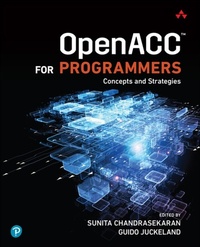
OpenACC for Programmers
Concepts and Strategies
1st Edition
Published on 11. September 2017
320 pages
978-0-13-469434-4 (ISBN)
Description

The Complete Guide to OpenACC for Massively Parallel Programming
Scientists and technical professionals can use OpenACC to leverage the immense power of modern GPUs without the complexity traditionally associated with programming them. OpenACC (TM) for Programmers is one of the first comprehensive and practical overviews of OpenACC for massively parallel programming.
This book integrates contributions from 19 leading parallel-programming experts from academia, public research organizations, and industry. The authors and editors explain each key concept behind OpenACC, demonstrate how to use essential OpenACC development tools, and thoroughly explore each OpenACC feature set.
Throughout, you'll find realistic examples, hands-on exercises, and case studies showcasing the efficient use of OpenACC language constructs. You'll discover how OpenACC's language constructs can be translated to maximize application performance, and how its standard interface can target multiple platforms via widely used programming languages.
Each chapter builds on what you've already learned, helping you build practical mastery one step at a time, whether you're a GPU programmer, scientist, engineer, or student. All example code and exercise solutions are available for download at GitHub.
Discover how OpenACC makes scalable parallel programming easier and more practical
Walk through the OpenACC spec and learn how OpenACC directive syntax is structured
Get productive with OpenACC code editors, compilers, debuggers, and performance analysis tools
Build your first real-world OpenACC programs
Exploit loop-level parallelism in OpenACC, understand the levels of parallelism available, and maximize accuracy or performance
Learn how OpenACC programs are compiled
Master OpenACC programming best practices
Overcome common performance, portability, and interoperability challenges
Efficiently distribute tasks across multiple processors
Register your product at informit.com/register for convenient access to downloads, updates, and/or corrections as they become available.
Scientists and technical professionals can use OpenACC to leverage the immense power of modern GPUs without the complexity traditionally associated with programming them. OpenACC (TM) for Programmers is one of the first comprehensive and practical overviews of OpenACC for massively parallel programming.
This book integrates contributions from 19 leading parallel-programming experts from academia, public research organizations, and industry. The authors and editors explain each key concept behind OpenACC, demonstrate how to use essential OpenACC development tools, and thoroughly explore each OpenACC feature set.
Throughout, you'll find realistic examples, hands-on exercises, and case studies showcasing the efficient use of OpenACC language constructs. You'll discover how OpenACC's language constructs can be translated to maximize application performance, and how its standard interface can target multiple platforms via widely used programming languages.
Each chapter builds on what you've already learned, helping you build practical mastery one step at a time, whether you're a GPU programmer, scientist, engineer, or student. All example code and exercise solutions are available for download at GitHub.
Discover how OpenACC makes scalable parallel programming easier and more practical
Walk through the OpenACC spec and learn how OpenACC directive syntax is structured
Get productive with OpenACC code editors, compilers, debuggers, and performance analysis tools
Build your first real-world OpenACC programs
Exploit loop-level parallelism in OpenACC, understand the levels of parallelism available, and maximize accuracy or performance
Learn how OpenACC programs are compiled
Master OpenACC programming best practices
Overcome common performance, portability, and interoperability challenges
Efficiently distribute tasks across multiple processors
Register your product at informit.com/register for convenient access to downloads, updates, and/or corrections as they become available.
All prices
More details
Edition
1. Auflage
Language
English
Place of publication
Boston
United States
Publishing group
Pearson Education (US)
Target group
Professional and scholarly
File size
19,72 MB
ISBN-13
978-0-13-469434-4 (9780134694344)
Copyright in bibliographic data and cover images is held by Nielsen Book Services Limited or by the publishers or by their respective licensors: all rights reserved.
Schweitzer Classification
Other editions
Additional editions
Book
05/2018
Addison Wesley
€47.00
Shipment within 15-20 days
Persons
Sunita Chandrasekaran is assistant professor in the Computer and Information Sciences Department at the University of Delaware. Her research interests include exploring the suitability of high-level programming models and runtime systems for HPC and embedded platforms, and migrating scientific applications to heterogeneous computing systems. Dr. Chandrasekaran was a post-doctoral fellow at the University of Houston and holds a Ph.D. from Nanyang Technological University, Singapore. She is a member of OpenACC, OpenMP, MCA and SPEC HPG. She has served on the program committees of various conferences and workshops including SC, ISC, ICPP, CCGrid, Cluster, and PACT, and has co-chaired parallel programming workshops co-located with SC, ISC, IPDPS, and SIAM.
Guido Juckeland is head of the Computational Science Group, Department for Information Services and Computing, Helmholtz-Zentrum Dresden-Rossendorf, and coordinates the work of the GPU Center of Excellence at Dresden. He and also represents HZDR at the SPEC High Performance Group and OpenACC committee. He received his Ph.D. from Technische Universitaet Dresden for his work on performance analysis for hardware accelerators. He was a Gordon Bell Award Finalist in 2013. Previously he worked as the IT-architect and post-doctoral researcher for the Center for Information Services and High Performance Computing (ZIH) at TU Dresden, Germany. He has served on the program committees of various conferences and workshops, including ISC, EuroPar, CCGrid, ASHES, P^3MA, PMBS, WACCPD, and PACT, and has co-chaired parallel programming workshops co-located with SC.
Guido Juckeland is head of the Computational Science Group, Department for Information Services and Computing, Helmholtz-Zentrum Dresden-Rossendorf, and coordinates the work of the GPU Center of Excellence at Dresden. He and also represents HZDR at the SPEC High Performance Group and OpenACC committee. He received his Ph.D. from Technische Universitaet Dresden for his work on performance analysis for hardware accelerators. He was a Gordon Bell Award Finalist in 2013. Previously he worked as the IT-architect and post-doctoral researcher for the Center for Information Services and High Performance Computing (ZIH) at TU Dresden, Germany. He has served on the program committees of various conferences and workshops, including ISC, EuroPar, CCGrid, ASHES, P^3MA, PMBS, WACCPD, and PACT, and has co-chaired parallel programming workshops co-located with SC.
Content
Foreword xv
Preface xxi
Acknowledgments xxiii
About the Contributors xxv
Chapter 1: OpenACC in a Nutshell 1
1.1 OpenACC Syntax 3
1.2 Compute Constructs 6
1.3 The Data Environment 11
1.4 Summary 15
1.5 Exercises 15
Chapter 2: Loop-Level Parallelism 17
2.1 Kernels Versus Parallel Loops 18
2.2 Three Levels of Parallelism 21
2.3 Other Loop Constructs 24
2.4 Summary 30
2.5 Exercises 31
Chapter 3: Programming Tools for OpenACC 33
3.1 Common Characteristics of Architectures 34
3.2 Compiling OpenACC Code 35
3.3 Performance Analysis of OpenACC Applications 36
3.4 Identifying Bugs in OpenACC Programs 51
3.5 Summary 53
3.6 Exercises 54
Chapter 4: Using OpenACC for Your First Program 59
4.1 Case Study 59
4.2 Creating a Naive Parallel Version 68
4.3 Performance of OpenACC Programs 71
4.4 An Optimized Parallel Version 73
4.5 Summary 78
4.6 Exercises 79
Chapter 5: Compiling OpenACC 81
5.1 The Challenges of Parallelism 82
5.2 Restructuring Compilers 88
5.3 Compiling OpenACC 92
5.4 Summary 97
5.5 Exercises 97
Chapter 6: Best Programming Practices 101
6.1 General Guidelines 102
6.2 Maximize On-Device Compute 105
6.3 Optimize Data Locality 108
6.4 A Representative Example 112
6.5 Summary 118
6.6 Exercises 119
Chapter 7: OpenACC and Performance Portability 121
7.1 Challenges 121
7.2 Target Architectures 123
7.3 OpenACC for Performance Portability 124
7.4 Code Refactoring for Performance Portability126
7.5 Summary 132
7.6 Exercises133
Chapter 8: Additional Approaches to Parallel Programming 135
8.1 Programming Models135
8.2 Programming Model Components142
8.3 A Case Study 155
8.4 Summary170
8.5 Exercises170
Chapter 9: OpenACC and Interoperability 173
9.1 Calling Native Device Code from OpenACC 174
9.2 Calling OpenACC from Native Device Code 181
9.3 Advanced Interoperability Topics 182
9.4 Summary185
9.5 Exercises185
Chapter 10: Advanced OpenACC 187
10.1 Asynchronous Operations 187
10.2 Multidevice Programming 204
10.3 Summary 213
10.4 Exercises 213
Chapter 11: Innovative Research Ideas Using OpenACC, Part I 215
11.1 Sunway OpenACC 215
11.2 Compiler Transformation of Nested Loops for Accelerators 224
Chapter 12: Innovative Research Ideas Using OpenACC, Part II 237
12.1 A Framework for Directive-Based High-Performance Reconfigurable Computing 237
12.2 Programming Accelerated Clusters Using XcalableACC 253
Index 269
Preface xxi
Acknowledgments xxiii
About the Contributors xxv
Chapter 1: OpenACC in a Nutshell 1
1.1 OpenACC Syntax 3
1.2 Compute Constructs 6
1.3 The Data Environment 11
1.4 Summary 15
1.5 Exercises 15
Chapter 2: Loop-Level Parallelism 17
2.1 Kernels Versus Parallel Loops 18
2.2 Three Levels of Parallelism 21
2.3 Other Loop Constructs 24
2.4 Summary 30
2.5 Exercises 31
Chapter 3: Programming Tools for OpenACC 33
3.1 Common Characteristics of Architectures 34
3.2 Compiling OpenACC Code 35
3.3 Performance Analysis of OpenACC Applications 36
3.4 Identifying Bugs in OpenACC Programs 51
3.5 Summary 53
3.6 Exercises 54
Chapter 4: Using OpenACC for Your First Program 59
4.1 Case Study 59
4.2 Creating a Naive Parallel Version 68
4.3 Performance of OpenACC Programs 71
4.4 An Optimized Parallel Version 73
4.5 Summary 78
4.6 Exercises 79
Chapter 5: Compiling OpenACC 81
5.1 The Challenges of Parallelism 82
5.2 Restructuring Compilers 88
5.3 Compiling OpenACC 92
5.4 Summary 97
5.5 Exercises 97
Chapter 6: Best Programming Practices 101
6.1 General Guidelines 102
6.2 Maximize On-Device Compute 105
6.3 Optimize Data Locality 108
6.4 A Representative Example 112
6.5 Summary 118
6.6 Exercises 119
Chapter 7: OpenACC and Performance Portability 121
7.1 Challenges 121
7.2 Target Architectures 123
7.3 OpenACC for Performance Portability 124
7.4 Code Refactoring for Performance Portability126
7.5 Summary 132
7.6 Exercises133
Chapter 8: Additional Approaches to Parallel Programming 135
8.1 Programming Models135
8.2 Programming Model Components142
8.3 A Case Study 155
8.4 Summary170
8.5 Exercises170
Chapter 9: OpenACC and Interoperability 173
9.1 Calling Native Device Code from OpenACC 174
9.2 Calling OpenACC from Native Device Code 181
9.3 Advanced Interoperability Topics 182
9.4 Summary185
9.5 Exercises185
Chapter 10: Advanced OpenACC 187
10.1 Asynchronous Operations 187
10.2 Multidevice Programming 204
10.3 Summary 213
10.4 Exercises 213
Chapter 11: Innovative Research Ideas Using OpenACC, Part I 215
11.1 Sunway OpenACC 215
11.2 Compiler Transformation of Nested Loops for Accelerators 224
Chapter 12: Innovative Research Ideas Using OpenACC, Part II 237
12.1 A Framework for Directive-Based High-Performance Reconfigurable Computing 237
12.2 Programming Accelerated Clusters Using XcalableACC 253
Index 269
