

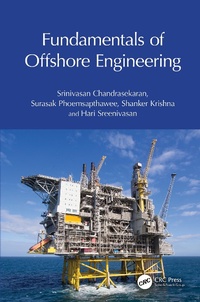
Fundamentals of Offshore Engineering
1st Edition
Published on 28. October 2024
320 pages
978-1-040-14494-7 (ISBN)
Description

Fundamentals of Offshore Engineering addresses the basics of design for offshore oil and gas production systems and examines the health, safety, and environmental (HSE) aspects in the oil and gas industry with emphasis toward safety measures in design and operations. It also covers fundamental issues of crude oil and natural gas exploration and extraction and also includes coverage of seismic surveys and green energy systems. Details of offshore platforms, describing the types, historical development, basics of analysis and design, environmental loads, and potential hazards are also provided. The book serves as a useful resource for universities that teach offshore engineering to senior undergraduate and graduate students as well as a guide for practicing engineers.
Includes coverage of wave loads, wind loads, ice loads, and fire loads on structures.
Discusses offshore pipelines and subsea engineering to help readers understand the fundamentals of petroleum production and related pipeline installation.
Includes coverage of wave loads, wind loads, ice loads, and fire loads on structures.
Discusses offshore pipelines and subsea engineering to help readers understand the fundamentals of petroleum production and related pipeline installation.
More details
Edition
1. Auflage
Language
English
Place of publication
London
United Kingdom
Publishing group
Taylor & Francis Ltd
Target group
College/higher education
Professional and scholarly
Illustrations
34 Tables, color; 59 Line drawings, color; 58 Line drawings, black and white; 15 Halftones, color; 74 Illustrations, color; 58 Illustrations, black and white
ISBN-13
978-1-040-14494-7 (9781040144947)
Copyright in bibliographic data and cover images is held by Nielsen Book Services Limited or by the publishers or by their respective licensors: all rights reserved.
Schweitzer Classification
Other editions
Additional editions
Srinivasan Chandrasekaran | Surasak Phoemsapthawee | Shanker Krishna
Fundamentals of Offshore Engineering
Book
approx. 06/2026
1st Edition
CRC Press
€69.00
Not yet published
Srinivasan Chandrasekaran | Surasak Phoemsapthawee | Shanker Krishna
Fundamentals of Offshore Engineering
Book
10/2024
1st Edition
CRC Press
€156.50
Shipment within 10-20 days
Persons
Srinivasan Chandrasekaran is currently a professor with a Higher Academic Grade at the Department of Ocean Engineering, Indian Institute of Technology, Madras. He is also a visiting professor at the Faculty of International Maritime Studies, Kasetsart University, Sriracha campus, Thailand, and a visiting professor at International College, Kasetsart University, Bangkok campus, Thailand. He has a rich experience in teaching, research, and industrial consultancy of about 29 years. He has supervised many sponsored research projects and offshore consultancy assignments, both in India and abroad. His active research areas include dynamic analysis and design of offshore structures, structural health monitoring of ocean structures, risk and reliability, fire resistant design of structures, use of functionally graded materials (FGM) in marine risers, and health, safety and environmental (HSE) management in process industries. He was a visiting fellow under the Ministry of Italian University Research (MiUR) invitation to the University of Naples Federico II for two years. During his recent position as a visiting professor in Italy, he participated in ongoing research activities concerning response control of structures and published a few papers with international cooperation. He has authored about 180 research papers in peer-reviewed international journals and refereed conferences organized by professional societies worldwide. He has authored 22 textbooks, which various publishers of international repute publish. He is an active member of several professional bodies and societies, both in India and abroad. He has also conducted about 20 distance education programs on various engineering subjects for the National Program on Technology-Enhanced Learning (NPTEL), Govt. of India. He is a vibrant speaker and has delivered many keynote addresses at international conferences, workshops, and seminars organized in India and abroad. He is designated as a top researcher, listed within 2% of experts in the world, as quoted by an independent survey conducted by Google and Stanford University, USA.
Surasak Phoemsapthawee is an assistant professor specializing in naval architecture and offshore structures in the Department of Maritime Engineering, Faculty of International Maritime Studies, Kasetsart University, Sri Racha campus, Thailand. His primary research interests include hydrodynamic simulation of gliders for coastal and multi-sensors application, sheet cavitation flow in unsteady potential-flow simulation over hydrofoil and propeller, and the design of offshore structures. He is the nodal faculty involved in training graduates for offshore structural engineering and has wide international exposure with Ecole Nationale Superieure de Techniques Avancees de Bretagne (ENSTA-Bretagne), France, Universite Europeenne de Bretagne, France, and Service Hydrodynamique et Oceano-meteo, Ifremer, France. He is a member of many international professional societies and has published research papers in leading Scopus-indexed journals in the domain of naval architecture, ocean engineering, ship technology and research, and others.
Shanker Krishna is an assistant professor in the Department of Petroleum Engineering, School of Energy Technology, at Pandit Deendayal Energy University (PDEU). He is the charge of the Drilling, Cementing, and Stimulation Research Centre at PDEU. His areas of expertise are geomechanics and petrophysics, hydraulic fracturing, enhanced oil recovery, gas hydrates, rock mechanics, and material characterization. He has published many research papers in refereed journals and presented his works in international conferences of high repute. He is also an active member of many professional societies in India and abroad.
Hari Sreenivasan is an assistant professor in the Department of Petroleum Engineering, School of Energy Technology, at Pandit Deendayal Energy University (PDEU). He is the charge of the Petroleum Engineering Lab at PDEU. His areas of expertise are offshore engineering, functionally graded materials, drilling and production of oil and gas engineering. He has published many research papers in refereed journals and presented his works at international conferences of high repute. He is also an active member of many professional societies in India and abroad. He has also been granted a patent on the design and product development of FGM for corrosion resistance applications.
Surasak Phoemsapthawee is an assistant professor specializing in naval architecture and offshore structures in the Department of Maritime Engineering, Faculty of International Maritime Studies, Kasetsart University, Sri Racha campus, Thailand. His primary research interests include hydrodynamic simulation of gliders for coastal and multi-sensors application, sheet cavitation flow in unsteady potential-flow simulation over hydrofoil and propeller, and the design of offshore structures. He is the nodal faculty involved in training graduates for offshore structural engineering and has wide international exposure with Ecole Nationale Superieure de Techniques Avancees de Bretagne (ENSTA-Bretagne), France, Universite Europeenne de Bretagne, France, and Service Hydrodynamique et Oceano-meteo, Ifremer, France. He is a member of many international professional societies and has published research papers in leading Scopus-indexed journals in the domain of naval architecture, ocean engineering, ship technology and research, and others.
Shanker Krishna is an assistant professor in the Department of Petroleum Engineering, School of Energy Technology, at Pandit Deendayal Energy University (PDEU). He is the charge of the Drilling, Cementing, and Stimulation Research Centre at PDEU. His areas of expertise are geomechanics and petrophysics, hydraulic fracturing, enhanced oil recovery, gas hydrates, rock mechanics, and material characterization. He has published many research papers in refereed journals and presented his works in international conferences of high repute. He is also an active member of many professional societies in India and abroad.
Hari Sreenivasan is an assistant professor in the Department of Petroleum Engineering, School of Energy Technology, at Pandit Deendayal Energy University (PDEU). He is the charge of the Petroleum Engineering Lab at PDEU. His areas of expertise are offshore engineering, functionally graded materials, drilling and production of oil and gas engineering. He has published many research papers in refereed journals and presented his works at international conferences of high repute. He is also an active member of many professional societies in India and abroad. He has also been granted a patent on the design and product development of FGM for corrosion resistance applications.
Content
Offshore Oil and Gas Industry. HSE in the Oil and Gas Industry. Crude Oil and Natural Gas. Offshore Platforms. Petroleum Production. Subsea Engineering and Offshore Pipelines.
