

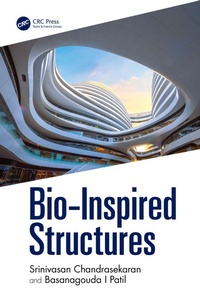
Bio-Inspired Structures
1st Edition
Published on 29. December 2025
184 pages
978-1-040-77009-2 (ISBN)
Description

Bio-Inspired Structures bridges the transformative intersection of biological principles and engineering innovation, offering a comprehensive framework for translating nature's evolutionary wisdom into next-generation infrastructure solutions. Drawing from biological systems ranging from termite mounds to dolphin hydrodynamics, this scholarly work establishes a robust theoretical foundation for bioinspiration, biomimicry, and bionics while delivering practical applications across structural engineering and marine systems.
The authors expertly navigate four fundamental principles-efficiency, resilience, adaptability, and self-repair-demonstrating their implementation in advanced materials, dynamic structures, and sustainable energy systems, including adaptive building envelopes and bioinspired coastal protection mechanisms.
This essential reference equips graduate students, researchers, and industry professionals with both conceptual understanding and actionable design strategies, ultimately advancing the paradigm shift from resource-intensive engineering toward nature-integrated, regenerative systems that promise more sustainable and resilient infrastructure solutions for our increasingly complex world.
The authors expertly navigate four fundamental principles-efficiency, resilience, adaptability, and self-repair-demonstrating their implementation in advanced materials, dynamic structures, and sustainable energy systems, including adaptive building envelopes and bioinspired coastal protection mechanisms.
This essential reference equips graduate students, researchers, and industry professionals with both conceptual understanding and actionable design strategies, ultimately advancing the paradigm shift from resource-intensive engineering toward nature-integrated, regenerative systems that promise more sustainable and resilient infrastructure solutions for our increasingly complex world.
More details
Edition
1. Auflage
Language
English
Place of publication
London
United Kingdom
Publishing group
Taylor & Francis Ltd
Target group
Professional and scholarly
Illustrations
33 Tables, black and white; 61 Line drawings, black and white; 31 Halftones, black and white; 92 Illustrations, black and white
File size
20,77 MB
ISBN-13
978-1-040-77009-2 (9781040770092)
Copyright in bibliographic data and cover images is held by Nielsen Book Services Limited or by the publishers or by their respective licensors: all rights reserved.
Schweitzer Classification
Other editions
Additional editions
Srinivasan Chandrasekaran | Basanagouda I. Patil
Bio-Inspired Structures
Book
approx. 12/2025
1st Edition
CRC Press
€176.70
Not yet published
Persons
Srinivasan Chandrasekaran is currently a Professor with Higher Academic Grade in the Department of Ocean Engineering, Indian Institute of Technology Madras and a Visiting Professor in the Department of Structural Engineering, University of Naples Federico II, Italy. He holds the prestigious Fellowship conferred by the Ministry of Italian University Research (MiUR Fellow). He commands a rich experience in teaching, research, and industrial consultancy of about 30 years. He is also a Visiting Professor at the faculty of International Maritime Studies, Kasetsart University, Sri Racha campus, Thailand. He has supervised many sponsored research projects and offshore consultancy assignments, both in India and abroad. His active research areas include dynamic analysis and design of offshore structures, structural health monitoring of ocean structures, risk and reliability, fire-resistant design of structures, and the use of functionally graded materials (FGM). He was a visiting fellow under the MiUR invitation to the University of Naples Federico II for 2 years. During his stay in Italy, he researched the advanced nonlinear analysis of buildings under earthquake loads and other impact loads with experimental validation on full-scaled models. He has authored about 170 research papers in peer-reviewed international journals and refereed conferences organized by professional societies worldwide. He has authored 22 textbooks, which various publishers of international repute publish. He is an active member of several professional bodies and societies, both in India and abroad. He has also conducted about 30 engineering courses on structural engineering for the National Program on Technology-Enhanced Learning (NPTEL), Government of India. He is a vibrant speaker and delivered many keynote addresses at international conferences, workshops, and seminars organized in India and abroad. He holds lifetime membership of many national and international professional societies.
Basanagouda I Patil is an Assistant Professor at at KLE Technological University, Hubli, with 8 years of academic experience. He integrates teaching and research, mentoring students in advanced structural analysis and ocean engineering. His research aspires to develop sustainable, resilient infrastructure inspired by nature for future energy and coastal systems. Dr. Basanagouda I Patil is a Prime Minister's Research Fellow at the Indian Institute of Technology Madras, specializing in structural engineering with a focus on bioinspired offshore and renewable energy systems. He earned his Ph.D. in 2025 for pioneering work on the TSUSUCA-DOLPHIN platform, a patented multi-utility floating structure for wave energy harvesting and tsunami mitigation. Prior to his doctoral research, he completed his M.Tech. in Structural Engineering from KLSGIT Belagavi and B.E. in Civil Engineering from BVBCET Hubli. Dr. Patil has co-authored multiple high-impact publications in reputed journals such as Energy, Journal of Marine Science and Technology, and Journal of Ocean Engineering and Marine Energy. His work bridges marine bioinspiration, structural dynamics, and renewable energy, employing advanced computational tools and experimental methods. He has presented at premier international conferences, including OMAE and ICSOS, and holds patents and trademarks for innovative marine energy devices.
Basanagouda I Patil is an Assistant Professor at at KLE Technological University, Hubli, with 8 years of academic experience. He integrates teaching and research, mentoring students in advanced structural analysis and ocean engineering. His research aspires to develop sustainable, resilient infrastructure inspired by nature for future energy and coastal systems. Dr. Basanagouda I Patil is a Prime Minister's Research Fellow at the Indian Institute of Technology Madras, specializing in structural engineering with a focus on bioinspired offshore and renewable energy systems. He earned his Ph.D. in 2025 for pioneering work on the TSUSUCA-DOLPHIN platform, a patented multi-utility floating structure for wave energy harvesting and tsunami mitigation. Prior to his doctoral research, he completed his M.Tech. in Structural Engineering from KLSGIT Belagavi and B.E. in Civil Engineering from BVBCET Hubli. Dr. Patil has co-authored multiple high-impact publications in reputed journals such as Energy, Journal of Marine Science and Technology, and Journal of Ocean Engineering and Marine Energy. His work bridges marine bioinspiration, structural dynamics, and renewable energy, employing advanced computational tools and experimental methods. He has presented at premier international conferences, including OMAE and ICSOS, and holds patents and trademarks for innovative marine energy devices.
Content
Preface
About the Authors
Chapter 1: Bio-inspiration and Structural Similitude
Chapter 2: Bioinspired Structures for Earthquake Resilience and Tall Buildings
Chapter 3: Bioinspired Offshore Floating Platforms and Energy Systems
Chapter 4: Bioinspired Wave Energy Converters
About the Authors
Chapter 1: Bio-inspiration and Structural Similitude
Chapter 2: Bioinspired Structures for Earthquake Resilience and Tall Buildings
Chapter 3: Bioinspired Offshore Floating Platforms and Energy Systems
Chapter 4: Bioinspired Wave Energy Converters
