

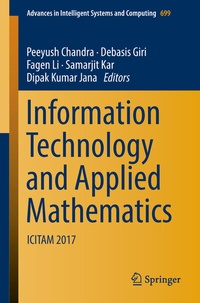
Information Technology and Applied Mathematics
Description

This book discusses recent advances and contemporary research in the field of cryptography, security, mathematics and statistics, and their applications in computing and information technology. Mainly focusing on mathematics and applications of mathematics in computer science and information technology, it includes contributions from eminent international scientists, researchers, and scholars. The book helps researchers update their knowledge of cryptography, security, algebra, frame theory, optimizations, stochastic processes, compressive sensing, functional analysis, and complex variables.
More details
Other editions
Additional editions

Persons
Dr. Debasis Giri is Dean of the School of Electronics, Computer Science and Informatics and a professor at the Department of Computer Science and Engineering, Haldia Institute of Technology, India. He completed his M.Tech. and M.Sc. at IIT Kharagpur, India and also his doctorate at IIT Kharagpur, India. He was ranked tenth in the country in the India Graduate Aptitude Test in Engineering in 1999. He has published over 50 papers in international journals/conferences. His current research interests include cryptography, information security, e-commerce security and design & analysis of algorithms. He is an editorial board member and reviewer for numerous international journals. He is also a program committee member for various international conferences. He is a life member of the Cryptology Research Society of India and the International Society for Analysis, its Applications and Computation (ISAAC).
Prof. Peeyush Chandra is a retired professor at the Department of Mathematics and Statistics, Indian Institute of Technology (IIT) Kanpur, India and past president of the Indian Mathematical Society and Indian Society of Theoretical and Applied Mechanics. He completed his M.Sc. and Ph.D. at IIT Kanpur, India and B.Sc. at Meerut College, Meerut University, India. His research interests include bio-fluid mechanics, fluid mechanics (low Reynolds number flow) lubrication theory, magnetic fluids, ecological modeling and mathematical epidemiology. Prof. Chandra has published over 100 articles in refereed journals and proceedings of leading national and international conferences. Dr. Chandra has over 35 years of teaching and over 45 years of research experience.
Dr. Fagen Li is a professor at the School of Computer Science & Engineering, University of Electronic Science and Technology of China (UESTC), Chengdu, P.R. China. He received his Ph.D. in Cryptography from Xidian University, Xi'an, in 2007 and from 2008 to 2009, he was a postdoctoral fellow at the Future University-Hakodate, Hokkaido, Japan, which is supported by the Japan Society for the Promotion of Science (JSPS). He worked as a research fellow at the Institute of Mathematics for Industry, Kyushu University, Fukuoka, Japan from 2010 to 2012. His recent research interests include cryptography and network security. He has published more than 80 papers in international journals and conferences. He is a member of the IEEE.
Dr. Samarjit Kar is associated with the Department of Mathematics, National Institute of Technology, Durgapur, India. He received his Ph.D. from Vidyasagar University, Midnapore, India and M.Sc. & BSc. from Calcutta University, Kolkata, India. His research interests include operations research and optimization, multi-criteria decision-making, financial modeling, soft computing, and uncertainty modeling. Dr. Kar has published 74 journal papers, 2 books and 5 edited volumes. He has supervised 12 Ph.D. students to date.
Dr. Dipak Kumar Jana is an associate professor at the Department of Applied Science at Haldia Institute of Technology, India. Dr. Jana received his Ph.D. (Science) from IIEST, Shibpur, and his M.Sc. and B.Sc. from Vidyasagar University, India. He has 12 years of teaching and 5 years of research experience. His areas of interest include operations research, inventory, uncertainty theory, bio-mathematics, transportation, rough sets, optimal control and fuzzy inference. Dr. Jana has published 6 books, 2 book chapters, 37 journal papers and 16 conference papers.
Content
- Intro
- Preface
- Committee
- Message from the General Chairs
- Message from the Program Chairs
- Contents
- About the Editors
- Information Technology
- Identity-Based Combined Public Key Schemes for Signature, Encryption, and Signcryption
- 1 Introduction
- 1.1 Contributions
- 1.2 Organization
- 2 Identity-Based Combined Signature and Encryption
- 2.1 Syntax
- 2.2 Security Notions
- 2.3 A Secure IBCSE Scheme
- 3 Identity-Based Combined Signature, Encryption and Signcryption
- 3.1 Syntax
- 3.2 Security Notions
- 4 Two IBCSESC Constructions
- 4.1 A Weakly Secure IBCSESC Scheme
- 4.2 A Strongly Secure IBCSESC Scheme
- 5 Conclusions
- References
- Cluster-Based Energy-Efficient Secure Routing in Wireless Sensor Networks
- 1 Introduction
- 2 Network and Energy Consumption Models
- 3 Preliminaries
- 4 E2SDRSN: The Proposed Framework
- 4.1 Cluster Formation Using Maximal Independent Set for Unit Disk Graph (CFMISUDG)
- 4.2 Cluster Head and Path Selection Technique (CPST)
- 4.3 Secure ID-Based Data Routing (SIBDR)
- 5 Performance Analysis of E2SDRSN
- 5.1 Security Analysis of SIBDR
- 5.2 Computation Analysis of SIBDR
- 6 Conclusion
- References
- A Two-Stage Approach for Text and Non-text Separation from Handwritten Scientific Document Images
- 1 Introduction
- 2 Related Work
- 3 Present Work
- 3.1 Nature of the Database
- 3.2 Image Binarization and Connected Component Extraction
- 3.3 Stage 1: Separation and Recognition of Components Representing a SL/ASL
- 3.4 Stage 2: Feature Extraction and Classification
- 4 Experimental Results and Error Analysis
- 4.1 Error Analysis
- 4.2 Performance Comparison with Some Existing Methods
- 5 Conclusion
- References
- The Approximate Solution for Multi-term the Fractional Order Initial Value Problem Using Collocation Method Based on Shifted Chebyshev Polynomials of the First Kind
- 1 Introduction
- 2 Preliminaries
- 2.1 Caputo Fractional Derivative
- 3 Chebyshev Polynomials of the First Kind
- 4 Description of the Approximate Formula and Error Analysis
- 5 Collocation Method for Multi-term FDEs
- 6 Numerical Experiments
- 7 Conclusion
- References
- Analysis of Typing Pattern in Identifying Soft Biometric Information and Its Impact in User Recognition
- 1 Introduction
- 2 Static and Shared Keystroke Dynamics Datasets
- 3 Research Methodology
- 4 Experimental Results
- 5 Conclusion
- References
- An Ideal and Perfect (t, n) Multi-secret Sharing Scheme Based on Finite Geometry
- 1 Introduction
- 2 Notation
- 3 Basic Description
- 4 Proposed Scheme
- 4.1 A Simple Example
- 5 Security Analysis
- 6 Comparative Study
- 7 Conclusion
- References
- Solving Arithmetic Mathematical Word Problems: A Review and Recent Advancements
- 1 Introduction
- 2 Description of Systems and Research Methodologies
- 2.1 Early Stage (1964-2006)
- 2.2 New Era (2007-2017)
- 3 Standard Datasets and Evaluations
- 4 Comparative Analysis and Discussions
- 5 Conclusions
- References
- Pose-Invariant Hand Geometry for Human Identification Using Feature Weighted k-NN Classifier
- 1 Introduction
- 2 Related Work and Challenging Issues
- 3 Pose-Invariant Hand Biometric Framework
- 3.1 Pose-Invariant Hand Image Normalization
- 3.2 Geometric Feature Definition
- 4 Feature Weighted k-NN Classification Algorithm
- 5 Performance Evaluation
- 5.1 Experimental Description
- 5.2 Result Analysis
- 6 Conclusion
- References
- Pre-bond Testing of TSVs in 3D IC Using Segmented Cellular Automata
- 1 Introduction
- 2 Fundamentals of Cellular Automata (CA)
- 3 Defects in TSVs Before Bonding
- 4 Proposed Design
- 5 The Formation of SACA
- 5.1 Test Design Using SACA
- 6 Hardware Realization of the Scheme
- 7 Result Analysis
- 8 Conclusion
- References
- Natural Language Description of Surveillance Events
- 1 Introduction
- 2 Related Work and Contributions
- 3 Proposed Tag-Based Description Generation
- 3.1 Surveillance Video and Text Representation
- 4 Results
- 4.1 VIRAT Dataset
- 4.2 In-House Dataset
- 5 Conclusion and Future Work
- References
- Real-Time Intrusion Detection System Using Computational Intelligence and Neural Network: Review, Analysis and Anticipated Solution of Machine Learning
- 1 Introduction
- 2 Related Work
- 2.1 Intrusion Detection
- 2.2 Computational Intelligence
- 3 Proposed Algorithm
- 3.1 Artificial Neural Networks
- 3.2 Performance Evaluation
- 4 Experimental Outcomes
- 5 Conclusion
- References
- A New Dual Image-Based Steganographic Scheme for Authentication and Tampered Detection Using (7, 4) Hamming Code
- 1 Introduction
- 2 Proposed Steganographic Scheme
- 2.1 Data Embedding
- 2.2 Data Extraction and Image Reconstruction
- 3 Experiment and Comparison
- 4 Robustness
- 4.1 Steganographic Attacks
- 4.2 Brute Force Attacks
- 5 Conclusion
- References
- DFA-Based Online Bangla Character Recognition
- 1 Introduction
- 2 Stroke Database Generation
- 3 Pre-processing and Feature Extraction
- 3.1 Distance-Based Feature
- 3.2 Zone-Based Path Traversal (ZPT) Feature
- 4 Recognition
- 4.1 Stroke Recognition
- 4.2 Character Formation
- 5 Conclusion
- References
- Applied Mathematics
- An Integrated Imperfect Production-Inventory Model with Optimal Vendor Investment and Backorder Price Discount
- 1 Introduction
- 2 Model Development
- 2.1 Notations and Assumptions
- 2.2 Buyer's Perspective
- 2.3 Vendor's Perspective
- 2.4 Integrated Approach
- 3 Solution Procedure
- 3.1 The Algorithm:
- 4 Numerical Examples
- 4.1 With Constant Lead-Time
- 4.2 With Variable Lead-Time
- 5 Managerial Insights and Some Concluding Remarks
- References
- Fuzzy Time Series Model for Unequal Interval Length Using Genetic Algorithm
- 1 Introduction
- 2 Preliminaries
- 2.1 Fuzzy Time Series
- 2.2 Genetic Algorithm (GA)
- 3 Proposed Approach Using Double GA on Fuzzy Time Series
- 4 Result and Discussion
- 5 Conclusion
- 6 Appendix
- 6.1 Mean Square Error (MSE)
- References
- A Multi-item EPQ Model with Variable Demand in an Imperfect Production Process
- 1 Introduction
- 2 Literature Review
- 3 Assumptions and Notations
- 4 Model Formulation
- 4.1 Fuzzy Model (FM)
- 5 Numerical Experiment
- 6 Practical Uses
- 7 Conclusion
- References
- Author Index
