

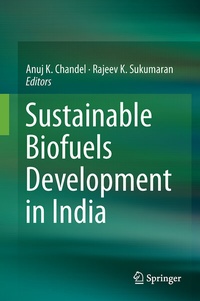
Sustainable Biofuels Development in India
Description

This book will provide assistance to the broad range of readers involved in the crude oil import and production; renewable energy production; biomass analysis and bioconversion; greenhouse gas emissions; techno-economic analysis and government policies for implementing biofuels in India. This book presents important aspects on the large scale production of biofuels following a bio-refinery concept and its commercialization and sustainability issues. Hence, it is a useful resource to policy makers, policy analysts, techno-economic analysts and business managers who deal with commercialization and implementation of bio-based energy and other value-added products. The following features of this book attribute its distinctiveness:
- As a first uniquely focused scientific and technical literature on bioenergy production in the context of India.
- To its coverage of technological updates on biomass collection, storage and use, biomass processing, microbial fermentation, catalysis, regeneration, solar energy and monitoring of renewable energy and recovery process.
- To the technical, policy analysis, climate change, geo-political analysis of bioenergy and green transportation fuels at industrial scale.
More details
Other editions
Additional editions
Persons
Dr. Anuj K. Chandel is working as a lead scientist for cellulosic ethanol production at Centro de Tecnologia Canavieira (Sugarcane Technology Centre, CTC), Piracicaba, Brazil. He is responsible for scientific leadership for deployment of cellulosic ethanol process at demonstration plant and scale up activities. Overall, he has 16 years' research experience working in industries and universities on biomass conversion into ethanol, industrial enzymes production and membrane based separations. He has published 52 articles in peer-reviewed journals and 16 book chapters. He has also co-edited 4 books on D-xylitol, lignocellulose degradation, extremophiles and Brazilian bioenergy development. His primary research interest is to develop the sustainable process for bioconversion of lignocellulosics into renewable energy and biochemicals.Proactive research lead with entrepreneur mindset, that brings hands on strategic experience in research projects and startup of piloting to full commercial scale operations.
Dr. Rajeev Sukumaran is heading the Biofuels and Biorefineries Section at the CSIR-National Institute for Interdisciplinary Science and Technology's Microbial Processes and Technology Division., in Trivandrum, India. He is also the activity lead for the Centre for Biofuels (CBF) at CSIR-NIIST. He has 20 years of research experience spanning diverse fields including fermentation technology, embryonic stem cell biology and transcriptomics, though currently he is working mainly on biomass conversion technologies. He played the leading role in setting up the CBF's lignocellulosic ethanol pilot plant, and the solid state enzyme production pilot plant at CSIR-NIIST. His current research interests include-Developing enzymes for biomass conversion, Glucose tolerant ß-glucosidases, heterologous protein expression in fungi, and fungal genomics. He has served as consultant for some leading Biotech companies in India. He has also publishedwidely with 73 publications in International Journals and has several conference papers, book chapters and reports.
