

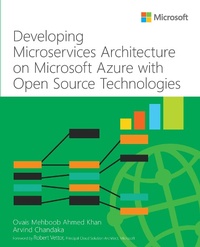
Developing Microservices Architecture on Microsoft Azure with Open Source Technologies
1st Edition
Published on 1. July 2021
304 pages
978-0-13-681937-0 (ISBN)
Description

Increasingly, organizations are modernizing application development by integrating open source technologies into a holistic architecture for delivering high-quality workloads to the cloud. Developing Microservices Architecture on Azure with Open Source Technologies is a complete, step-by-step guide to building flexible microservices architectures by leveraging services provided by the Microsoft Azure cloud platform, and key open source technologies such as Java, Node.JS, .NET Core and Angular.
Expert Microsoft consultants Ovais Mehboob and Arvind Chandaka guide you step-by-step through a realistic case study project that illuminates key technical implementation tasks for establishing end to end infrastructure, developing cloud-native applications, automating deployment, and realizing value. They show how to:
Identify application features and requirements, and map them onto microservices
Design microservices solution architectures that enable high-quality workloads
Develop app front ends, and build microservices with open source technologies and .NET Core
Leverage containerization with Docker, Azure Kubernetes Services, Azure Container Registry, and AKS clusters
Make the most of Request/Response and Pub/Sub communication patterns
Enforce microservices app security, and use Azure AD B2C user authentication/authorization
Establish API gateways that provide a unified "front door" to back-end microservices
Set up continuous integration and continuous monitoring with Azure DevOps
Monitor microservices with Azure Monitor, Prometheus, and Datadog
Expert Microsoft consultants Ovais Mehboob and Arvind Chandaka guide you step-by-step through a realistic case study project that illuminates key technical implementation tasks for establishing end to end infrastructure, developing cloud-native applications, automating deployment, and realizing value. They show how to:
Identify application features and requirements, and map them onto microservices
Design microservices solution architectures that enable high-quality workloads
Develop app front ends, and build microservices with open source technologies and .NET Core
Leverage containerization with Docker, Azure Kubernetes Services, Azure Container Registry, and AKS clusters
Make the most of Request/Response and Pub/Sub communication patterns
Enforce microservices app security, and use Azure AD B2C user authentication/authorization
Establish API gateways that provide a unified "front door" to back-end microservices
Set up continuous integration and continuous monitoring with Azure DevOps
Monitor microservices with Azure Monitor, Prometheus, and Datadog
More details
Series
Edition
1. Auflage
Language
English
Place of publication
Boston
United States
Publishing group
Pearson Education (US)
Target group
Professional and scholarly
File size
9,50 MB
ISBN-13
978-0-13-681937-0 (9780136819370)
Copyright in bibliographic data and cover images is held by Nielsen Book Services Limited or by the publishers or by their respective licensors: all rights reserved.
Schweitzer Classification
Other editions
Additional editions
Arvind Chandaka | Ovais Mehboob Ahmed Khan
Developing Microservices Architecture on Microsoft Azure with Open Source Technologies
Book
07/2021
Addison Wesley
€42.50
Article not available at the moment
Persons
Ovais Mehboob Ahmed Khan is a seasoned programmer and solutions architect with nearly 20 years of experience in software development, consultancy, and solution architecture. He has worked with various clients across the United States, Europe, Middle East, and Africa, and he currently works as a Senior Customer Engineer at Microsoft, based in Dubai. He specializes mainly in application development using .NET and other OSS technologies, Microsoft Azure, and DevOps. He is a prolific writer and has published several books on enterprise application architecture, .NET Core, VS Code, and JavaScript, and he has written numerous technical articles on various sites. He likes to talk about technology and has delivered various technical sessions around the world.
Arvind Chandaka is a product manager at Microsoft and has led products across Azure and Cloud + AI Engineering. He has worked with strategy executive teams to grow Microsoft Azure as well as built IP at the company resulting in several services and products. He is a recognized SME in enterprise technology and has advised many Fortune 100 companies and international clients around the world. He specializes across infrastructure, identity, cyber security, open source, and more. A strong believer in empowerment, he works closely with startups, is a founder himself, invests in the entrepreneurial ecosystem, and serves on the board of non-profits in New York City. Arvind earned his Bachelor of Science at Cornell University where he studied several disciplines ranging from computer science to business. In his spare time, you will likely find him at a tennis court or traveling the world for the next great foodie destination.
Arvind Chandaka is a product manager at Microsoft and has led products across Azure and Cloud + AI Engineering. He has worked with strategy executive teams to grow Microsoft Azure as well as built IP at the company resulting in several services and products. He is a recognized SME in enterprise technology and has advised many Fortune 100 companies and international clients around the world. He specializes across infrastructure, identity, cyber security, open source, and more. A strong believer in empowerment, he works closely with startups, is a founder himself, invests in the entrepreneurial ecosystem, and serves on the board of non-profits in New York City. Arvind earned his Bachelor of Science at Cornell University where he studied several disciplines ranging from computer science to business. In his spare time, you will likely find him at a tennis court or traveling the world for the next great foodie destination.
Content
1. Introduction to Microservices
2. Introduction to Real-Life Case Study
3. Build Microservices Architecture and Use Azure
4. Develop App Front-end and Build Microservices
5. Microservices on Containers
6. Communication Patterns
7. Security in Microservices
8. Setup API Gateway
9. Build and Deploy Microservices
10. Monitor Microservices
2. Introduction to Real-Life Case Study
3. Build Microservices Architecture and Use Azure
4. Develop App Front-end and Build Microservices
5. Microservices on Containers
6. Communication Patterns
7. Security in Microservices
8. Setup API Gateway
9. Build and Deploy Microservices
10. Monitor Microservices
