

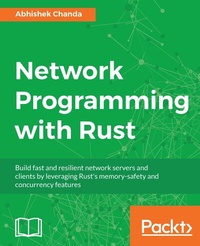
Network Programming with Rust
Build fast and resilient network servers and clients by leveraging Rust's memory-safety and concurrency features
1st Edition
Published on 23. September 2024
278 pages
978-1-78862-171-7 (ISBN)
Description

Learn to write servers and network clients using Rust's low-level socket classes with this guideKey Features - [*]Build a solid foundation in Rust while also mastering important network programming details
- [*]Leverage the power of a number of available libraries to perform network operations in Rust
- [*]Develop a fully functional web server to gain the skills you need, fast
Book DescriptionRust is low-level enough to provide fine-grained control over memory while providing safety through compile-time validation. This makes it uniquely suitable for writing low-level networking applications. This book is divided into three main parts that will take you on an exciting journey of building a fully functional web server. The book starts with a solid introduction to Rust and essential networking concepts. This will lay a foundation for, and set the tone of, the entire book. In the second part, we will take an in-depth look at using Rust for networking software. From client-server networking using sockets to IPv4/v6, DNS, TCP, UDP, you will also learn about serializing and deserializing data using serde. The book shows how to communicate with REST servers over HTTP. The final part of the book discusses asynchronous network programming using the Tokio stack. Given the importance of security for modern systems, you will see how Rust supports common primitives such as TLS and public-key cryptography. After reading this book, you will be more than confident enough to use Rust to build effective networking software What you will learn - [*]Appreciate why networking is important in implementing distributed systems
- [*]Write a non-asynchronous echo server over TCP that talks to a client over a network
- [*]Parse JSON and binary data using parser combinators such as nom
- [*]Write an HTTP client that talks to the server using reqwest
- [*]Modify an existing Rust HTTTP server and add SSL to it
- [*]Master asynchronous programming support in Rust
- [*]Use external packages in a Rust project
Who this book is forThis book is for software developers who want to write networking software with Rust. A basic familiarity with networking concepts is assumed. Beginner-level knowledge of Rust will help but is not necessary.
- [*]Leverage the power of a number of available libraries to perform network operations in Rust
- [*]Develop a fully functional web server to gain the skills you need, fast
Book DescriptionRust is low-level enough to provide fine-grained control over memory while providing safety through compile-time validation. This makes it uniquely suitable for writing low-level networking applications. This book is divided into three main parts that will take you on an exciting journey of building a fully functional web server. The book starts with a solid introduction to Rust and essential networking concepts. This will lay a foundation for, and set the tone of, the entire book. In the second part, we will take an in-depth look at using Rust for networking software. From client-server networking using sockets to IPv4/v6, DNS, TCP, UDP, you will also learn about serializing and deserializing data using serde. The book shows how to communicate with REST servers over HTTP. The final part of the book discusses asynchronous network programming using the Tokio stack. Given the importance of security for modern systems, you will see how Rust supports common primitives such as TLS and public-key cryptography. After reading this book, you will be more than confident enough to use Rust to build effective networking software What you will learn - [*]Appreciate why networking is important in implementing distributed systems
- [*]Write a non-asynchronous echo server over TCP that talks to a client over a network
- [*]Parse JSON and binary data using parser combinators such as nom
- [*]Write an HTTP client that talks to the server using reqwest
- [*]Modify an existing Rust HTTTP server and add SSL to it
- [*]Master asynchronous programming support in Rust
- [*]Use external packages in a Rust project
Who this book is forThis book is for software developers who want to write networking software with Rust. A basic familiarity with networking concepts is assumed. Beginner-level knowledge of Rust will help but is not necessary.
More details
Other editions
Additional editions
Abhishek Chanda
Network Programming with Rust
Book
02/2018
Packt Publishing
€55.90
Shipment within 3-4 weeks
Person
Chanda Abhishek :
Abhishek Chanda studied computer science at IIEST Shibpur in India and electrical engineering at Rutgers University. He has been working on networking and distributed systems since 2008. Over his career, he has worked with large companies (like Microsoft and Dell) and small startups (Cloudscaling, DataSine) in India, US, and the UK. He is enthusiastic about open source software and has contributed to a number of projects like OpenStack, Nomad etc. He contributes to a number of open source projects. He came across Rust in 2015 and found it to be a perfect fit for writing highly performant systems.
Abhishek Chanda studied computer science at IIEST Shibpur in India and electrical engineering at Rutgers University. He has been working on networking and distributed systems since 2008. Over his career, he has worked with large companies (like Microsoft and Dell) and small startups (Cloudscaling, DataSine) in India, US, and the UK. He is enthusiastic about open source software and has contributed to a number of projects like OpenStack, Nomad etc. He contributes to a number of open source projects. He came across Rust in 2015 and found it to be a perfect fit for writing highly performant systems.
Content
Table of Contents - Introduction to client/server networking
- Introduction to Rust and it
- TCP and UDP using Rust
- Data serialisation, deserialisation and parsing
- Application Layer Protocols
- Talking HTTP in the Internet
- Asynchronous network programming using Tokio
- Security
- Appendix
- Introduction to Rust and it
- TCP and UDP using Rust
- Data serialisation, deserialisation and parsing
- Application Layer Protocols
- Talking HTTP in the Internet
- Asynchronous network programming using Tokio
- Security
- Appendix
