

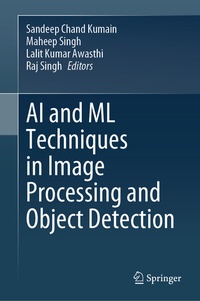
AI and ML Techniques in Image Processing and Object Detection
Description

This book highlights the evolution and interdisciplinary approach of AI and ML in image processing, tracing historical development and exploring their convergence with different fields. It delves into optimizing neural architectures and making deep learning models interpretable while exploring recent trends like versatile CNN applications and edge computing deployment. The intersection of AI and creativity, dynamic transfer learning, and domain adaptation are discussed alongside object detection techniques and reinforcement learning. It examines advanced applications in satellite imagery, healthcare, and smart cities, addressing ethical considerations like bias mitigation and transparency. This book also outlines future trends such as quantum-inspired computing and the evolution of edge AI ecosystems.
More details
Other editions
Additional editions
Persons
Dr. Sandeep Chand Kumain is an assistant professor at the School of Computer Sciences, UPES, Dehradun. He holds a Ph.D. and an M.Tech. in Computer Science and Engineering from the National Institute of Technology, Uttarakhand, India. His research interests include computer vision, image processing, and deep learning. Proficient in MATLAB, C, C++, Java, and Python, Dr. Kumain has authored over 15 publications in reputed international journals and conferences.
Dr. Maheep Singh is an assistant professor at the School of Computer Science, Doon University, Dehradun. Before joining Doon University, he served as an assistant professor at NIT Uttarakhand. He earned his Ph.D. from MNIT Jaipur. His research interests include salient object detection, image processing, machine learning, and security. With over 18 years of experience in teaching and research, Dr. Singh has published 30+ research papers in reputed international journals and conferences.
Prof. Lalit K. Awasthi is the vice chancellor of Sardar Patel University, Mandi, HP, India. Previously, he served as the director at NIT Uttarakhand. He earned his M.Tech. in Computer Science and Engineering from IIT Delhi (1993) and his Ph.D. from IIT Roorkee (2002). Prof. Awasthi was the first faculty member of the Computer Science and Engineering Department at REC Hamirpur (now NIT Hamirpur) and contributed significantly for 25 years. He played a key role in establishing the B.Tech. CSE program at NIT Hamirpur, developing laboratories, buildings, and the Computer Centre. He has also held various leadership roles, including Head of CSE, Director of the Computer Centre, and Dean (Students and Alumni).
Mr. Raj Singh, M.Sc., PGD, is a research scholar in the Department of Environmental Science GITAM Deemed to be University, Visakhapatnam, Andhra Pradesh, India. He served as an assistant professor at Dr. K. N. Modi University, Newai, Rajasthan, and Tula's Institute, Dehradun, India. He is an alumnus of the Indian Space Research Organization (ISRO), Department of Space, Gov. of India, and also worked on a France-funded IDDRI project at BITS Pilani, KK Birla Campus, Goa, India.
Content
Attention based Deep Neural Networks for Automatic Organ Classification from 2D CT Scan images.- Artificial Intelligence and Machine Learning use in Agriculture Domain A Review.- Evolution of Object Detection From Classical to Modern AI Approaches.- Unlocking the Secrets of Deep Space AI Techniques for Object Detection in Astronomical Imagery.
